“Environmental Sustainability can be a substantial differentiator for CDMOs”
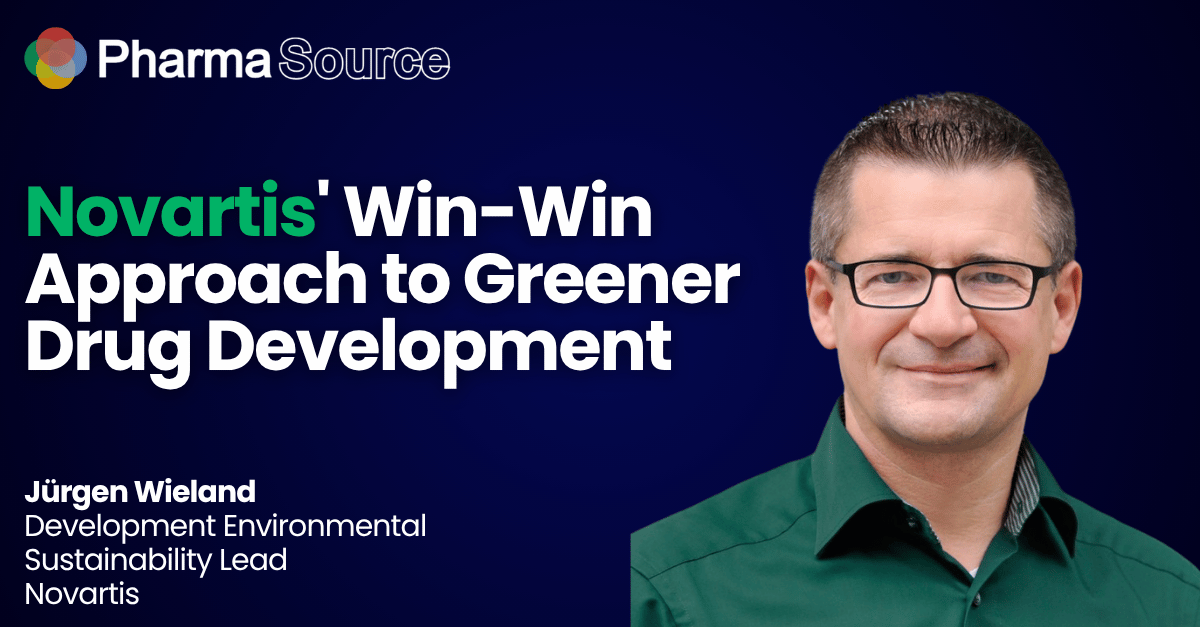
Jürgen Wieland, Development Environmental Sustainability Lead at Novartis, is committed to mitigating the harmful health implications of emissions caused by the global healthcare sector. With healthcare responsible for 4-5% of global carbon emissions (roughly the combined emissions of aviation and digital infrastructure), the sector dedicated to extending and improving people’s life by providing life-saving treatments is also one of the planet’s large polluters, contributing to the very health problems it seeks to cure.
Jürgen brings over 20 years of finance and controlling experience to his sustainability role at Novartis, where he’s responsible for embedding environmental considerations across R&D and clinical operations. Before joining Novartis in 2011, he served as CFO of an NGO bringing solar energy to rural East Africa.
In a recent PharmaSource podcast recorded at CPHI Frankfurt, Jürgen shares how pharmaceutical companies and their CDMO partners can reduce scope 3 emissions while improving operational efficiency—proving that sustainability and profitability are not mutually exclusive.
Where Greener is More Affordable
With scope 3 emissions dominating pharma’s carbon footprint, manufacturing partners hold the key to meaningful decarbonization. Jürgen identifies clear priorities for CDMOs looking to differentiate themselves.
“In the CDMO business, which is typically very cost-conscious, identifying areas where you have win-wins is key,” Jürgen explains. “Reducing consumption of natural resources, reducing waste, and applying circular economy principles—that’s a good starting point.”
Electricity decarbonization offers the easiest entry point. Novartis has partnered with other major pharmaceutical companies through the World Business Council for Sustainable Development’s “Energize” program, creating virtual power purchase agreements that smaller suppliers can join without significant investment. “We realized making large renewable energy projects was overwhelming for smaller players, so we teamed up,” Jürgen notes. “Each CDMO can sign up to contribute without big hurdles.”
Heat and steam decarbonization presents more complexity but significant opportunity. “Switching to biogas is typically more expensive, but if you find operational efficiencies by reducing consumption or optimizing your HVAC system, you can decarbonize in a cost-neutral or cost-beneficial way,” he says.
For small molecule production, solvent management and precious metal catalyst recovery offer substantial savings. “Rhodium and palladium catalysts—if you can recover and reuse them, that’s a great business case. You don’t need to source raw materials constantly, you have fewer supply chain risks, and less waste disposal cost.”
Supplier Evaluation: Separating Substance from Greenwashing
I asked Jürgen how Novartis distinguishes between suppliers that are truly committed to sustainability and those that are simply talking the talk.
“You can see relatively fast where there are unsubstantiated green claims,” Jürgen observes. “Companies have nice brochures and bold marketing language, but when we discuss the real program and contribution, the answer can get rather thin.”
Novartis requires its suppliers to meet mandatory sustainability criteria. For the largest carbon-emitting partners, Novartis conducts detailed one-on-one sustainability roadmap discussions. “We discuss the specific product and process they are supplying, identify optimization opportunities, share our experience, and see how we can get suppliers on board.”
The most valuable CDMO partners go beyond compliance. “Advanced suppliers are proactive. Even for established commercial products where traditional negotiations ask for year-over-year savings, they’re opening up opportunities. They say, ‘If you allow us to move to more advanced technology and support us in regulatory filing, we can contribute to both cost savings and lower footprints.'”
Evaluation criteria include understanding scope 1, 2, and 3 emissions, setting ambitious targets, disclosing progress, and sharing decarbonization roadmaps. For specific products, Novartis asks for product carbon footprints or more comprehensive life cycle assessments, which encompass aspects such as water use, land impact, and ecotoxicity, in addition to carbon emissions.
“The more mature and advanced you are, the more likely you become a preferred supplier,” Jürgen emphasizes. “If you think you can ignore this topic, good luck. In five to 10 years, you might be out of business.”
Sustainable Product Design
Novartis integrates environmental considerations throughout drug development, with Phase 2 clinical studies offering the optimal intervention point.
“The sweet spot is typically during Phase 2,” Jürgen explains. “Before that, there’s a high probability compounds won’t progress. After that, in Phase 3, the manufacturing process is already part of your regulatory submission. If you start only then, you miss the launch window.”
From early research through commercialization, sustainability assessments become more granular at each milestone. “With every major milestone, we reassess the product and identify hotspots and optimization opportunities. It’s part of our technical development plan—not done on the side or optional, but a core deliverable.”
The approach considers production technology, raw materials, batch size, yield improvements, and packaging design. “There’s huge opportunity during development. What raw materials you use, how you scale up, how you improve yields—these decisions aren’t locked in yet during R&D.”
When optimization can’t be implemented before launch due to development timelines, Novartis aims for technical lifecycle management activities. “We line up early improvements so before the product hits many markets and scales up in volume, we aim to introduce the more sustainable production process at the earliest possible time.”
Balancing Patient Need with Environmental Impact
When asked how Novartis balances its sustainability goals with the need to produce life-saving drugs that can carry a heavy carbon footprint, Jürgen says patient needs come first, though every decision depends on context.
“The clear priority is patient need and efficacy. But we need to think beyond individual product footprint and consider the overall patient care pathway,” he explains. “A cell therapy might be carbon-intensive per dose, but if that single dose cures the patient and avoids years of standard care, hospitalization, and other drugs, the overall impact is positive.”
This systems-thinking approach reveals surprising insights. “The CO2 intensity per million dollars of sales is typically much lower for personalized medicine. For a generic product, you might need millions of pills to generate $1 million of revenue. For high-value medicines, you need only a few doses—actually helping reduce the business’s overall CO2 intensity.”
Healthcare’s 4-5% contribution to global emissions carries a mortality cost. A 2021 University of Columbia study calculated that 4434 tons of CO2 emitted today triggers one premature death later this century. “If you do the math for healthcare overall, the sector is killing up to 600,000 people a year with emissions—the fundamental opposite of what we’re here to do.”
The Business Case for Sustainability
Contrary to consumer perceptions that sustainable products cost more, Jürgen has built a “self-funding model” proving the opposite in pharmaceutical operations.
Clinical supply optimization delivered the breakthrough. “When we started looking at clinical supply, we realized that by consolidating medication shipments, introducing reusable shipper boxes, and reducing overage, we had huge savings potential.”
The model allocates up to half of sustainability-driven financial savings to Jürgen’s sustainability budget. “On my first day, based on previous optimizations in my former finance role, we started with a two-digit million amount of savings. Half became my budget—I could afford 15 FTEs and several million in external costs to tackle areas where sustainability had no natural owner and offered meaningful optimization potentials.”
Examples of cost-positive sustainability initiatives include:
- Green chemistry: Solvent and catalyst recovery eliminates raw material sourcing costs and waste disposal fees
- Packaging optimization: Multi-device hospital packs reduce material costs, storage space, and transport expenses
- Process improvement: Eliminating unnecessary chromatography steps in biologics manufacturing without compromising quality
- Yield enhancement: Advanced technologies that reduce raw material needs while improving output
“Sustainability has a business case,” Jürgen emphasizes. “It’s de-risking. Employees are committed and willing to go the extra mile. And thinking bigger picture: there’s no healthy human being on a dead planet, no healthy business on a dead planet.”
Industry Collaboration
Pharmaceutical companies are increasingly treating sustainability as a pre-competitive issue, collaborating through multiple forums to accelerate progress.
The Pharmaceutical Environmental Group brings competitors together in work streams covering topics such as life cycle assessment, water management, and solvents. “Everyone realizes that going together in the same direction makes the journey easier,” Jürgen notes. “It’s good for CDMOs and suppliers to have clarity that this doesn’t depend on one company or CEO.”
The Sustainable Markets Initiative, introduced by King Charles and led by AstraZeneca’s CEO, brings together large pharmaceutical companies, the WHO, UNICEF, NHS England, and the Sustainable Healthcare Coalition. “CEO commitment, where they meet at least quarterly and jointly commit to ambitious targets, gives clear market signals to our joint supplier base.”
Practical collaboration includes Novo Nordisk’s take-back scheme for injection devices. “Novo was leading on that in Denmark and opened the scheme to other players. The industry is joining forces—if you’re able to make it easy for patients, hospitals, and pharmacies to collect devices across multiple suppliers rather than having 10 different systems, it’s much more efficient.”
Advice for Emerging Biotechs
For small organizations without dedicated sustainability teams, Jürgen recommends starting with resource efficiency and regulatory-relevant decisions.
“You don’t need to reinvent the wheel. Try to learn what best practice looks like in your area and integrate that as much as possible. If you can apply sustainable approaches from the very beginning in your processes, you’ll benefit.”
Sustainability performance directly impacts asset valuation in M&A scenarios. “It’s part of our BD&L and merger acquisition evaluation. Your company will be evaluated less favorably if you’re not performing on sustainability. If you use highly regulated substances like PFAS, you’re reducing your asset value right now.”
The advice extends to CDMOs. “If you’re willing to consider more sustainability activities, don’t hesitate to reach out to existing collaboration forums or leading companies in this field. Pharma customers are willing and happy to engage on this topic with their suppliers.”
Starting with win-win opportunities—resource efficiency improvements that reduce costs—creates momentum without requiring significant investment. “You can reallocate freed-up savings into those areas and deliver on both sustainability and business performance.”