“We are really good at firefighting, but there were no real guidelines.” Alfredo Vidal explains how Vertex built a resilient supply network
Alfredo Vidal, Director of Risk Management for Commercial Supply Chain at Vertex Pharmaceuticals, leads the company’s commercial manufacturing and supply chain risk management program, along with business continuity and resilience. He joined Vertex in 2022 and has overseen its shift from a simple risk program to an integrated, global framework.
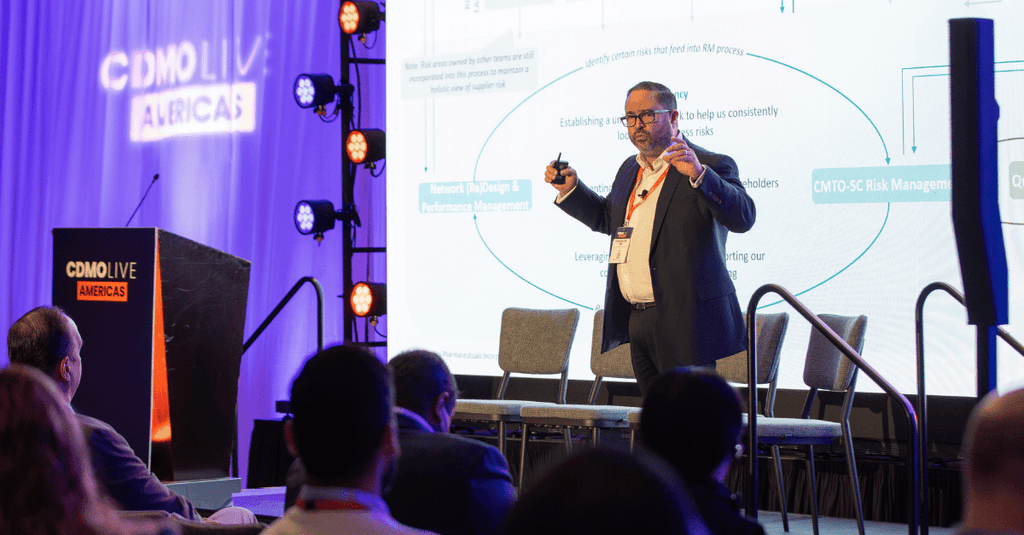
In this session recorded at CDMO Live Americas 2026 in Boston, Alfredo explains how Vertex embeds risk management into external manufacturing decisions. A panel followed, with Nicole Falk, Senior Director, Joint Audit and Quality Operations at Rx-360, Alvaro Camino, CDMO Associate Director at mAbxience, and Julia Morandi, Senior Director, Life Sciences Business Transformation at FTI Consulting. Together they covered redundancy, contracts, stress testing and crisis response for sponsors and CDMOs.
Why resilience is now a business requirement
Vertex has grown fast for several years. Its original risk program could not keep pace. Alfredo says it was not “scalable, sustainable” or “future ready,” so the team rebuilt it from the ground up.
The company works in rare, life-threatening diseases. Its cystic fibrosis therapies have changed patient outcomes, and it has expanded into cell and gene therapy with Casgevy. That makes supply continuity a patient issue.
“Continuity is critical. It’s not optional,” Alfredo says. He describes the current environment as a “polycrisis era” that began with COVID and now includes geopolitical instability, natural disasters and cyber incidents.
He also warns that supply disruptions spread. “These are not isolated incidents. You can have severe downstream effects if you were to have a major disruption at one of your critical suppliers.”
Key takeaways:
- Embed risk in strategy: Vertex treats risk as part of how it executes its 2030 strategy. It is more than an annual check-the-box exercise.
- Protect the patient: Resilience work exists to prevent drug outages.
- Think network-wide: Risk sits across suppliers, sites and geographies, so governance has to cover all of them.
Network design principles that put risk first
Last year Vertex created a network strategy and design function. Its first job was to set guiding principles that apply across every modality and product portfolio. The team then wrote strategy documents for each modality and each product.
Alfredo lists the principles Vertex weighs together:
- Risk: Understand threats by region and by product.
- Capacity: Provide enough throughput, storage and labor to handle demand swings.
- Technical: Secure CMO expertise and systems that are scalable, secure and interoperable.
- Financial: Cut cost of goods without sacrificing service levels.
- Resiliency and redundancy: Build alternate paths, sites and capabilities for fast recovery.
- Complexity reduction: Standardize designs and remove unnecessary handoffs.
- Regionalization: Place supply as close to the patient as possible.
- Decision balance: Make trade-offs product by product.
The last principle matters most. “It’s basically taking a holistic look and then making the right decisions for the right product for the right disease area,” Alfredo says.
Integrating risk governance across the business
When Alfredo arrived, risk was assessed in different ways in different forums. No one had a complete picture of Vertex’s risk profile. The company now links several layers.
At the top, the Enterprise Risk Management and Business Continuity Office checks each year that supply chain risks connect to the company’s top risks. Below that sits third-party risk management, built over three years with strategic sourcing. It starts when a team identifies the need for a vendor and assesses inherent risk before anyone signs a contract. At the working level, supply chain risk teams collaborate with quality, regulatory and network design.
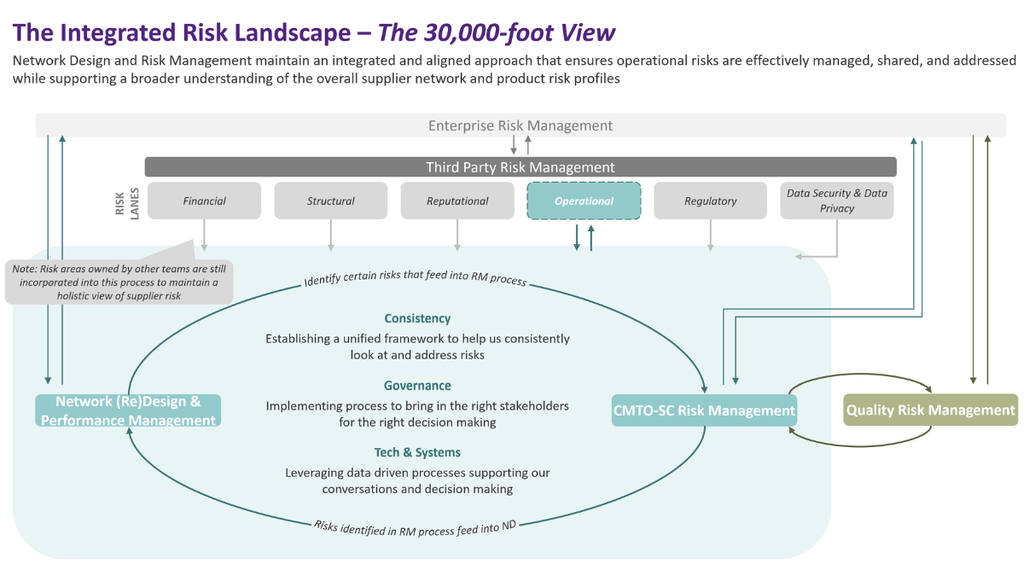
Vertex links enterprise risk, third-party risk, network design, supply chain risk and quality risk in one governance model. Source: Vertex Pharmaceuticals, presented at CDMO Live Americas 2026.
Alfredo is candid about the gaps. “We’re not completely there yet. It’s a journey.” Third-party risk, supply chain risk and quality each run on separate systems. Vertex is closing those gaps through governance, process and people. Data sharing is the goal. “The more we democratize data and share the information, the better decisions we can make.”
Vertex also created a first-of-its-kind supplier risk and performance scorecard. Previously, quality, regulatory and other teams each presented a different slice of a supplier in business reviews. The scorecard combines those views. It also gives leaders early warning if a decision to stay single-sourced needs revisiting.
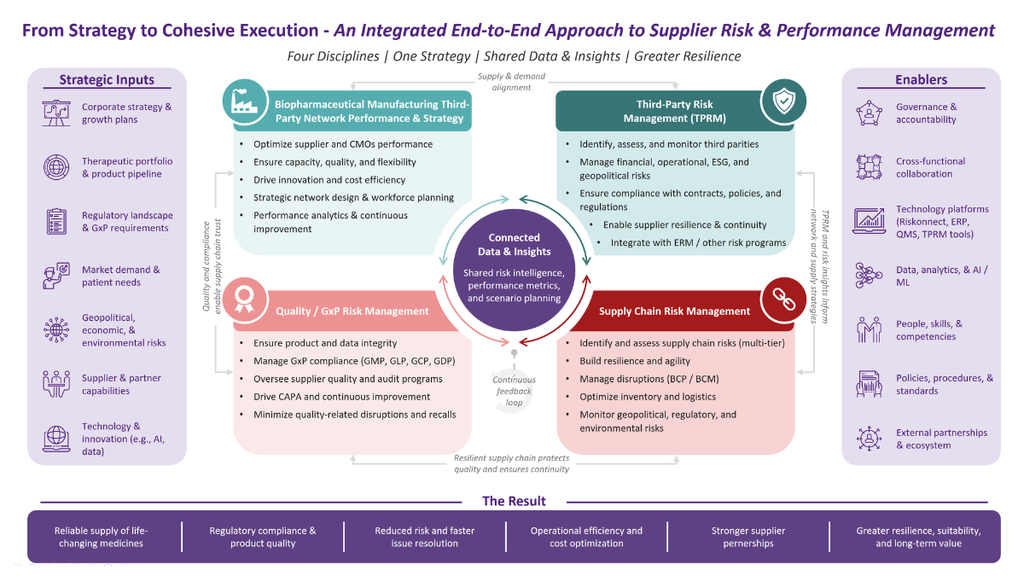
Four disciplines share one pool of data and insights: network performance and strategy, third-party risk, quality and GxP risk, and supply chain risk. Source: Vertex Pharmaceuticals, presented at CDMO Live Americas 2026.
Key takeaways:
- Connect the layers: Link enterprise risk, third-party risk and functional risk in one view.
- Fix the data first: Separate systems limit visibility, so plan for integration.
- Merge performance and risk: One scorecard per supplier beats scattered reports.
Risk champions and a shared playbook
Vertex standardized its approach with a playbook. It now has six chapters covering risk fundamentals, governance, classifications, process maps, business continuity and the risk platform. The goal is a consistent language across functions.
Alfredo credits one role above the rest. Risk champions represent specific functions or disease areas. They connect governance forums, align on mitigations and ratings, and report progress against milestones. Vertex also launched a risk management community of practice a few months ago. Champions and risk owners meet to share what works and what does not.
Julia Morandi, who has worked with Vertex on parts of this program, backs the approach. “The way that someone in quality thinks about risk is very different than the way that someone in supply chain thinks about it,” she says. Champions give busy colleagues a place to bring those views together.
Visibility and incident management
Vertex split business continuity from supply continuity. Business continuity covers internal functions. Supply continuity covers the outsourced network, including critical vendors and applications.
The company built visibility with its Global Security Operations Center. It tracks suppliers and sites worldwide and flags disruptive events. The team tuned alerts to deliver signal and cut noise. “We did not desensitize people,” Alfredo says.
Vertex already had a crisis framework at the top level. It lacked one at the operating level. “We are really good at firefighting, but there were no real guidelines, standards, communication, coordination, escalation protocol,” he says. The new framework defines how to gather the right people, triage an event and form a task force if needed.
It has already paid off. After a natural disaster in Asia, Vertex received an alert over a weekend. The team warned its external manufacturing group. That group contacted the CMOs, which secured material and protected inventory.
Vertex runs tabletop exercises at least once a year. This year it ran four. The latest focused on a geopolitical event affecting Journavx, its non-opioid pain therapy.
Cost-effective redundancy: not every product needs a backup
The panel turned to a hard question. Does every product need a second supplier? Alfredo says no. “You don’t need a backup supplier for every single product or every single supply chain node.”
His test starts with demand. Is the product declining? Does safety stock cover the gap? Where do critical materials come from, and can anyone else supply them? If a primary vendor fails, can you qualify a new one before stock runs out? The aim is to avoid any “delta” between safety stock and the time needed to stand up a replacement.
He also defends single sourcing when the analysis supports it. “Let me show you the analysis behind why we decided to remain single source. These are the monitoring mechanisms that we have in place.”

What a CDMO can offer as a backup site
Alvaro Camino, CDMO Associate Director at mAbxience, described how a CDMO can serve as a backup. mAbxience runs two sites on two continents with the same design, setup and suppliers. The sites can act as one company or work independently. Sponsors gain flexibility when disruption hits.
He says the baseline is response time. “How much time would you need to react?” A backup arrangement also reserves capacity, including tech transfer teams. That costs money, so the contract should say how long the CDMO stays ready.
His numbers show the value. “A regular tech transfer can be between 20 to 24 months.” If the CDMO already manages both sites for a sponsor, he says that can fall to “between eight to 10 months.”
Contract terms that build flexibility
Alvaro says sponsors should start by stating their risk appetite. “Everything has a cost. If you want to be 100% sure of something, it’s going to cost you more than the budget that they have.” Sponsors want fast timelines, a controlled budget, low risk and reliable delivery. CDMOs must balance all four.
Asked which single clause he would insist on, Alfredo chose sub-tier mapping. He explains the logic:
“It doesn’t have to be the entire sub-tier network, but if you’re a tier one supplier to me, you’re a very critical supplier. We need to understand who your critical suppliers are, and if you are aware of their supply and business continuity plans. Have they been tested? When was the last time? What were the findings? We’re not going to manage the second tier. That’s the CMO’s job. But we need assurance that they’re doing their due diligence.”
Nicole Falk, Senior Director of Joint Audit and Quality Operations at Rx-360, agrees that high-risk items belong in the quality agreement. She adds that data matters as much as paper. “Contracts aren’t the problem. It’s the data that’s the problem.” Sponsors should ask whether they receive inspection findings and change notifications. Rx-360 also keeps a library of audits so sponsors can see sub-suppliers they cannot audit directly. The group runs a joint audit program that lets several sponsors share one site audit, which cuts cost for sponsors and burden for sites.
Stress testing with tabletop exercises
Julia cautions against relying on scenario-modeling software alone. “Bad data in is bad data out.” If visibility into sub-suppliers or inventory is thin, the model will not reflect reality. She recommends running tabletop sessions in parallel. Bring supply chain, quality, regulatory and procurement together, even for an hour, and ask what happens if a site goes down tomorrow.
The result guides spending. “If it’s weeks, maybe that’s a risk you’re willing to accept. If it’s a year-long recovery due to lengthy tech transfers,” she says, that case may justify built-in redundancy.
Nicole adds that findings need an owner and a deadline. Rx-360 advises sponsors to run self-assessments, hold tabletops and then turn the gaps into CAPAs. She names four common weak spots:
- Silos: Procurement, supply chain and quality do not work together often enough.
- Late change notifications: Changes reach change control too slowly.
- One-time qualification: Teams qualify a supplier up front and then walk away.
- Calendar-based oversight: Teams follow a fixed schedule, not a risk-based one.
Alfredo describes the Journavx exercise. Raw materials or APIs may come from China. The team asks where else to source, such as India. Then new complications arrive, and the team responds to each. Afterward, an after-action report records what went well, where gaps remain, who owns each gap and where communication broke down.
Governance when disruption hits
Julia calls real-time monitoring the gold standard for both sponsors and suppliers. Sponsors should load every critical node into a monitoring system such as Everbridge. That includes CDMO sites, ports and airports. They do not need suppliers on the same platform.
She advises sponsors to take the lead. “Any of their suppliers are an extension of their own operations.” If a CDMO lacks a business continuity plan, sponsors should help build one.
Alvaro explains what a CDMO needs from a sponsor in the first 24 to 48 hours. His answer is trust, then time to carry out the plan. If a critical item such as a single-use bioreactor bag runs short, he tells the sponsor how long recovery will take and which validated alternates are ready. Shared platforms help because materials and safety stock can move between programs. Transparency builds comfort.
Practical steps to take next week
Each speaker closed with one action.
- Place risk champions across functions (Julia): Share risk work with people outside the risk team, since quality and supply chain view risk differently.
- Run a 15 to 20 minute flash session on a high-risk supplier (Nicole): Check whether you know the quality agreement, the change notification process and the sub-suppliers. Any question you cannot answer is a gap.
- Know your suppliers well and let them explain their disruption strategy (Alvaro): Strategy has to be designed ahead of time, so ask for the plan before you need it.
- Run short, focused tabletop exercises at least quarterly (Alfredo): Check assumptions against reality, because a backup supplier from last year may no longer be viable. Build a risk community. Keep leadership informed.
Alfredo’s final point covers all of them. A plan on a shelf protects no one. A trained team, a monitored network and a clear escalation path protect patients.