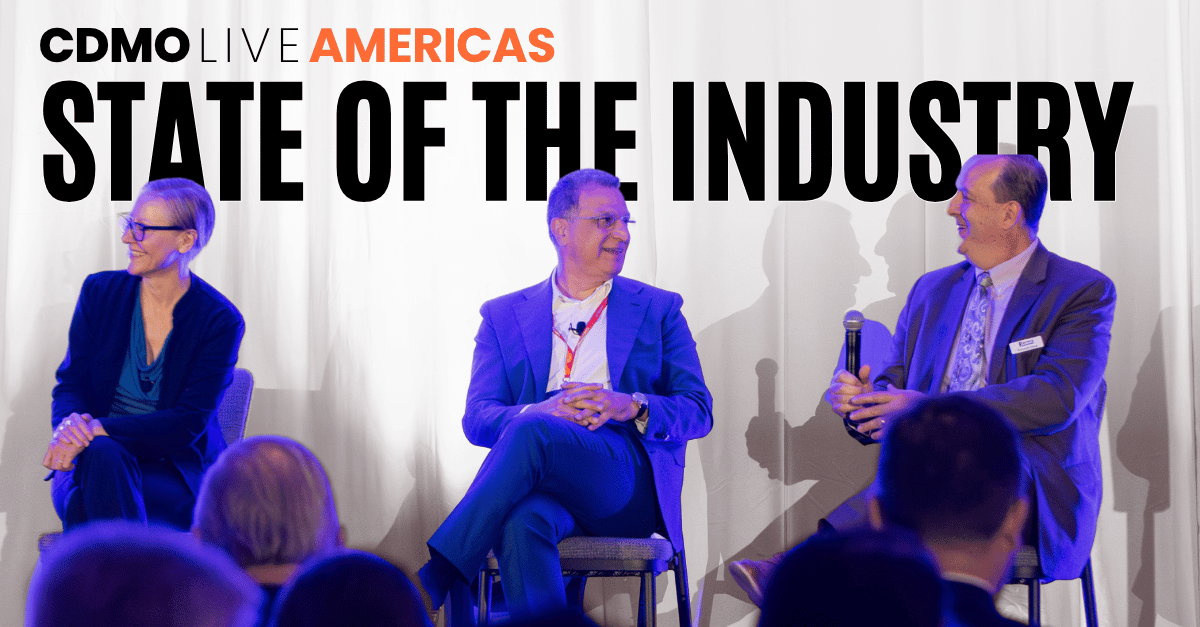
Marta Wosińska senior fellow at The Brookings Institution, Reza Oliyai, president and CEO of Oliyai Consulting, and Kenneth Drew, vice president at Flamma, joined an interactive panel at CDMO Live Americas in Boston, reacting to live audience polling on the forces shaping contract manufacturing in 2026.
Seventy percent of the audience at the CDMO Live Americas opening panel called themselves optimistic about the next 12 months. The panel agreed on the near term, then spent half an hour on what could go wrong over the next five years. In a plenary session sponsored by Flamma, Wosińska, Oliyai and Drew responded to live audience polls on tariffs, reshoring pledges, China and the talent gap, and the room’s answers shaped the discussion at each stage.
1. Optimism holds for the next year, and caution starts beyond it
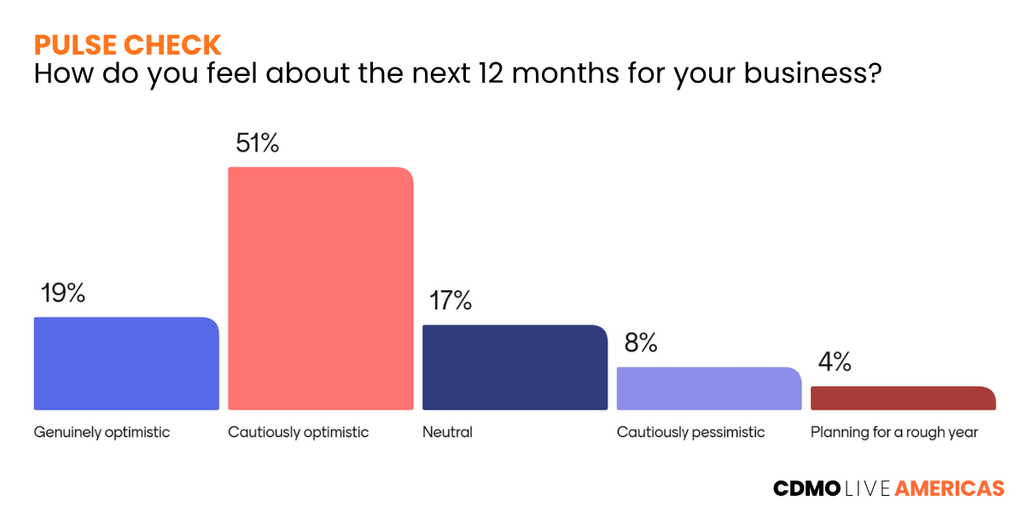
Half the room, 51%, chose “cautiously optimistic.” Another 19% chose “genuinely optimistic,” 17% were neutral, 8% were cautiously pessimistic and 4% are planning for a rough year.
Oliyai spent 28 years at Gilead, where he helped commercialize 27 products, before founding a consultancy that now has more than 160 clients. He placed himself at the top of the scale: “I’m extremely optimistic.” Drew, a PhD organic chemist who moved into business development about 20 years ago, called himself “a glass half full guy.” He sees a split in the market. “Current customers are doing great business with lots of companies,” he said. “It’s the newer ones that are having difficulties.”
Wosińska, an economist who has studied drug supply and shortages throughout her career, shares the one-year optimism and draws her line at the horizon. “In the next year I am very optimistic,” she said. “What I worry about and where my caution comes from is the longer term.”

2. Tariffs top the worry list, and they will not save CDMOs
Trade tariffs drew 41% of votes, ahead of FDA staffing cuts and review delays at 27%, AI in manufacturing and quality 11%, and most-favored-nation pricing 9%.

Wosińska opened by narrowing the scope of the problem. Shortages tied to tariffs concern generics, she said, and she does not expect any branded shortages. Branded sponsors face a different exposure. When the Section 232 tariffs on branded drugs were announced, 17 companies representing roughly 86% of total sales signed deals. About 300 sponsors hold NDAs and BLAs, and once orphan drug holders are removed, nearly 200 remain exposed. “A lot of them just have one product,” she said, “and most of them don’t have a facility anywhere. They’re your clients.”
Size decides who can absorb the hit. “A 20% tariff could be absorbed by a branded manufacturer, not by a generic,” she said. “But 100% tariff puts your back against the wall.” Drew sees the same divide between large and small sponsors. Big pharma struck deals in Washington. “Emerging and small and mid-sized pharma companies, they weren’t able to go to Washington and cut deals,” he said, and he warned that this could stifle US innovation while China takes up the banner.
Oliyai took a calmer view. For branded companies developing high-cost medicines, “tariff and cost of goods are really small portion of the overall cost of the patients,” he said. His firm has recently helped four clients with NDAs and three with BLAs, all successful, and he reported good collaboration from FDA. He also argued that sponsors can redesign supply chains to circumvent many tariffs.
He had a blunt message for CDMOs:
“The tariffs are not going to save the U.S. and EU CDMO industry. Sorry to be so blunt.”
Wosińska added that tariffs miss their stated target. National security concerns center on key starting materials, yet the tariff rate follows where the API is made. “Tariffs are not a good tool for getting at the national security risk,” she said.
Geography matters less than value to the people choosing partners. “We hardly ever make a decision just based on pure geography,” Oliyai said, listing speed, quality, price, technical expertise, analytical support and project management. Drew offered a counterexample. His company lost a project because the customer already had a supplier in Italy and did not want a second one next door. “It was a little bit sad because it’s a blockbuster drug now,” he said.
3. The $500 billion reshoring pledge faces a skeptical audience
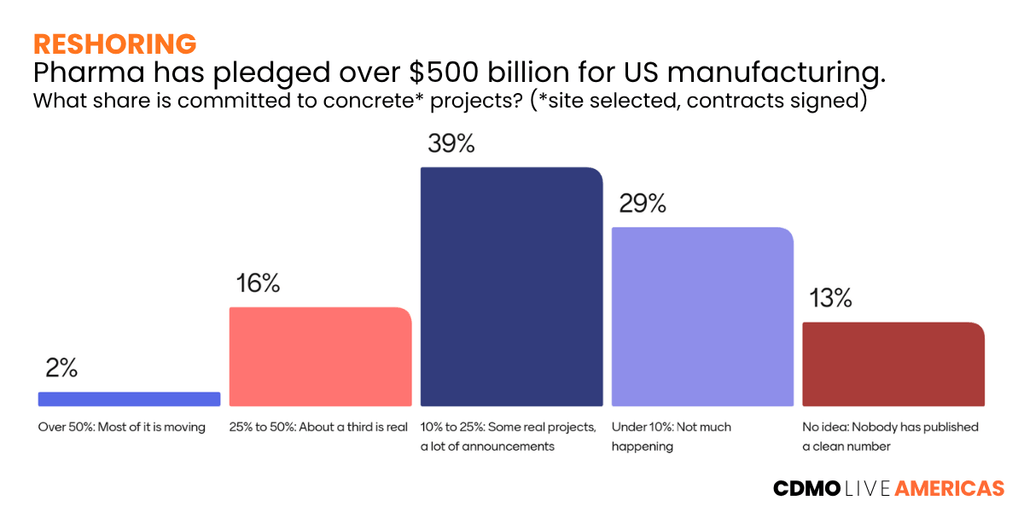
Pharma has pledged more than $500 billion for US manufacturing. The audience was asked how much of that has reached concrete projects, defined as a selected site and signed contracts. 68% said the real amount is either 10-25% or less than 10%.
Oliyai put it bluntly: “There’s more bark than bite when it comes to building large manufacturing capacity in the U.S. by large pharma.” Drew went further. He asked the room who remembers Kodak, and the plant in New York that was going to be converted into a big pharmaceutical facility, and then predicted that the pledged investments “will disappear in two years and will never be built.” He added: “I will bet dollars to donuts that there is no chance that all of that money pledged to build capacity in the U.S. will take place. I think right now they’re just playing the game.”
Wosińska agreed that big pharma will not need many new buildings. “They’re going to make in America for America, and they will make in Europe for Europe,” she said. Capital investment is where her caution returns. The sponsors now arriving at CDMOs to escape tariffs may leave when policy shifts, and the big pharma capacity that is being built may go unused. “Those clients that are banging at the doors of CDMOs because they want to get away from the tariffs, are they going to stay with you guys?” she asked. “Is it really worth investing in capacity?”
She also noted that small sponsors are at a disadvantage in the interim. Big pharma can “reorganize the chairs” across its global network, she said, while a small company competing for US CDMO space brings low volumes, and CDMOs prefer a few large branded manufacturers to 20 small ones.
4. China is a blended market, with legislation on the horizon
China’s share of new drug candidates entering trials rose from 8% in 2018 to 30% in 2025.
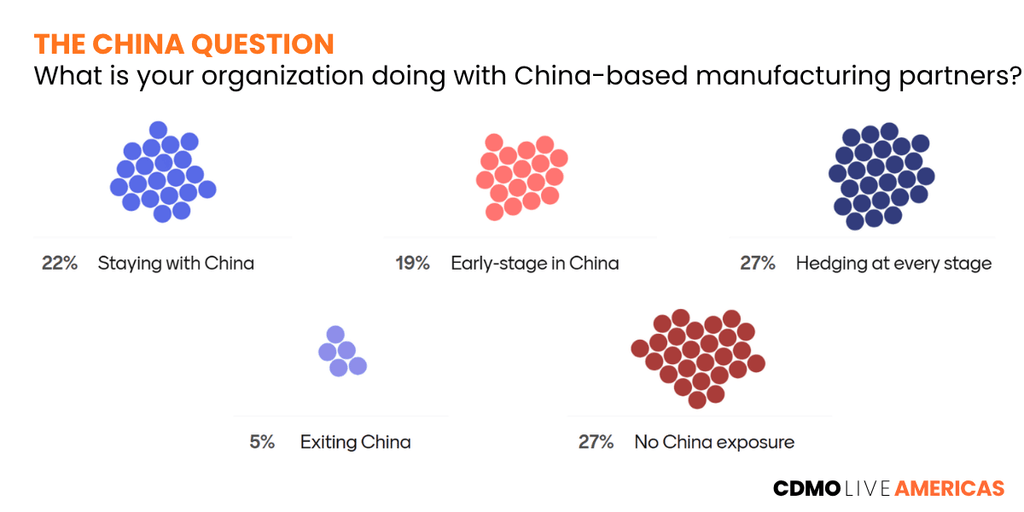
For the sponsors and CDMOs in the room, the top responses were “Hedging at every stage” and “having no China exposure” tied for the largest share, each at 27%. Another 22% are staying with China, 19% use it for early-stage work and 5% are exiting.
Oliyai said the market no longer divides cleanly by region. “There are a lot of great CDMOs in China,” he said, and many are expanding into Singapore, Japan, the US and Europe. “We have no hesitation in terms of working with Chinese CDMOs.” Drew agreed: “There are good CDMOs everywhere, and there are also not so good CDMOs everywhere.” He described a blended model where his company combines its China facility with its US and Italian sites, and he is candid about cost.
“If you’re going to do everything in the West and not include the East, you’re going to pay more.”
One customer runs two supply chains, one that uses Asia and one that avoids it, and accepts the higher price of the second as insurance against a crisis over Taiwan.
Drew also described what Chinese pricing pressure looks like from a Western CDMO’s seat. He said he had heard recently that without AI and tech, China’s economy would be shrinking by 5%, and he sees the effect in bids. One company, he said, is making an Fmoc amino acid in China for the cost of the raw material just to keep the doors open, and he knows people in China who are being laid off. “WuXi is killing it,” he said. “Take WuXi out of the picture, the CDMO industry in China is really, really tough.” The result is lower prices across the board. WuXi was the poster child of the BioSecure Act, and Drew said the legislation produced a surge of orders at his company. “We had our best year ever. Thank you, BioSecure Act.” He added that the benefit may be temporary, because “big pharma likes big CDMO” and large pharma deals in China continue. For the virtual biotech backed by a little private equity money, he said, “they are taking the lowest price eight days of the week.”
Wosińska sees legislative risk ahead. She pointed to the idea of extending the Comprehensive Outbound Investment National Security (COINS) Act to biopharma. The COINS Act is a permanent statutory framework that regulates and restricts American outbound capital flowing into foreign adversaries. Applied to biopharma, it would ban any engagement with Chinese firms, including partnerships as well as ownership. “It sounds good to a lot of policymakers,” she said.
Pharma’s standard response, that such restrictions hurt innovation, “has gotten a little tired,” in her view, because the industry made the same argument about the Inflation Reduction Act and innovation has not dried up. “I can see the stars aligning in a way that something like BioSecure could actually go through,” she said. She also thinks the industry may have complicated its own case. “Pharma has done itself a disservice by calling emerging biotech a national security matter,” she said, because national security framing invites protectionist responses.
5. The talent gap stays open
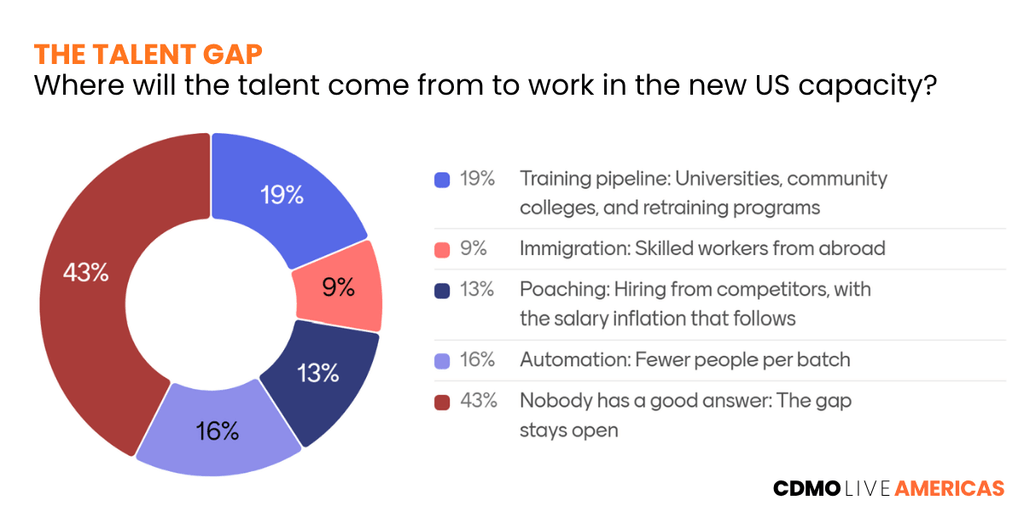
Forty-three percent of the audience said nobody has a good answer and the gap stays open. The training pipeline drew 19%, automation 16%, poaching from competitors 13% and immigration 9%.
Oliyai expects the shortage to hit hardest in “sterile manufacturing, quality and compliance, more complex chemistry.” Drew gave an example from his own order book. One US company asks him to deliver starting materials six months before it needs them, because its quality team is so understaffed that release testing takes that long. “They’re pressuring us to get material six months before they actually even really need it,” he said. When he asks the innovator why, he said, “I’m like, either they lost a batch, or they’ve got a problem with their analytical.”
Wosińska named immigration as the policy lever most likely to move. “Obviously immigration. That’s the big one,” she said. CDMOs may find it hard to lobby for change, but big pharma will be louder if its new plants sit unstaffed. “They’re going to be very outspoken about this.”
Advice for the next 12 months
The panel closed with one practical tip each. Wosińska urged sponsors to look beyond the next year and weigh the level of uncertainty against any investment they make. Oliyai advised planning supply chain design 12 to 24 months ahead, depending on modality. “It’s very tight right now,” he said.
Drew’s advice was to get on site. “Don’t be a follower,” he said.
“There are a lot of good CDMOs out there. Go visit them. Go see them. Talk to the people.” A Teams or Zoom call is no substitute for walking around a facility, he said, and the visit works for sponsors of any size. His company won an API project last year from a customer that had not had it on their radar, and the site visit turned the tide. He also advised sponsors without strong in-house CMC expertise to hire consultants who have it.