The U.S. Food and Drug Administration (FDA) and the European Medicines Agency (EMA) on January 14, 2026, jointly published ten guiding principles for good artificial intelligence (AI) practice in drug development, establishing a shared regulatory framework spanning the full medicines lifecycle — from early research and clinical trials through manufacturing and post-market safety surveillance.
The principles are directed at medicine developers, marketing authorization applicants, and authorization holders, and are intended to lay the foundation for future AI-specific regulatory guidance in both the U.S. and EU while advancing international harmonization.
A Framework Built on Ethics and Risk Management
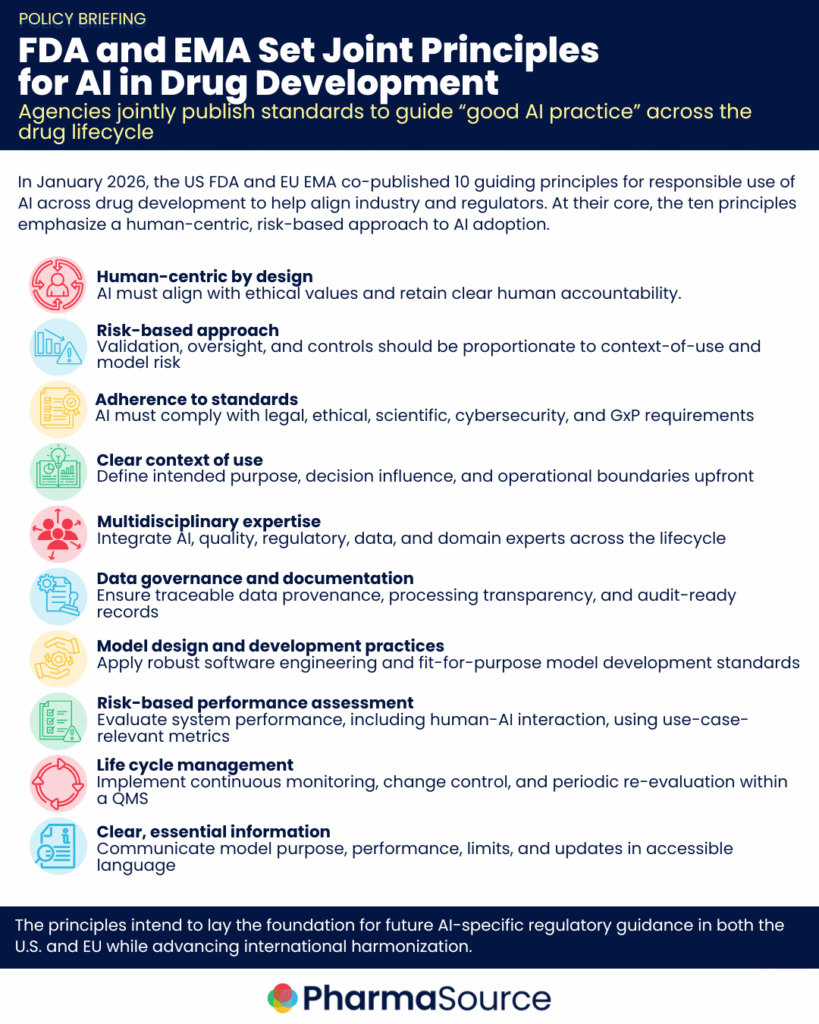
At their core, the ten principles emphasize a human-centric, risk-based approach to AI adoption. European Commissioner for Health and Animal Welfare Olivér Várhelyi called the publication “a first step of a renewed EU-US cooperation in the field of novel medical technologies,” adding that the principles demonstrate how transatlantic collaboration can preserve global innovation leadership while ensuring the highest level of patient safety.
The ten principles are:
- Human-centric by design — AI development and use must align with ethical and human-centric values
- Risk-based approach — Proportionate validation, risk mitigation, and oversight tailored to context and model risk
- Adherence to standards — Compliance with legal, ethical, technical, scientific, cybersecurity, and GxP requirements
- Clear context of use — Well-defined scope and role for each AI application
- Multidisciplinary expertise — Integration of cross-disciplinary knowledge throughout the AI lifecycle
- Data governance and documentation — Traceable, verifiable documentation of data provenance and processing in line with GxP
- Model design and development practices — Best practices in software engineering, interpretability, explainability, and predictive performance
- Risk-based performance assessment — Evaluation of the complete human-AI system using fit-for-use data and metrics
- Life cycle management — Ongoing monitoring and periodic re-evaluation to address issues such as data drift
- Clear, essential information — Plain-language communication of AI capabilities, limitations, and performance to users and patients
Voluntary Today, Potentially Binding Tomorrow
While the principles are currently non-prescriptive and voluntary, regulatory observers note that early alignment could confer strategic advantage. As legal analysis from Jones Day noted, the principles could shape future mandatory regulatory guidance on both sides of the Atlantic, making proactive compliance a prudent approach for drug developers.
The framework is broad enough to apply across a wide range of AI use cases, including AI-enabled clinical trial design and patient recruitment, machine-learning-driven pharmacovigilance and signal detection, real-world evidence analysis for regulatory decision-making, and predictive tools for manufacturing process control and quality assurance.
Building on Prior Collaboration and Existing Guidance
The joint initiative follows a bilateral FDA-EMA meeting in April 2024 and builds on EMA’s AI reflection paper, adopted by the Committee for Human Medicinal Products (CHMP) and the Committee for Veterinary Medicinal Products (CVMP) in September 2024. The effort also aligns with the European Medicines Agencies Network Strategy (EMANS) to 2028 and the joint Heads of Medicines Agencies and EMA multi-annual Data and AI workplan.
In the EU, additional guidance is already in development, with future frameworks expected to incorporate requirements under the EU AI Act, the proposed Biotech Act, and updated pharmaceutical legislation. On the manufacturing side, EMA is also consulting stakeholders on new GMP Annex 22 specifically governing AI in manufacturing.
Both agencies have signaled that these principles will evolve alongside the technology, supplemented by jurisdiction-specific guidance as scientific understanding and legal frameworks mature.
 Sign up to the free weekly newsletter for all the latest news, resources and podcasts in pharma manufacturing.