The need for a strategic, comprehensive approach to your drug development journey is essential for success.
The journey of a novel therapeutic from a lab concept to a market-approved medicine is complex, time-consuming, risky, and costly. The average likelihood of approval for a new Phase I drug is just 6.7%. In this guide, we provide an in-depth overview of the Drug Development Plan (DDP), also known as the Integrated Development Plan (IDP).
The following guide will cover:
- What information is needed to complete each section
- Who should be involved in preparing the document
- Who typically reviews and approves the document
- The role of change control in managing updates
- Common mistakes to avoid
Drug Development Plan: Downloadable Resources
Before you go any further, fill out this form to download 1) the full guide, 2) DDP template and 3) example documentation:
Why should one invest time and resources in creating a Drug Development Plan?
A DDP is a multidisciplinary strategic framework that provides a detailed roadmap for advancing a new compound from discovery through every stage of development to regulatory approval and commercial launch. One can see it as a roadmap of a drug development program, laying out the route from discovery to approval and ensuring every team knows where they are headed, working in alignment toward a common, well-defined destination. The reasons why DDP is critical for success are presented below:
1. Strategic clarity and organizational alignment
Drug development requires coordinated contributions from many specialists across disciplines, each with distinct expertise and perspectives. The DDP serves as a central reference document that translates the overall scientific and strategic intent of the program into a structured and shared development plan. By aligning stakeholders, from research and development teams to commercial leadership, around common objectives such as the target product profile (TPP), defined Go/No-Go criteria, and key timelines, the DDP helps ensure that program activities remain coordinated and focused.
Key Takeaway: Think of the DDP as the program’s single source of truth. When it is properly maintained throughout the drug’s lifecycle becomes the institutional memory of the program.
2. Early identification of risks and failure modes
Developing a Drug Development Plan pushes the team to address critical questions early in the program. For example, from a purely CMC perspective, how might supply chain or formulation limitations affect study timelines? What contingency plans exist if the primary manufacturing site experiences delays or GMP issues? Capturing these risks while options remain flexible is far less costly than confronting them later, when changes become complex or prohibitively expensive.
3. Accelerated development timelines
A DDP explicitly maps the dependencies between functional tracks, providing a clear view of what must be completed before subsequent activities can proceed. By making these dependencies visible, the program team can run activities in parallel, minimize gaps between phases, and compress the overall development timeline.
4. Optimized investment decisions and investor confidence
For startups, a Drug Development Plan serves as a critical tool for fundraising and business development. A well-constructed DDP demonstrates to potential investors, partners, and acquirers that the team has a clear understanding of the full development pathway, has identified key risks, and has a credible plan to manage them.
Key Takeaway: A well-crafted, data-driven DDP demonstrates deep understanding of the disease area, the investigational drug, and its potential commercial opportunity, positioning the team to engage confidently with larger pharma partners. It shows that the program is strategically oriented toward patient impact and market success, not merely a scientific research exercise.
5. Streamlined regulatory interactions
The regulatory strategy defines the path to submission, pinpoints which data is necessary, and plans for interactions with regulatory agencies. Programs that engage the FDA or EMA with a clear, internally consistent strategy receive more productive feedback.
Information required before you begin
The Drug Development Plan aligns the scientific data with strategic intent, translating available evidence into a forward-looking, decision-driven roadmap. Before drafting a DDP, the 40 source documents described in this guide should be assessed for availability (Checklist 1, appendix section). Keep in mind that documents at preliminary or draft level are acceptable inputs, and not all 40 are required simultaneously.
The sequence, however, matters as the 15 IND/CTA-blocking documents must reach sufficient maturity before regulatory submission, while the remaining program-level documents can evolve in parallel with early drafting. The DDP itself is a living document; it is version-controlled, owned by a named function, and revised on a defined cadence or when a material trigger event occurs.
Every claim made in the DDP must trace back to one of the 40 source documents. Where a claim cannot be referenced, that is a gap signal requiring resolution before the DDP can be considered complete. The DDP is structured to answer four master questions in sequence:
- What are we building? 🡪 the therapeutic hypothesis, target product profile, and strategic rationale for the chosen indication.
- How do we know it works well enough to test in humans? 🡪 the integrated nonclinical-to-clinical evidence chain, including MABEL/NOAEL analysis, safety pharmacology, and translation rationale.
- How will we test it? 🡪 the Phase 1 design concept, CMC readiness, regulatory filing plan, and operational execution framework.
- What does success look like at each stage? 🡪 the decision criteria, go/no-go thresholds, and stage-gate logic that define what Phase 1 must deliver to justify continuation.
Every section of the DDP maps to one of these four questions. If a section cannot be anchored to a question, it does not belong in the DDP. If a question cannot be answered because a source document is missing, that gap must be declared in the Assumptions Log and escalated to the Risk Register.
Who should be involved in preparing the DDP
By its very nature a DDP is a cross-functional document. It simply cannot be written from start to end by a single person or functional team. The most valuable DDPs are generated through integration of multiple expert perspectives. Every company may follow its own process for establishing a DDP. One way of approaching it is through establishing of a core DDP writing team, supported by extended team members / subject matter experts (SMEs) as shown below:
| Role | Function | Primary Contribution to DDP |
|---|---|---|
| Program medical director | Clinical / medical | Site feasibility assessment, enrollment assumptions, geography strategy, clinical timelines, CRO selection, and oversight plan |
| Clinical development lead | Clinical/medical | Phase 1-3 study designs concepts, protocol outlines, starting dose justification input, patient population definition, biomarker strategy |
| Clinical operations lead | Clinical operations | Site feasibility assessment, enrollment assumptions, geography strategy, clinical timelines, CRO selection and oversight plan |
| Head of CMC/CMC lead | Clinical/medical | Cell line selection criteria, DS and DP process summaries, formulation development plan, CQA determination, analytical method strategy, stability program, GMP readiness timeline, supply chain and sourcing risk assessment, CMO oversight |
| Head of regulatory affairs | Regulatory | Biomarker strategy (patient selection, PD, response), companion diagnostic development considerations, natural history, and patient registry assessment |
| Non-clinical lead | Pharmacology/toxicology | Nonclinical development plan, pharmacology and PK/ADME summaries, MABEL/NOAEL analysis, safety pharmacology, genotox and reproductive tox strategy, nonclinical-to-clinical translation rationale |
| Biostatistics lead | Statistics | Statistical analysis plan framework, Phase 1 dose-escalation model input, Phase 2/3 statistical design concepts, sample size calculations, interim analysis strategy |
| Translational/biomarker lead | Translational medicine | TPP commercial attributes, competitive landscape analysis, market access and reimbursement landscape, HEOR strategy, patient advocacy, and KOL engagement plan |
| Commercial/market access lead | Commercial | High-level budget estimate, resource plan, contingency calculations, and budget tracking against milestones |
| Program director / project manager | Program director/project manager | Master integrated timeline, critical path and dependencies, stage-gate process, risk register maintenance, assumptions log, cross-functional integration, governance approval process |
| Head of finance | Finance | High-level budget estimate, resource plan, contingency calculations, budget tracking against milestones |
| Intellectual property/legal lead | Legal | Overall DDP owner, executive summary, TPP (minimum and target attributes), integrated evidence narrative, go/no-go criteria, and stage gate thresholds |
Given the complexity of a DDP and the number of experts involved, it is important to establish a working process that enables efficient collaboration and alignment across functions. The exact process for developing a DDP can vary depending on factors such as company culture, team workload, and organizational structure. Nevertheless, a structured approach always helps ensure efficiency and alignment across functions.
A practical starting point is a kick-off meeting, where the Program Director convenes the Core Team, assigns ownership of the different sections, and agrees on a timeline for preparing the first draft. Functional leads can then draft their respective sections independently, using a shared template and guidance to ensure consistency.
Once initial drafts are available, the Core Team may benefit from a 1-2 day integration workshop to review the sections together, check for consistency, resolve interdependencies between functions, and align on timelines and overall strategy. The consolidated draft can subsequently be circulated for internal review, inviting written feedback from the Core Team and relevant subject matter experts, typically allowing around two weeks for comments. After incorporating the feedback, the Program Director can revise the document and circulate it for formal sign-off by key stakeholders. Finally, the completed plan may be submitted to the Program Governance Committee for ratification and approval of the official version. This step ensures that the document becomes the agreed strategic framework guiding the program.
Best Practice:
- Use a shared document management platform (e.g. SharePoint) to manage versions and review comments. Avoid emailing documents to prevent version confusion.
- Ensure participants review the full draft in advance of the workshop, allowing them to familiarize themselves with sections beyond their own area and enabling them to lead a constructive discussion.
- Use workshop time to address strategy alignment, timeline conflicts, critical risks, and functional interfaces rather than editing text.
- Too many review rounds can slow progress. Establish a defined review window and encourage consolidated feedback from each function.
Who typically reviews and approves the Drug Development Plan?
How to structure the DDP review process
The DDP is a high-stakes strategic document. Its approval process must be clearly defined and must involve appropriate level of seniority to ensure accountability and cross-functional commitment. Proposed review tiers are described below.
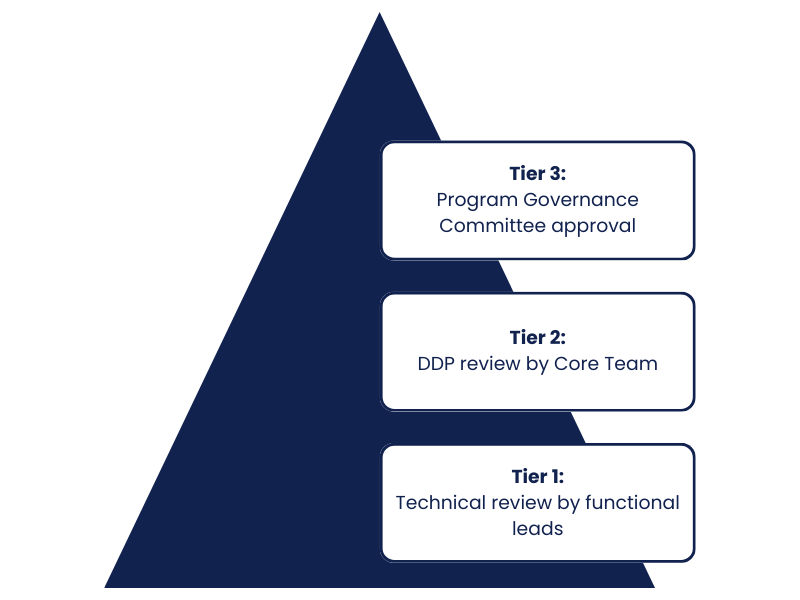
Tier 1: technical scrutiny – all eyes on the details
Each section is reviewed within its function by the responsible functional lead and at least one independent subject matter expert to verify scientific accuracy, completeness, and internal consistency. For example, CMC content may be reviewed by the Head of CMC and an independent SME or QA representative; nonclinical sections by the Non-clinical Lead and a toxicology expert; clinical sections by the Medical Director with biostatistics support.
Tier 2: Cross-functional alignment – ensuring the plan works as a whole
The consolidated document is then reviewed by the Core Team to ensure cross-functional consistency, aligned timelines, and coherence of the overall strategy and budget.
Tier 3: Strategic endorsement – leadership commitment
Finally, the document is submitted to the Program Governance Committee, typically including senior leaders from R&D, medical, regulatory, CMC, commercial, and finance, for formal approval of the strategy and associated commitments.
Best Practice: DDP approvers must have the authority to commit resources and timelines. They must be aware that their signature represents commitment to the plan and is not simply an acknowledgment of its existence.
How quickly can a Drug Development Plan be approved?
This section presents an exemplary, suggested milestone schedule for the approval of a DDP. It is intended as an illustrative guideline rather than a fixed timeline. In practice, the actual duration can vary considerably depending on factors such as the organization’s internal procedures, company culture, and the level of coordination among the designated stakeholders. Timely approval largely depends on the active involvement of all relevant parties and their commitment to addressing questions and resolving discussions promptly.
| Activity | Recommended Duration | Responsible |
|---|---|---|
| Pre-work/information collection | 2-3 weeks | All functional leads |
| Section drafting (parallel) | 2 weeks | Individual section owners |
| Integration workshop | 1-2 days | Core team |
| Internal review cycle | 2 weeks | Core team + SMEs |
| Revision and preparation for governance | 1 week | Program Director |
| Program Governance Committee approval | 1 meeting | Governance Committee |
Importance of change control in context of Drug Development Plans
A well prepared DDP must be regularly updated to remain relevant. Any change in the competitive landscape, evolving regulatory guidelines, or new emerging data must be periodically captured and assessed. Change control process provides a formal framework for ensuring transparency, enabling proper evaluation of change, and appropriate governance oversight.
Typically, the process begins when a Core Team member or functional lead identifies the need for a change and submits a Change Request Form to the Program Director, outlining the proposed modification and its rationale. The Program Director, together with the relevant functional leads, then assesses the potential impact of the change on timelines, budget, risks, and cross-functional dependencies.
The proposed change is subsequently reviewed by the Core Team during a scheduled program review meeting or during an ad hoc session if the matter is time-critical. If the change is considered material, it must be approved by the same Governance Committee that endorsed the current version of the IDP, typically through a majority vote or consensus decision.
Once approved, the change is formally incorporated into the DDP. The document version number is updated to reflect the scope of the change, and the Change Control Log is updated with key details such as the date, description of the change, initiator, and approver.
Finally, the updated DDP is redistributed to all Core Team members, and previous versions are archived in the document management system to maintain a clear record of document history.
Key Takeaway: A well-maintained change control log supports transparency and traceability in program decision-making and provides a clear record of how and why key development decisions evolved over time. A DDP that lacks version history or contains insufficiently documented changes may raise questions regarding the robustness and consistency of the program’s quality management practices.
Drug Development Plan mistakes to avoid
This section highlights mistakes to avoid, with the goal of helping teams strengthen the clarity, usability, and strategic value of their Drug Development Plan.
By learning from common pitfalls teams can adopt the right first-time mindset and hit the ground running with a robust, actionable, and strategically focused development plan. Common pitfalls include:
1. Building the DDP forward from available data rather than backward from decision criteria
This is the single most consequential error. Teams assemble what they have and call it a plan. The correct discipline is to start with what data Phase 1 must generate to make a go/no-go decision, then scope every protocol, CMC, and biomarker deliverable to produce exactly that data.
Define stage-gate success criteria before drafting any other section; every subsequent section must justify itself against those criteria.
2. Assumptions are embedded in the narrative rather than declared
Enrollment rates, PK projections, tolerability windows, and competitive timeline assumptions are buried in prose where they cannot be tracked, challenged, or updated when they change. When an assumption fails it is not recognized as a DDP trigger because it was never formally declared.
Maintain a dedicated Assumptions Log (distinct from the Risk Register) as a named section of the DDP; every assumption must have an owner and a defined invalidation threshold.
3. Reproducing the source documents inside the DDP content
Teams copy sections of the nonclinical summary, TPP, or regulatory strategy directly into the DDP body, creating a document that is simultaneously redundant with its source documents and immediately out of date when those documents are revised.
The DDP references and draws conclusions from source documents; it never reproduces them. Every claim should carry a document reference, not the underlying content.
4. Establishing the Drug Development Plan too late
Begin drafting the DDP before pre-IND meeting planning, not merely before IND submission. The pre-IND meeting strategy is itself informed by the DDP; starting after submission means the document is already behind the program. Update the DDP regularly, at minimum at each phase transition and each governance milestone.
5. Treating the DDP as a one-time deliverable
Schedule formal DDP reviews at every program milestone and ensure updates are a standing agenda item. Separately, define explicit triggers for out-of-cycle revisions: a clinical hold, a competitor failure, a new nonclinical finding, a manufacturing deviation, or a budget overrun above a defined threshold should each automatically initiate a DDP review. Assign the Program Director responsibility for calling an out-of-cycle review when a trigger is met. Without defined triggers, material changes accumulate silently between scheduled reviews.
6. Writing the DDP as a single-author document
No section should be written without input from the relevant functional owner. Mandate cross-functional section ownership using a sign-off matrix that maps each section to the accountable function. Governance approval of the whole document does not substitute for functional accountability for individual sections.
7. Confusing functional sign-off with governance approval
Governance approves the strategy; functional leads are accountable for the accuracy of their sections. These are separate processes.
Implement a cross-functional sign-off matrix prior to and independent of governance submission, so that governance is reviewing a document whose content has already been verified by the functions who own it.
8. Risk register lists risks, but no owners or mitigations
A risk list without owners is not a risk register. Keep the risk register as a live document, assign a named owner to every risk, define the mitigation strategy and its current status, and distinguish between risks that are being actively mitigated and those that are accepted and monitored. Any document from the 40-document inventory marked as a Gap in the IND-blocking tier must be entered immediately as a program risk.
9. CMC plan disconnected from clinical timeline
CMC readiness milestones must be explicitly mapped to clinical key dates. A GMP batch delay, a stability failure, or a CMO resourcing gap can hold a clinical program without appearing on the clinical team’s radar until it is too late to recover. Ensure bidirectional dialog between CMC and clinical operations functions is scheduled, not assumed.
10. Regulatory strategy written as an afterthought
Regulatory must be involved before the TPP is finalized, not after.
Specifically, regulatory must contribute to the TPP minimum and target attributes, the indication selection rationale, the expedited program eligibility assessment, and the go/no-go criteria, not only to the regulatory strategy section. A regulatory strategy that is written to fit a pre-formed clinical plan rather than to shape it is a strategy in name only.
11. Target Product Profile disconnected from clinical endpoints
The TPP defines what the program must achieve commercially and clinically; the study endpoints define what will be measured. If these are not formally reconciled at each DDP revision, drift accumulates and Phase 2/3 studies risk measuring outcomes that cannot support the intended label claim.
Establish a formal TPP-to-endpoint traceability check as part of every scheduled DDP review.
12. Budget estimates built as a single-point projection without scenario modelling
A budget with contingency added as a percentage is still a fragile single-point estimate. Prepare at minimum a base case and a downside scenario, for example, one additional dose cohort, a protocol amendment, or a six-month timeline slip. This way, the governance can approve a resource range rather than a single number.
Define explicitly the conditions and the authority level required to access contingency funds.
13. The integrated program timeline exists only as a Gantt chart
A Gantt chart shows dates but not dependencies, decision logic, or the consequence of slippage on downstream activities. When a milestone moves, teams lack the analytical structure to understand what else moves with it.
The timeline section of the DDP should describe critical path dependencies in narrative form alongside any visual timeline.
14. No version control or change history
Use a document management system wherever possible. Never overwrite a prior version; every approved version must carry a version number, approval date, and a summary of what changed and why. The version history is not an administrative formality, it is the audit trail that allows governance, regulators, and new team members to understand how the program’s strategy evolved and on what evidence each decision was based.
This article forms a practical guide for the creation of a DDP. It is intended as a proposed framework to provide clarity and structure, particularly for teams preparing such a document for the first time. As DDPs are strategic, high-value internal documents, many readers may have limited exposure to their typical structure and content, especially since examples in public domain are scarce. The approach described here should therefore be viewed as a practical reference rather than a prescriptive standard.
Each organization remains free to adopt and adapt a format that best fits its internal processes, governance structure, and company culture.
These resources were developed in collaboration with Marta Kijanka, PhD, a medical biotechnologist and founder of MK Bio Consultancy.
At CDMO Live Europe 2027, Marta will be hosting the Biotech CMC Bootcamp, designed to explore the CMC strategies that separate funded biotechs from failed ones.