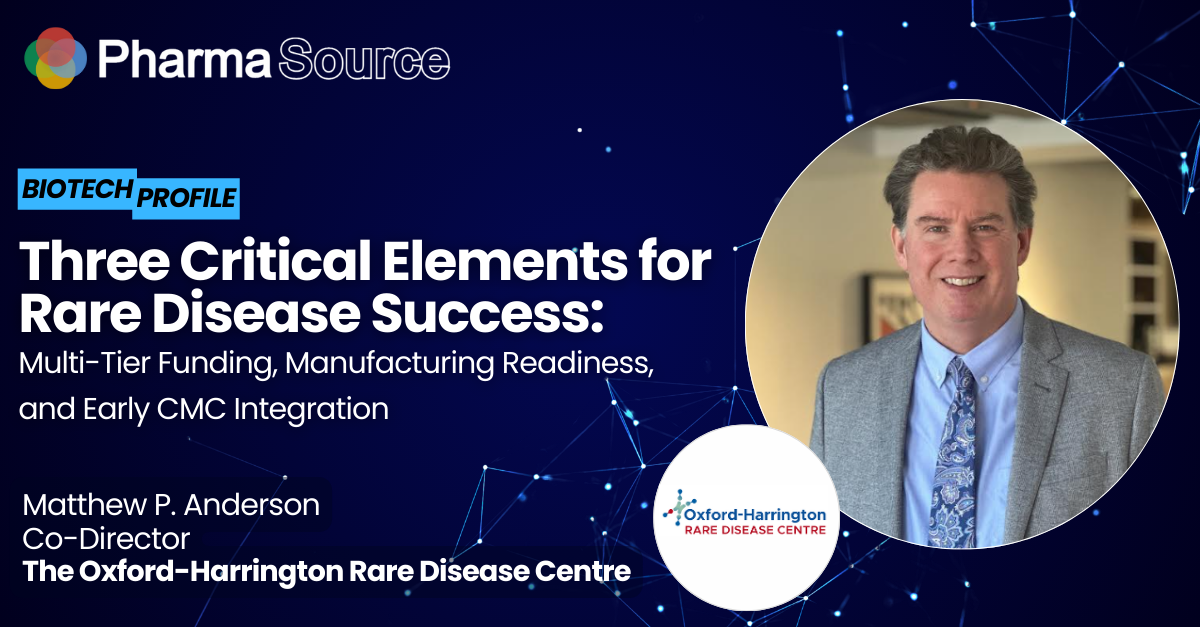
Oxford-Harrington Rare Disease Centre operates a transatlantic model that embeds industry expertise directly into academic rare disease programs. The partnership between University of Oxford and Harrington Discovery Institute has committed $250 million to address a market where 95% of 7,000 rare diseases lack approved treatments. Programs span neurological disorders, developmental and metabolic conditions, and rare cancers.
Embedding Industry Expertise in Academic Discovery
Founded in 2019, OHC operates from Oxford, UK and Cleveland, Ohio. The model combines Oxford’s 250 principal investigators working across 350 rare diseases with Harrington Discovery Institute’s decade of translational experience.
“We embed industry expertise directly into academia through our Scholar Award program, which provides a mini-biotech/pharma team to each Oxford-Harrington Scholar we support,” says Matthew Anderson, the Centre’s Co-Director. Each Scholar receives drug development, commercial strategy, and business development support.
The approach differs from traditional academic research. Philanthropic capital de-risks early-stage innovations before commercial partners enter. The Centre announced its second cohort of 10 Rare Disease Scholars in 2025, working on treatments for conditions affecting the brain, immune system, metabolism, and cancer using gene and RNA therapies, enzyme replacement, and targeted medicines.
Multi-Tier Funding Strategy
OHC’s funding extends beyond initial philanthropic awards. “We provide catalytic and investment capital to the most promising projects and spin-out companies, often partnering with industry to increase impact,” Anderson notes.
The model combines philanthropic partnerships—including Morgan Stanley GIFT Cures—with investment partners Oxford Science Enterprises and Advent Life Sciences. This structure supports projects through key milestones including IND-enabling studies and early clinical readiness, either through academia or venture-backed spinout companies.
Clinical Development Approach for Small Patient Populations
Rare disease trials present specific operational challenges: extremely small and geographically dispersed patient populations, limited natural history data, and highly tailored trial designs. Harrington’s Therapeutics Development Team addresses these by optimizing protocols, coordinating regulatory engagement, and designing natural history studies critical for first-in-human trials.
The team builds cases for partnerships that accelerate patient access. This systematic support addresses regulatory, clinical, and commercial requirements that typically slow academic projects.
Manufacturing Strategy: The Rare Therapies Launch Pad
Manufacturing readiness determines clinical translation success for gene and cell therapies. OHC collaborates with pharma, biotech accelerators, and specialized infrastructure to prepare therapies for this transition.
“We collaborate with pharma, biotech accelerators, and specialized infrastructure—most notably the Rare Therapies Launch Pad, a dedicated platform that supports the manufacturing of gene and cell therapies from early development through clinical scale,” Anderson explains.
The Rare Therapies Launch Pad allows OHC to:
- Evaluate scalability early in development
- Align with regulatory expectations before clinical trials
- Secure Chemistry, Manufacturing & Controls (CMC) pathways
This infrastructure addresses manufacturing challenges specific to rare disease gene and cell therapies, preventing bottlenecks that derail development timelines. Integration at early development stages ensures therapies meet safety, efficiency, and regulatory requirements before clinical translation.
Network Infrastructure
OHC’s operational model relies on collaboration across academic labs, pharma partners, governmental bodies, and advocacy groups. An Advisory Council of global leaders in science, policy, and philanthropy supports operations.
The network spans US and UK academic institutions, philanthropic organizations, and investment partners. This structure provides funding, expertise, and infrastructure needed to advance rare disease programs from discovery through clinical development.
Next 12-18 Months
OHC will expand its rare disease portfolio, advance multiple candidates to preclinical and early clinical inflection points, and deepen strategic partnerships with pharma and philanthropic organizations. The 2025 Scholar cohort expands therapeutic modalities and target conditions, supporting the goal of 40 drugs in clinical trials by 2034.
Key Takeaways for Biotech Founders
Anderson outlines three operational principles: “Build partnerships early, embrace flexibility, and keep patient impact at the center of every decision. By working with partners who understand the full translational journey, founders can move promising therapies from the lab to patients more efficiently and effectively.”
The OHC model demonstrates that translating science into medicine requires more than research capability. Success depends on collaborative ecosystems and early integration of development expertise across clinical, regulatory, and manufacturing pathways.