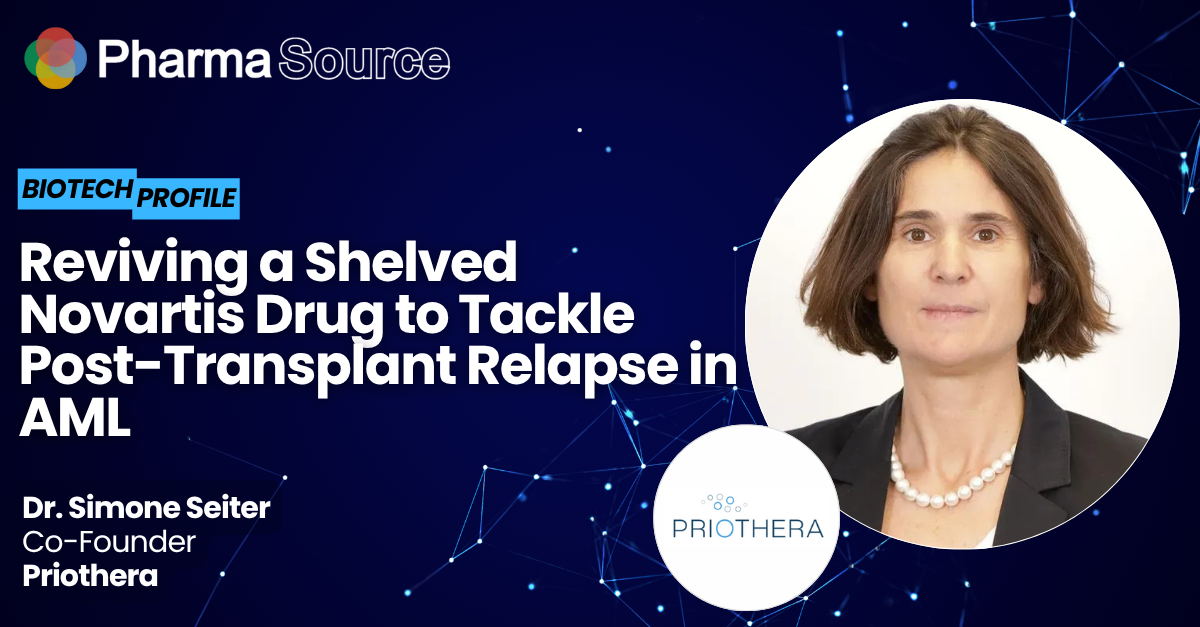
Irish biotech Priothera is advancing mocravimod, a non-immunosuppressive S1P receptor modulator that the founding team rescued from Novartis’ pipeline, now targeting improved survival outcomes for AML patients undergoing stem cell transplantation. Co-founder Dr. Simone Seiter outlines how strategic protocol amendments and a streamlined site selection approach have positioned the company for interim results by late 2026.
Rescuing Promise from Big Pharma Deprioritization
Founded in October 2020, Dublin-based Priothera represents a compelling case study in asset rescue and focused development. The company’s lead compound, mocravimod, originated at Novartis where it demonstrated strong efficacy in reducing graft-versus-host disease (GvHD) and improving survival after allogeneic stem cell transplantation (allo-HCT). Despite promising data, Novartis deprioritized the program in favor of another internal candidate, creating the opportunity for the original development team to spin out and continue the work.
Priothera targets a significant unmet need in acute myeloid leukemia (AML), where relapse and shortened survival after allo-HCT remain major challenges with limited post-transplant therapeutic options. The company’s approach positions them in a space with only one other Phase 3 program addressing this specific indication, highlighting both the opportunity and the technical challenges involved.
Differentiated Immunomodulation Strategy
Mocravimod’s mechanism of action sets it apart from conventional post-transplant therapies. As an S1P receptor modulator, it retains lymphocytes in lymphoid tissues, which minimizes GvHD while enhancing the beneficial graft-versus-leukemia (GvL) effect. This dual action represents a departure from traditional immunosuppressive approaches that often compromise anti-cancer immunity while attempting to control transplant complications.
“Mocravimod is a non-immunosuppressive immunomodulator that retains lymphocytes in lymphoid tissues—minimizing GvHD while enhancing the beneficial graft-versus-leukaemia (GvL) effect. Unlike conventional therapies, it avoids suppressing the immune system while supporting anti-cancer activity,” the company explains.
This positioning addresses a fundamental challenge in post-transplant care: balancing immune control to prevent GvHD against maintaining sufficient immune activity to prevent cancer relapse.
Navigating Phase 3 Complexity and Global Site Management
Priothera’s Phase 3 MOTRANS trial demonstrates the operational challenges inherent in rare disease development. The study required significant protocol modifications, including FDA-guided redesign to incorporate two dose levels, which increased patient enrollment requirements by 30%. The company initially planned to open 110 sites across 14 countries during the COVID-19 pandemic, presenting logistical complexities that required strategic adaptation.
The company has since streamlined its approach, focusing resources on high-enrolling sites and implementing multiple protocol amendments to optimize study execution. This pragmatic approach to site management reflects broader industry trends toward efficiency and quality over geographic breadth in clinical trial design.
Early blinded data from the ongoing trial are described as “very encouraging/promising,” though the company maintains that full enrollment will complete in 2027, with primary results expected by Q4 2028. An interim safety and efficacy analysis is targeted for late 2026/early 2027, providing a potential inflection point for the program.
Manufacturing Strategy: Leveraging Established CDMO Partners
Priothera has adopted a fully outsourced manufacturing approach, partnering with established CDMOs for different aspects of production. EuroAPI in Hungary handles active pharmaceutical ingredient (API) production, while Almac in Northern Ireland manages drug product manufacturing. Both partners operate under GMP conditions and are positioned to support commercial-scale production.
The manufacturing strategy addresses specific technical challenges inherent in mocravimod’s complex synthesis. EuroAPI has developed what the company describes as a viable commercial process for the API, while Almac has demonstrated consistent manufacturing capabilities despite the compound’s high potency and correspondingly low dosage requirements.
A significant advantage in Priothera’s manufacturing profile is mocravimod’s stability characteristics. The molecule demonstrates high stability and extended shelf life, which simplifies storage requirements and distribution logistics—particularly important for a specialized oncology product that may require global distribution to transplant centers.
“The molecule is highly stable and it has a long shelf life. This simplifies storage and logistics,” the company notes, highlighting an often-overlooked advantage in specialty pharmaceutical development.
Financial Strategy and Rare Disease Funding Challenges
Priothera’s funding approach illustrates both the opportunities and constraints in rare disease financing. The company has raised €33M in Series A funding and secured €17.5M from the European Investment Bank, demonstrating access to both private and institutional capital sources. A €44M+ Series B round is currently in progress, with targeted closure in Q4 2025.
The funding strategy reflects the particular challenges of rare disease development, where limited early-stage data can complicate investor evaluation. The company acknowledges that jumping directly from Phase 1b/2a into Phase 3 development, while possible in rare diseases, creates funding complexities that require careful financial planning and investor education.
Strategic Partnerships and Clinical Network Development
Priothera’s clinical execution relies on a network of specialized partnerships that extend beyond traditional CDMO relationships. The company works with ALAN, a global network of patient organizations, and maintains collaborations with academic institutions including the University of Hokkaido. In the UK, partnership with Accelerating Clinical Trials (ACT Ltd), a regional haemato-oncology research organization, provides access to the IMPACT network for patient recruitment in transplant studies.
These partnerships reflect the specialized nature of stem cell transplantation, where clinical expertise is concentrated in specific centers and patient populations require careful coordination across multiple stakeholders. The company notes strong support from investigators and clinical sites, including those that participated in the original Novartis-sponsored studies, providing continuity of clinical experience and institutional memory.
Regulatory Strategy and Early Engagement
Priothera’s regulatory approach emphasizes early and frequent engagement with authorities, particularly given the complexity of designing trials in the post-transplant setting. The company’s experience with FDA-guided protocol modifications demonstrates both the challenges and benefits of proactive regulatory dialogue.
The two-dose design requirement, while increasing study complexity and patient numbers, reflects regulatory guidance aimed at optimizing the risk-benefit profile for this patient population. This regulatory input has shaped not only trial design but also the company’s development timeline and resource requirements.
Lessons in Rare Disease Development
Priothera’s experience offers several practical insights for biotechs navigating similar development challenges. The company emphasizes that jumping from early-phase studies directly to Phase 3 is possible in rare diseases but requires exceptional operational flexibility and planning.
“Limited early data can make funding harder, so financial planning is crucial. Success depends on an experienced, resilient team ready to navigate unexpected challenges,” the company observes, highlighting the importance of team composition in rare disease development.
The company also stresses the value of regulatory engagement, noting that regulators should be viewed as allies rather than obstacles in the development process. This perspective reflects a broader industry trend toward collaborative regulatory relationships, particularly in areas of high unmet medical need.
“Engage early with regulators—they’re allies. Be ambitious but grounded in your planning. Stay persistent and build a team that thrives on solving problems together,” the company advises.