The global prefilled syringe (PFS) market will grow from $9.5 billion in 2026 to $18.1 billion by 2033, a compound annual growth rate of 9.7%, according to Grand View Research’s latest analysis of the sector. The market was valued at $8.7 billion in 2025. Europe holds the largest regional share, at 37.1% of 2025 revenue, while Asia Pacific is forecast to grow fastest through 2033.
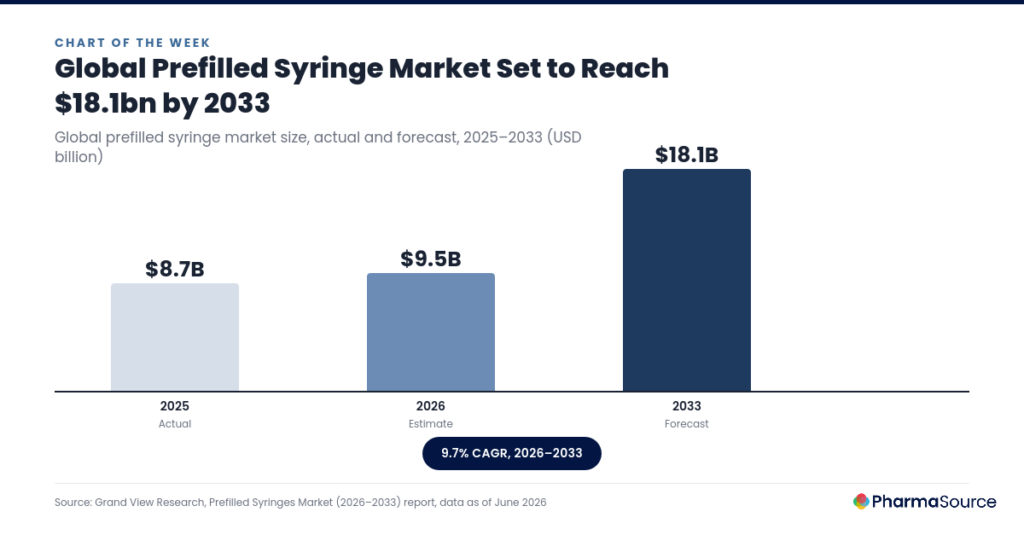
Source: Grand View Research, Prefilled Syringes Market (2026–2033), data as of June 2026.
Disposable syringes accounted for 95.6% of 2025 revenue, with reusable syringes, used for chronic conditions such as hormone therapy, forecast to grow faster, at a 7.0% CAGR. Glass held the largest share by material, valued for its compatibility with sensitive biologics, while plastic syringes made from cyclic olefin polymer are the fastest-growing material segment, driven partly by aesthetic medicine applications such as hyaluronic acid and botulinum toxin injectables.
By application, vaccines and immunizations held the largest 2025 revenue share, while autoimmune disease treatment is forecast to grow fastest as biologic therapies expand. Hospitals remain the largest distribution channel, but mail order pharmacies are growing fastest as chronic-disease patients increasingly receive injectable medicines at home.
What’s Driving Growth
Four forces sit behind that trajectory.
Biologics and biosimilars. More monoclonal antibodies and chronic-disease therapies are moving toward fixed-dose, subcutaneous administration, making the syringe and delivery system an increasingly important part of the product itself rather than just its packaging.
Home administration. GLP-1 therapies are the clearest recent example of how quickly demand for self-administered injectables can scale, and the same shift is playing out more broadly across biologics as treatment moves outside the clinical setting and into patients’ homes.
More demanding devices. More concentrated biologics are pushing demand toward larger-volume formats, including 2.25mL syringes, along with low-friction systems and platforms built to work with autoinjectors, adding technical complexity on top of rising volumes.
Ready-to-administer care. For hospitals, prefilled formats mean fewer preparation steps, less opportunity for error, and less drug wastage than manually drawing doses from vials.
Manufacturing Implications
Siegfried is expanding fill-finish capacity at its Hameln site in Germany, adding two new manufacturing lines for prefilled syringes and cartridges, with the first coming online in 2026 and the second in 2027.
It isn’t alone. BD has committed $110 million to US prefillable-syringe manufacturing, citing demand from biologics and GLP-1 drug delivery, and SCHOTT Pharma is building a $371 million prefillable-syringe facility in Wilson, North Carolina, pointing to the same drivers.
That capacity has to translate into validated commercial supply, and that’s where the harder part of the work sits. Getting a prefilled syringe product from development onto a commercial line means transferring process, analytical, and product knowledge between sites and, increasingly, between manufacturing partners — all under Annex 1’s tightened requirements for European sterile fill-finish sites. A format that looks straightforward on paper can expose viscosity, fill-mechanics, or documentation gaps that weren’t visible during development.
Where Tech Transfers Go Wrong
That gap between development and commercial PFS supply is the subject of a live webinar on September 24, hosted by PharmaSource with Siegfried and SKAN. Jens Klein and Katrin Solmsdorff of Siegfried, alongside Thomas Zinn of SKAN, will walk through where PFS tech transfer projects run into difficulty, what a successful transfer looks like, how to compress transfer timelines without cutting corners, and what Annex 1 means in practice for teams moving products into commercial fill-finish. The panel will also address the shift from global to regional sterile-manufacturing sourcing, and the geopolitical considerations increasingly factoring into CDMO selection.