The Evolving CDMO Landscape
The expectations placed on CDMOs have evolved dramatically over the past decade. Fifteen years ago, most contract manufacturers were viewed primarily as capacity providers. Sponsors approached them because they needed manufacturing expertise or additional capacity—essentially a transactional relationship of “here’s our process, here’s our batch, help us get it made.”
That model has fundamentally shifted. Today, CDMOs aren’t just filling capacity gaps. They are being asked to serve as strategic partners, which means deeper collaboration, more specialized manufacturing, and in many cases, shared risk and accountability.
With this shift toward strategic partnerships, the expectations on CDMOs have reached unprecedented levels. Sponsors now evaluate potential partners beyond their ability to simply make product—they’re examining how that product is made. Recent industry research from firms like Accenture confirms that sponsors are gravitating toward contract manufacturers who demonstrate digital strength. They’re looking for systems that are connected, compliant, and able to scale without friction.
Digital maturity has become a baseline expectation in many conversations and is increasingly serving as a deciding factor in the vendor selection process.
Current State of Digital Transformation
The Survey Landscape
The research drew from a global sample of CDMOs with facilities across multiple continents and a broad range of revenue levels, from smaller startups to larger global enterprises.
Key Goals Driving Digital Investment
Before examining the current state of maturity, the research identified the top goals driving digital transformation investment among CDMOs:
- End-to-end traceability – This stands out as the primary objective
- Automation with batch records and real-time validation
- Workflow automation and scalability
These priorities reveal common themes around automation and greater visibility into data and real-time processes—fundamental aspects of digital maturity that represent the North Star for more flexible, agile, and proactive operations.
The Maturity Spectrum
The research presented a maturity spectrum ranging from:
- Manual: Most or all processes and manufacturing facilities operating on paper
- Emerging: Some digital systems in place, perhaps some lines digitized but not all
- Connected/Integrated: Significant digitization with systems beginning to communicate
- Intelligent: Everything connected and automated with AI maturity across facilities
Unsurprisingly, very few organizations claim to be at the “intelligent” level. Most CDMOs remain in the early stages, with a significant portion still operating manually and the majority falling into the “emerging” category with limited digitization and only some connectivity between systems.
A foundational challenge this state presents is a lack of data connectivity to inform critical decisions—a major pain point as organizations work toward that end-to-end traceability goal.
System Implementation Status
When asked which systems their companies currently have in place, the results revealed interesting patterns:
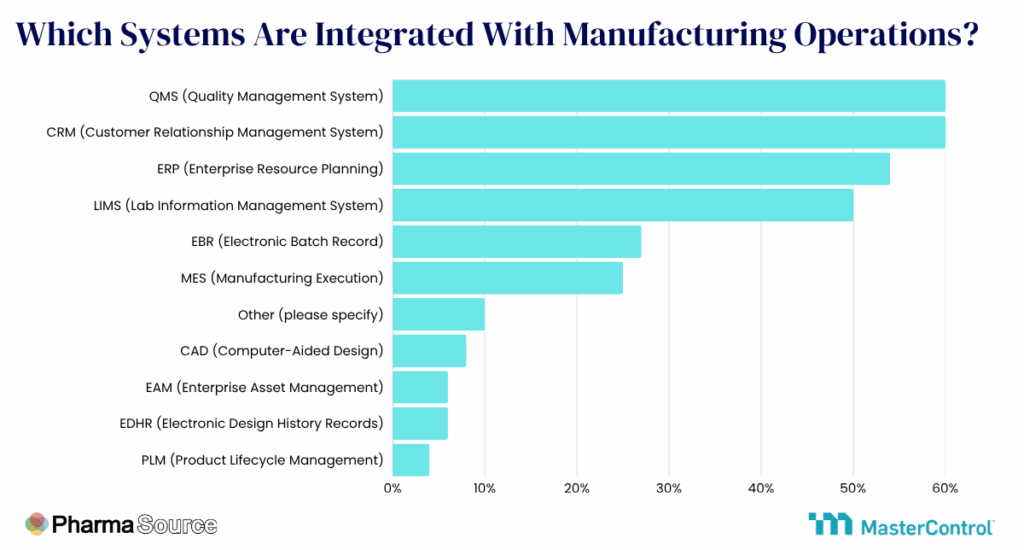
Most Digitized Systems (>50% adoption):
- Quality Management Systems (QMS) – with the highest adoption, even if in basic formats like paper-on-glass, SharePoint, or Excel spreadsheets
- Customer Relationship Management (CRM) systems
- Enterprise Resource Planning (ERP) systems
Least Digitized Systems (<50% adoption):
- Electronic Batch Records (EBR)
- Manufacturing Execution Systems (MES)
- Electronic Technical Records (ETR)
This disparity paints a telling picture: manufacturing facilities are significantly less likely to have digitized their production-related systems. Organizations appear to prioritize digitizing quality documentation, training, and quality events before tackling production records.
Success Factors and Barriers
What Drives Success
For organizations that have achieved “connected” or “integrated” status—perhaps implementing MES across multiple sites or lines—several common success factors emerged:
- Strategic system integration: A deliberate, planned approach to connecting systems
- Continuous improvement mindset: An organizational culture that embraces ongoing evolution
- Demonstrated ROI: The ability to showcase return on investment for digital initiatives
- AI foundation establishment: Laying groundwork for AI through broad governance and cross-functional use cases
These themes point to an underlying cultural mindset shift across successful organizations. Everyone must be committed to making digital transformation work. This also requires shifts in staffing, with teams becoming more adept at operating in modern, digital environments that look fundamentally different from legacy operations.
Common Barriers
On the other side, several barriers prevent organizations from achieving their digital maturity goals:
- Resource constraints: The inability to prioritize digitization initiatives, or simply lacking the resources to implement them
- Legacy infrastructure and processes: The overwhelming nature of having to modernize entire facilities, or dealing with outdated equipment
- Lack of clear prioritization: Difficulty determining where to focus limited resources
Resource constraints manifest across multiple aspects of manufacturing facilities, standing out as the core barrier preventing the transition from paper-based processes to more connected digital ecosystems.
AI Adoption: Current State and Future Outlook
The AI Maturity Curve
Beyond overall digital maturity, the research examined AI adoption specifically. The industry as a whole appears to feel pressure—whether from sponsors or competitive positioning—to evaluate, implement, and adopt AI as a demonstration of innovation and forward-thinking operations.
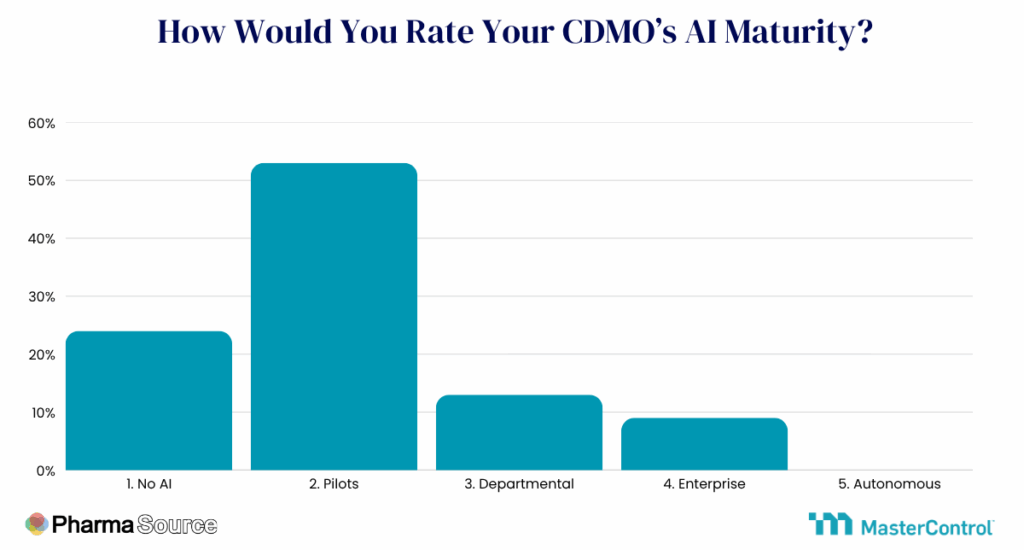
The AI maturity curve closely mirrors the broader digital maturity picture: most organizations are either not yet engaging with AI or are in the early days of pilot projects. Very few have achieved broad implementation approaching “intelligent” operations.
This early-stage positioning isn’t necessarily negative. Starting small with pilot projects allows organizations to determine what works and what doesn’t, while conducting due diligence and laying governance groundwork across departments.
Why Pilots Haven’t Progressed
Common reasons for organizations remaining at the pilot stage align closely with limited digital maturity:
- AI isn’t an organizational priority: Other initiatives take precedence
- Recognition that modern systems are prerequisites: Many organizations acknowledge that their lack of modern systems preventing digitization also blocks meaningful AI implementation
Encouragingly, respondents recognized that establishing core systems and building the necessary data foundation represents step one, before making significant time and money investments in AI. This suggests thoughtful prioritization rather than rushing to adopt AI for its own sake.
AI Adoption Success Factors
The approximately 20% of organizations showing more progress with AI adoption—achieving limited enterprise AI integration—shared several common characteristics:
- Practical use case identification: Moving beyond general tools like ChatGPT, Gemini, or Claude to focus on task-oriented agents or co-pilot-style assistance for specific functions
- Focus on data architecture: Recognizing that quality data infrastructure is critical for AI to deliver value
- Commercial use case success: Early wins in areas like content creation, sales planning, and communication
Notably, while the research focused on manufacturing operations, many organizations reported their most successful AI implementations have been in commercial functions rather than on the production floor.
The Reality Check: AI Timeline and Investment
The industry remains far from AI-driven autonomous operations, and the research confirms this is likely appropriate. Organizations should approach AI implementation intentionally, taking measured steps and ensuring governance, validation, and regulatory alignment before full deployment.
External research reinforces this cautious approach. A recent Gartner study reported that 40% of AI projects will be cancelled by 2027 due to escalating costs, weak business value, or insufficient risk controls. This represents substantial wasted investment.
The market appears to be shifting from vague or general pilots toward much more specific use cases that can deliver more direct ROI—those task-assistant applications mentioned earlier.
When asked when they expect AI to achieve significant value for their operations, most survey respondents indicated three or more years. This aligns with their current early adoption status and suggests realistic expectations. While the AI landscape evolves rapidly, organizations are looking further out for genuine return on investment.
Once again, resources emerge as the primary barrier: time, money, and the cost of implementation continue to challenge more mature AI adoption. This returns to the fundamental question of prioritization—where to invest limited digital transformation resources—with the recommendation being to ensure digital systems are implemented well and adopted broadly across the organization, creating the data foundation that will enable robust and meaningful AI capabilities three to five years from now.
Sponsor Expectations: The Growing Gap
Rising Digital Requirements
The research brings the conversation full circle to sponsor expectations. Earlier sections discussed how sponsors gravitate toward CDMOs demonstrating real digital maturity, and the research data strongly reinforces this trend.
92% of respondents reported that digital capabilities are increasingly part of sponsor conversations. These are no longer add-on features or nice-to-haves. Digital maturity has become part of the baseline assumption in CDMO partnerships—an important consideration as organizations think about projects to pursue and how to approach digital transformation.
What Sponsors Actually Expect
Sponsor expectations directly extend the shift from capacity providers to strategic partners:
- Speed and reliability: Sponsors expect CDMO partners to move rapidly and help keep programs on track, with consistency, visibility, and rapid responsiveness to needs
- Flexibility within complexity: As products become more complex, sponsors expect contract manufacturing partners to maintain quality while remaining flexible enough to shift between programs or scale activities as needs evolve—reliability combined with adaptability and minimal friction
- Extension of internal teams: Sponsors want partners providing real-time visibility, technical guidance, and insights that help anticipate issues before they occur
These expectations reveal that digital maturity transcends operational efficiency—it has become a competitive differentiator and signals that an organization is a forward-thinking, innovative partner.
The Integration Gap
Despite rising expectations, a significant gap exists in current practice. According to the research, only about one-third of CDMOs report any automated data exchange or shared portal with their sponsors. For the remaining two-thirds, connectivity is either absent or limited, relying on manual data transfer, PDF reports, or batch summaries that provide visibility only after the fact.
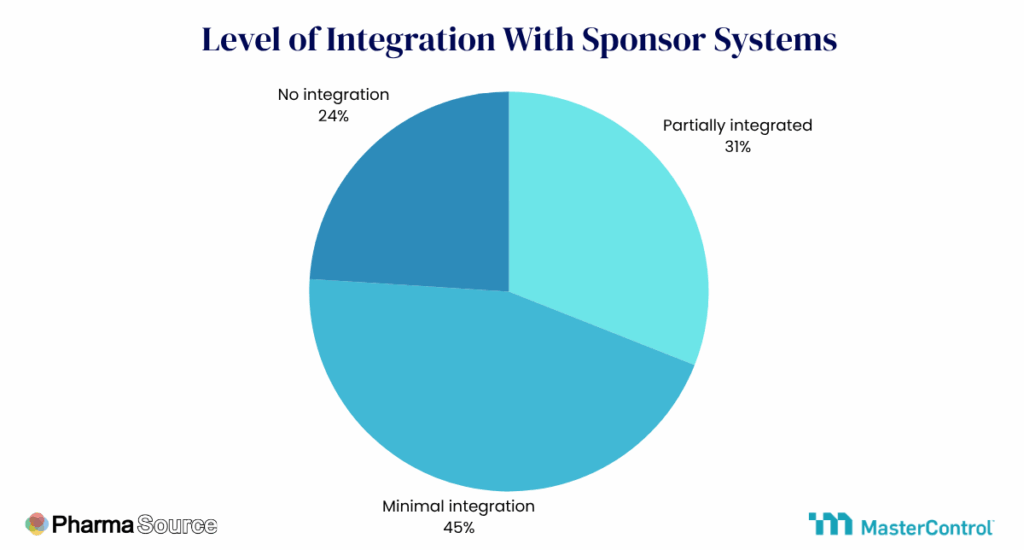
This creates real tension: sponsors want real-time visibility, but most contract manufacturing partners aren’t yet equipped to deliver it. However, this also presents a clear opportunity—organizations that can provide real-time sponsor visibility will stand out significantly from the competition.
Strategic Priorities for Building Digital Maturity
The Mindset Foundation
One theme emerged loud and clear from the research: successful digital transformation depends as much on organizational mindset and culture as on technology itself. Digital systems alone will not solve problems. To develop lasting change, organizations must:
- Get people on board
- Fix underlying process issues before layering on digital solutions
- Build solid foundations that allow digital investments (including AI) to deliver real value rather than adding noise to already broken systems
Five Strategic Priorities
With the proper mindset established, organizations should consider these five strategic priorities:
1. Build the Foundation Before Chasing AI
AI is powerful, but it cannot compensate for weak data or broken processes. Organizations must invest energy in stability and structure before pursuing the latest AI trends. Critically, data must be unlocked before AI tools can generate meaningful value.
2. Target Implementation Gaps with Proven ROI
Rather than broad, unfocused transformation efforts, focus on areas where digital maturity can drive measurable impact. This might mean starting with one small area, securing a quick win, and then expanding from that success.
3. Fix Processes Before Digitizing
This principle is crucial: if a process doesn’t work manually, making it electronic won’t fix it. Organizations must stabilize first, build foundations second, digitize third, and deploy AI fourth. This ensures that each layer builds on solid ground rather than automating dysfunction.
4. Solve the Sponsor Integration Problem
Research revealed that sponsor expectations around transparency and connected systems currently exceed CDMO capabilities. Finding technology partners who can help bridge this gap will become increasingly strategic for organizations seeking to win in a digital environment.
5. Deploy Resources with Precision
Digital maturity isn’t about doing everything simultaneously. It’s about examining what has already been accomplished, connecting systems, adding new ones strategically, and building resilience over time.
The Continuous Journey
Digital transformation has no finish line. It’s not a project to complete but an iterative, layered process that builds on existing systems as much as new ones.
Rather than viewing legacy infrastructure as purely a barrier, organizations should ask: What have we already accomplished? Where do we have islands of automation or digitization? How can we build connective tissue between them?
Almost no company starts from zero—everyone uses email and likely other digital tools. The most successful organizations invest in fundamentals, building thoughtfully and maturing with purpose.
Conclusion
The path forward requires starting now to lay groundwork for tomorrow’s capabilities. While the gap between sponsor expectations and CDMO capabilities is real and growing, it also represents a significant opportunity for organizations willing to approach digital transformation strategically.
Success will come to those who recognize that technology alone isn’t the answer—that cultural change, process improvement, and thoughtful implementation must come first. By building on these foundations, CDMOs can close the digital divide and position themselves as the strategic partners sponsors increasingly demand.