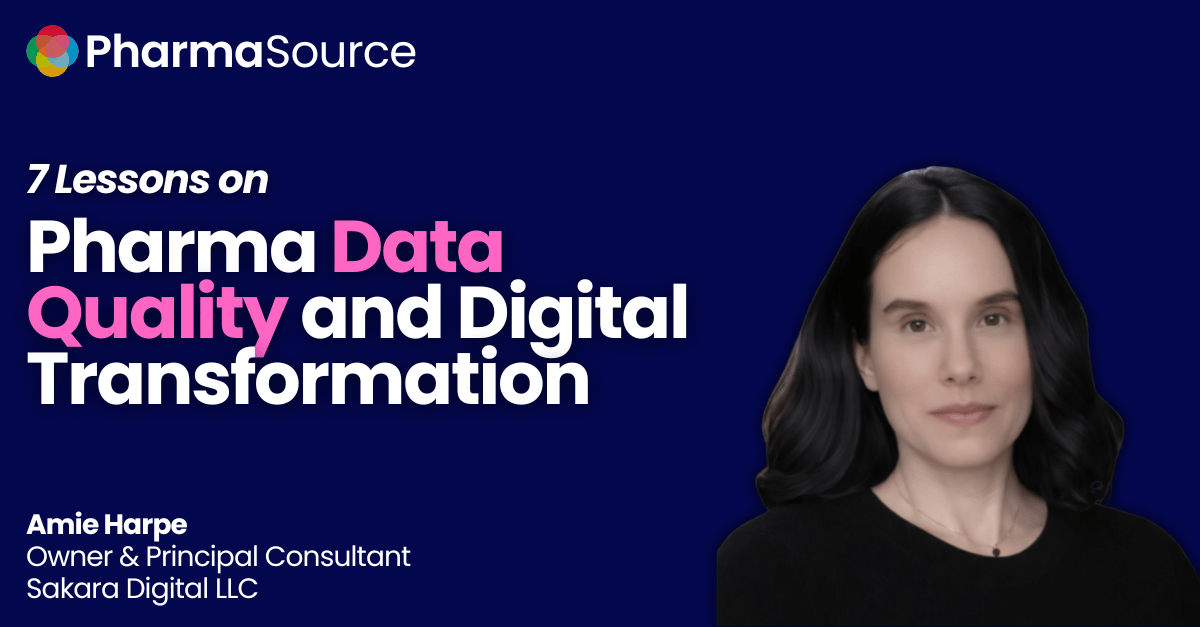
“If the data you give it is weak, the model becomes a liability rather than an asset. In regulated industries, that’s not just a technical failure; it’s potentially a compliance and an ethical failure as well,” says Amie Harpe.
Amie Harpe spent 23 years at Pfizer’s global IT organization, leading quality and manufacturing systems programs worth up to $40 million across 65 manufacturing sites worldwide. She’s now the founder of Sakara Digital, a boutique consultancy helping pharma and biotech organizations get more value from digital transformation, with a focus on quality management systems, pharma data quality, and AI readiness.
In a recent PharmaSource podcast episode, Amie explains why pharma’s digital transformation gap persists and what separates organizations that get lasting value from their technology investments from those that don’t.
Quality Systems are Pharma’s Unglamorous Backbone
Document management, learning management, complaints, deviations, and change control rarely make headlines, but Amie argues they’re what keep a manufacturing operation running, not to mention what regulators look at first.
“Quality is really the backbone of everything in pharma,” she says. “You could have the most innovative molecule in the world, but if you can’t manufacture it consistently, document it properly, and improve compliance, it will not get to the patients.”
Manufacturing professionals use these systems daily, and when they’re clunky or manual, the consequences compound. As Amie puts it, “clunky systems can create the conditions for human errors, and I think that’s the more important impact to keep in mind: inconsistent documentation and missteps. Those are exactly the kind of things that can become a regulatory finding when an auditor walks in the door.” Auditors, she notes, typically start by asking for deviation trends, CAPA closures, and change control documentation, so weaknesses there surface immediately.
Why Pharma’s Digital Transformation Lags
Pharma is known for scientific innovation but often criticized for lagging on digital transformation. Amie points to three intertwined causes.
First is system entanglement: “Replacing a document management system in pharma isn’t like swapping out a project management tool. It’s connected to training records, to SOPs, to regulatory submissions, and to manufacturing execution systems.” When a system has been integrated for 15 years, the cost and complexity of replacing it grows enormous.
Second is resource competition. Pharma companies have large technology portfolios and limited budgets, so governance processes exist to prioritize which digital initiatives get funded, meaning even valuable ideas often wait their turn.
Third, and the one Amie says gets overlooked, is the human pace of change. In a validated manufacturing environment, introducing too much technology change too quickly can raise error rates and lower confidence. “The good organizations pace change deliberately,” she says, “not because they’re resistant to progress, but because they’re protecting the ability of their staff, their workforce, to do the job well. From the outside, that can look like inertia or hesitancy. But from the inside, it’s a real constraint that leaders have to manage.”
The Hidden, Compounding Cost of Poor Data Quality
Data quality problems in pharma rarely announce themselves dramatically, Amie says — they show up as slow, quiet costs. A deviation record with three or four possible product codes across systems. A quality analyst spending hours reconciling change controls, ERP data, and batch records. A regulatory affairs team discovering that product names don’t match between the document management system and the registration database.
“It can manifest in a meeting where you spend the first 30 minutes trying to decide whose numbers are right instead of actually getting to make a decision,” she says.
The scale of the problem is bigger than most organizations realize. Amie cites industry research showing that up to 25% of quality issues and 90% of product recalls are linked to human error, often driven by manual data entry mistakes and inconsistent data. “This isn’t a small issue,” she says. “It stays quiet until it becomes a key operational risk in the industry.”
Acquisitions are Where Data Fragmentation Compounds Fastest
Frequent M&A activity is common in pharma, and Amie, who lived through it repeatedly at Pfizer, says data harmonization is usually the piece that gets deferred. Acquired companies typically get folded into corporate platforms and processes on an aggressive timeline, often 18 to 24 months, but the underlying data rarely gets reconciled in that window.
“I’ve seen companies with the same raw material registered under four or five different names across different sites because each legacy system and legacy company had its own conventions,” she says. Each new acquisition adds another layer of disparity, and the effects show up later in broken cross-site benchmarking and, increasingly, in AI models that can’t learn.
For example, building a predictive model for manufacturing deviations across 40 sites, where one site categorizes equipment failure into 15 specific codes and another site uses a completely different scheme. “The model can’t really learn patterns across the data because the underlying categories just aren’t the same thing,” Amie explains. Her recommended fix is to make data integration a standing part of the acquisition playbook, backed by a data governance committee and factored into budgets and timelines from the start.
Data Quality is The Real Foundation of AI Readiness
Amie explains where AI projects often fail. “AI, in any industry, rarely fails because the AI models are weak,” she says. “It often fails because the data foundations and the organizational behaviors surrounding the data are fragile.” AI models can reconcile superficial differences — “mg” versus “milligrams” — but not fundamentally different underlying categorizations.
That has a strategic implication, in her view: the models themselves are increasingly commoditized, since organizations can license algorithms and adopt open-source frameworks. “What cannot be commoditized is the proprietary, high-quality, well-governed data that pharma organizations generate. That’s where you can really get a true competitive advantage — and it’s also the most common point of failure when things go wrong.”
She points to the ALCOA principles — data that is attributable, legible, contemporaneous, original, and accurate — as the foundation for getting meaningful results from analytics and AI. For more on the topic, PharmaSource’s report on digital manufacturing trends similarly identifies data quality and silo issues as one of the industry’s biggest barriers to digital manufacturing.
Amie has published a series of posts on the Sakara Digital blog exploring data quality and AI readiness in more depth, including A Roadmap for AI Readiness in Pharma, Why 95% of Pharma AI Projects Fail, and Choosing the Right Data Governance Model.
Closing the Adoption Gap with Digital Adoption Solutions
Even well-designed systems fail to deliver value if people don’t know how to use them, Amie says, and that’s where digital adoption solutions come in. She describes them as “like a coach or guide that lives inside the software you’re already using,” offering step-by-step, in-context guidance instead of relying on training people received months earlier.
“Adoption of a solution is a process” rather than a one-time event, she says, and treating it otherwise is “a design problem,” not a people problem. The scale of the gap is striking: research from digital adoption platform providers found that users typically work with only about 40% of the features available in enterprise software, largely because they’re undertrained or simply forget the rest. With billions spent on enterprise software deployments, Amie argues that’s a significant amount of value left on the table. One that in-app guidance, step-by-step prompts, and real-time data validation can help recover, while also reducing errors and improving compliance readiness.
Where AI Delivers Real Value in Pharma Today
Asked where AI has the most realistic near-term impact on pharma quality and manufacturing, Amie names three areas all achievable with current technology.
The first is continuous trending and signal detection. Where organizations today do periodic, often quarterly, trend reviews, AI can monitor continuously and flag issues early. For example, an alert that a certain deviation type has risen 40% over 60 days, before it becomes systemic.
The second is document review and authoring assistance. AI tools can produce a comprehensive, GxP-ready draft procedure from a two- or three-sentence prompt in five to seven minutes, and check new documents for consistency against existing standards.
The third, and the one she’s most excited about, is agentic AI. Systems that can decide the next step in a process on their own. “That could mean an agent that triages incoming complaints, classifies them, and pulls in the relevant history related to the lot of the product that’s been reported on… so by the time the quality analyst opens it, half the work is done already,” she says. The technology exists, but adoption depends on the same data readiness and governance challenges she’s described throughout the conversation.
Career Advice: Don’t Boil the Ocean, and Listen First
Asked what advice she’d give her younger self, Amie offers two lessons shaped by two decades managing technology change in a regulated environment. The first: resist trying to do everything at once. Early in her career, she was part of programs that combined global rollouts, process harmonization, data migration, and custom reporting into single big-bang implementations. “The most successful implementations I’ve been part of were ones that broke it into phases… got some early wins… and could expand from there,” she says.
The second is the value of listening before proposing change, drawn from Stephen Covey’s principle of “seek first to understand, then to be understood.” Before introducing a new system or process at a site, Amie says the priority should be understanding what people’s day-to-day work actually looks like and what they’re worried about, not leading with the business case. “Once you’ve heard them and they feel like they’ve been heard, you can start asking them to make the change,” she says. That groundwork, she argues, is what turns stakeholders into champions of an initiative rather than reluctant adopters of it.