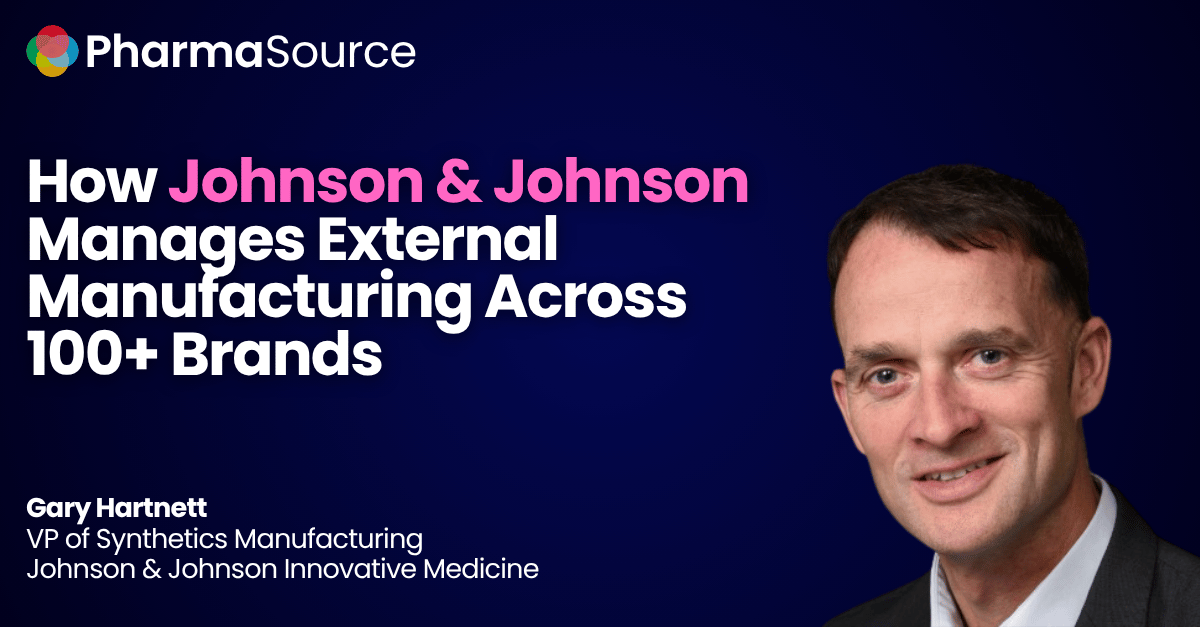
“We’ve fallen in love a lot more with our full supply chain going all the way back to the sub-tier suppliers,” says Gary Hartnett, reflecting on how COVID-era shortages permanently changed the way one of the world’s largest pharma companies thinks about risk.
Gary Hartnett, VP of Synthetics Manufacturing at Johnson & Johnson Innovative Medicine, leads the company’s synthetics platform, spanning internal API and drug product sites as well as a global network of external partners. In the latest PharmaSource podcast episode, Gary explains how J&J designs resilience into its external manufacturing network.
Design Resilience from Launch
Gary describes the in-house versus outsource decision at J&J as “a complex formula” shaped by product type, technology maturity, and whether the capability already exists in the network. The key principle being supply chains are designed for the full product life cycle, not just launch.
“We would build resilience in at the start, so that would mean that we would normally launch a product internally, but we would also make sure that we have an external node or a second node to be able to manufacture that product from the beginning. And then as that product develops through its life cycle, you may add more nodes, depending on the agility and resilience you want.”
That structure evolves as products mature: “Maybe as you go towards your late stage, then you may decide that you want to just allocate that to one node, depending on the volumes and requirements, and that might be an external. So in general, we really try to keep a healthy mix between internally manufactured and externally manufactured to drive the right structural design in our supply chain, so that we can actually manage that product right throughout its full life cycle, which can be for fifteen, twenty-plus years.”
Internal Investment Doesn’t Mean the End of Outsourcing
J&J has made headlines with major internal capacity announcements, including an investment in the US reported at $55 billion, with a new biomanufacturing facility in North Carolina. Gary explains that this reflects growth, not a retreat from external manufacturing or a wholesale regionalization of the network.
“We’ve announced a significant investment in North Carolina more recently in our biotherapeutics platform, and the reason for that is very much capacity driven. We have some new biologics products. US is one of our biggest markets, and it makes sense for us in the balance of our supply chain and business. But we’re also doing targeted investments across the globe that maybe just don’t get the headlines.”
Asked whether the industry-wide push toward regional “US-for-US, EU-for-EU” supply chains has changed how J&J structures external partnerships, his answers: “Not really, to be blunt about it. I would say it has challenged us in different ways.”
J&J’s global nodes have always served both their home region and world markets, he explains: “There’s a trade-off between agility and cost competitiveness when you’re making those decisions. So it’s always about trade-off decisions.”
Beyond Tier One: Mapping the Supply Chain Down to Tier Four
Where COVID did change J&J’s approach was upstream — in the layers of the supply chain beneath its direct suppliers.
“COVID taught us a little bit more to go beyond what I would call the tier one supplier down to the tier two, tier three, and tier four,” Gary says. “If I have a raw material, that raw material is made by somebody else, and then there’s another ingredient, and another ingredient and another ingredient. But sometimes what you find is that all of them go back to one supplier. One supplier in the world. So even though you might have all of this duality and resilience further up your supply chain, you could be in a lot of trouble from the business continuity perspective if there was a failure from that particular node or supplier.”
The mapping exercise required (and got) genuine collaboration from external partners: “When we spoke to our partners about it, we actually got a lot of transparency with those sub-tier suppliers. Getting the data was really eye-opening for us, because when we put those into databases, and we actually started to do some risk analysis of it to understand where our threats were and where our risks are, it presented an opportunity for us to improve on it.”
The scale of the task is significant. J&J has more than 100 brands in its portfolio, each with its own complex ingredient tree. The team segmented its critical brands first and has now worked through more than 50% of them, reducing risk scores significantly on those completed, with the rest still in progress.
Minimize risk before you mitigate it
The sub-tier data feeds a structured risk-scoring process at the brand level. Generic ingredients with multiple qualified suppliers might score medium; bespoke, custom-specification ingredients rate highest. When a brand’s aggregate score moves into the red zone, it triggers prioritized investment and action.
Gary describes a hierarchy of responses that goes beyond simply finding a second source:
“You mightn’t be able to eliminate the risk, but you can minimize the risk before you mitigate the risk. So minimizing the risk might be, for example, we keep more inventory for a period of time, and/or you might do a certain arrangement with the supplier in terms of holding inventory for us, or we might actually convert more of the ingredient into API and keep more of that stock of API if it’s a vulnerability, while we’re working on addressing the upstream challenges.”
“Of course, you can never have zero risk in a supply chain in a business, but we’re reducing it to what we establish as a tolerable level.”
Choose partners on shared values
When evaluating CDMOs, Gary’s criteria start well before technical capability.
“Number one, I think it has to be rooted in laying the right foundations. And that might have to do with shared values, clarity around objectives, open communication. Does that partner have the same focus on safety and quality culture that we have as an organization? Are they an innovative company? There are things you can do when you’re working with that partner to try and understand where their values are, because sometimes it doesn’t always show up on a PowerPoint slide.”
That philosophy is anchored in the company’s founding document: “Our credo is our mantra that we’ve had since 1943, which is really our mission statement. And one of those statements in the document written in 1943 by Robert Wood Johnson really states that our partners and suppliers need to make a fair income. Their success is also our success, and I think that’s the only way to really do business.”
Relationships are then built deliberately, in stages: “We will normally be thoughtful about how we construct a commercial arrangement so that we test each other out for a period. And then if we really are a good match, like in any relationship, then we might become more committed and deeper with each other.”
Transactional contracts to strategic alliances
Gary is candid about the pressures CDMOs face from the other side of the table.
“If you’re a CDMO, your business may be made up of 50, 60 different customers. So you have 50, 60 different Garys coming in saying, ‘This is what I want you to do for me. This is how I want you to make it, and these are the standards I want you to apply.'”
Speed-to-market pressure is creating a new capacity dilemma, as sponsors try to reserve slots for products still in the clinic: “I need to book 50 slots, but I want to be plus or minus 20 or 30 in that, because we could get delays in approval. And they’re saying, ‘Well, if I book them in for you and I don’t use them, I’m going to have idle capacity.’ So there comes a bit of an impasse where we’re trying to work together to make sure we get the right balance.”
His answer to that impasse, and his prediction for the next five to ten years of external manufacturing, is a decisive shift away from fee-per-batch arrangements.
“Unlike the transactional models which sometimes focus on short-term gains, these strategic alliances aim to create longer-term value. Having strategic partnerships will allow companies to share risks, to pool resources, and align objectives for mutual benefits. Having these kinds of strategic alliances would create that foundation for agility and innovation, and ultimately help companies not just survive, but thrive — but at the end of the day, ultimately make a strong difference for patient care.”
He points to vested and shared-success models as the destination: “There are lots of examples if you can go up to sort of condo models or vested models where there’s a lot more integration and shared success, shared failure models. And if you can do that, they tend to be longer relationships as well.”