At CDMO Live Europe 2026 Maik Talarczyk Head PMO External Supplier Operations, Sandoz, laid out the company’s three-year supplier network consolidation program, detailing a six-step make-vs-buy decision framework that reduced network complexity by 34% against its 2023 baseline.
Maik Talarczyk opened with a warning. “The fan is always on – and the shit is always flying.”
Sandoz entered 2024 managing approximately 500 finished dose form (FDF) suppliers — a network Talarczyk described as fragmented and expensive to run. The initial diagnosis was that 20% of suppliers accounted for 80% of sales. But the structural problem ran deeper: commercial and technical operations weren’t talking to each other. Country organizations understood top-line sales and margin. They did not see what was happening in technical operations.
“You can come up from technical operations and say you want to prune it all. But then it’s gone — and out of the blue, 95% of your ideas are blown away very fast.”
The company’s first response was to establish end-to-end visibility across the full supplier base, mapping criticality, risk, spend, complexity, performance, licensing, and country coverage. That foundation enabled a rationalization of the product portfolio at the product-family level, pruning or divesting non-strategic families driving network size. By end of 2024, the first cycle had reduced complexity by 21% from the 2023 baseline.
The 2025 acceleration phase added structure to what had been a largely diagnostic effort. Sandoz introduced an annual global portfolio simplification cycle and two formal decision tools: the six-step make-vs-buy assessment and the three-phase consolidation approach. These gave procurement and technical operations teams a common, documented framework for reaching commercially and contractually aligned decisions. A second cycle delivered a further 13 percentage points of complexity reduction, bringing the cumulative total to 34% below the 2023 baseline. An 8% additional reduction is targeted for 2026, with a third cycle currently underway.
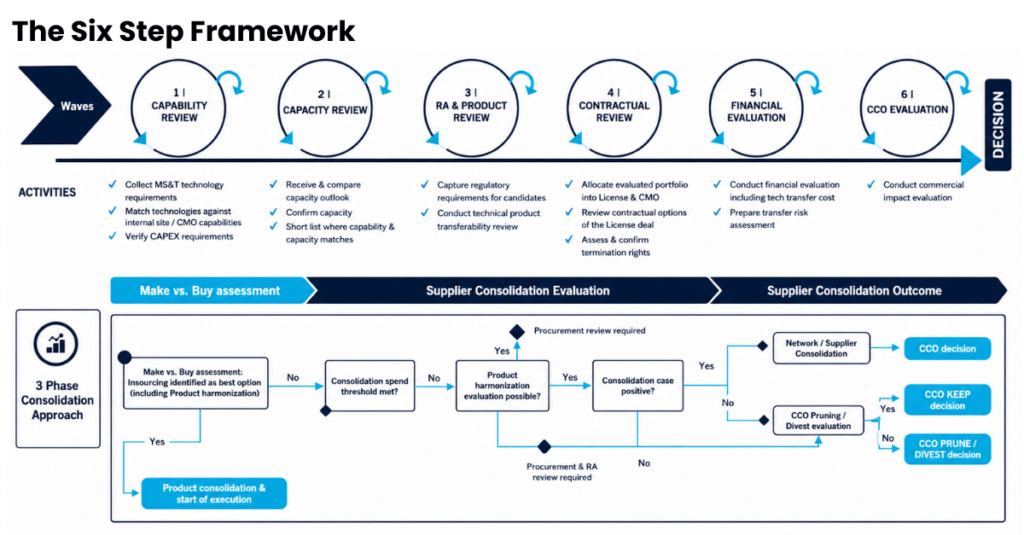
The make-vs-buy assessment runs six sequential evaluations before any consolidation decision is finalized:
- Capability review: matching manufacturing technology requirements against internal site and CMO capabilities, and verifying capital expenditure requirements
- Capacity review: confirming available capacity and shortlisting suppliers where capability and capacity align
- Regulatory and product review: capturing regulatory requirements and conducting technical product transferability analysis
- Contractual review: allocating the evaluated portfolio between the license and the CMO supply and reviewing termination rights
- Financial evaluation: modeling transfer costs and preparing a risk assessment — “it doesn’t make sense to spend months assessing a portfolio if the business case is negative”
- Commercial consequence review: assessing broader commercial impact before a final decision is recorded
The three-phase consolidation approach runs in parallel, determining whether a consolidation case is financially positive, whether spend thresholds are met, and whether product harmonization is possible. Cases that fail any gate are routed to a keep, prune, or divestment decision before re-entering the evaluation loop.
What CDMOs Need to Offer
Talarczyk outlined the internal transformation success factors — combined commercial and technical operations, strong governance, data quality, and geopolitical risk management — and mapped these directly to what Sandoz now expects from CMO partners. The requirements were specific: excellent tech transfer capabilities, the ability to handle complexity that Sandoz itself is exiting, technologies not broadly available in the market, cost and quality leadership, and additional services including EU retest, regulatory affairs support, and direct shipment release.
Easy data connectivity was listed as a prerequisite, not a differentiator. “Be easy to work with,” he added, framing it as a basic condition for continued partnership.
On volumes, he was direct: “There are no big fish anymore. There is the tail end — small volumes. Get ready to handle complexity.”
The session closed with a reference to the Samsung Bioepis partnership as an example of the strategic direction: concentrating a major biosimilar development relationship with a single specialized partner rather than distributing it across multiple suppliers.
Takeaways
- Map your supplier network against criticality, spend, and regulatory coverage before drawing any consolidation conclusions — visibility comes first.
- Combine commercial and technical operations into one team. Country organizations only act on decisions their commercial leads have agreed to.
- A 20/80 concentration ratio in supplier spend is typical; use it as the baseline argument for why consolidation makes commercial sense internally.
- Run make-vs-buy decisions through a fixed six-step sequence: capability, capacity, regulatory, contractual, financial, then commercial impact — in that order.
- CDMOs that cannot provide clean data connectivity, handle complexity at speed, and offer services beyond basic manufacturing will be deprioritized in consolidation outcomes.
- Environmental risk assessment (ERA) requirements introduced since 2024 are adding timeline and cost risk to tech transfers — factor them into consolidation planning now, not after decisions are approved.
- Complexity drivers worth tracking for prune or divestment include low batch size relative to line economics, high deviation rates, irregular demand patterns, and country-specific SKUs with minimal volume differences.
Download the full 112 page report from CDMO Live Europe here