At CDMO Live Europe 2026, Jeff Mason, VP and Head of US Sales at Samsung Biologics, demonstrated a risk-based, parallel approach to dual-site technology transfer that delivered a first GMP batch at a second facility within 90 days of initiation.
The Challenge of Dual-Site Transfer
Tech transfer to a second manufacturing site introduces three compounding problems. Scale differences between bioreactors, such as moving between 10,000-liter and 15,000-liter vessels, create variability in mixing, mass transfer, and process dynamics that can affect product comparability. Compressed client timelines leave insufficient room for the sequential optimization that traditional approaches require. And any delay or batch failure during the transfer directly threatens supply continuity.
Mason framed the problem in his customers’ terms: “What we’re seeing is a trend — a lot of our customers have an increased demand for dual-site tech transfer because of accelerated timelines and hedging supply chain risk for commercial. But this doesn’t allow a lot of time to process-optimize or align critical quality attributes across sites.” His response was to rebuild the transfer model from the ground up.
The 90-Day Framework
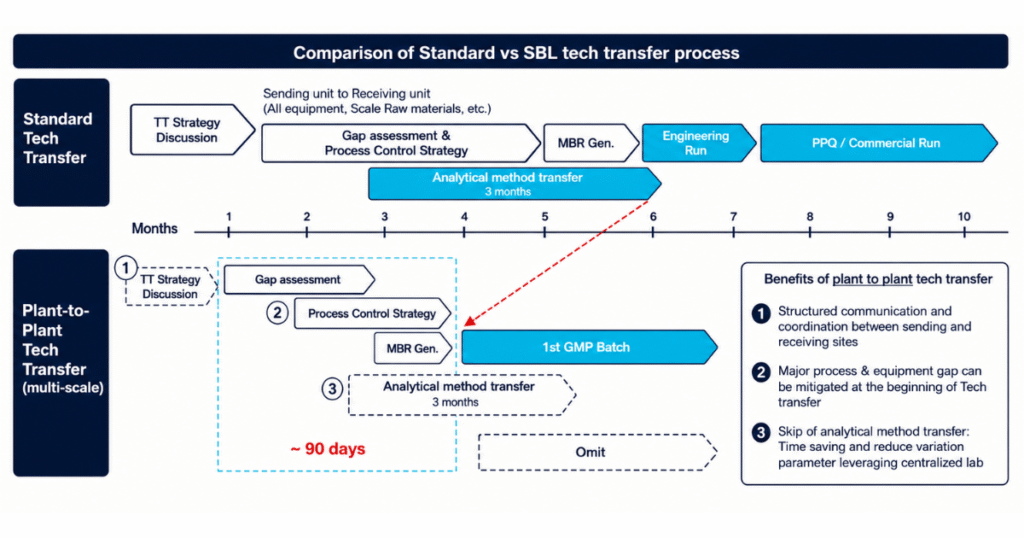
Samsung Biologics’ response is a plant-to-plant tech transfer model built on three pillars: supply chain readiness, analytical readiness, and knowledge transfer from the sending unit. The key structural change is parallelization. Rather than running analytical method transfer and process characterization in sequence, Samsung Biologics begins gap assessment and process control strategy development concurrently at both sites from day one.
A second acceleration lever is the company’s centralized laboratory infrastructure. Because Samsung Biologics operates a unified analytical platform across its facilities, sponsors transferring between internal sites can skip site-to-site analytical method transfer entirely. Mason explained, “Our plants are essentially carbon copies of each other — same quality platforms, same raw material management systems. That’s what allows us to apply one process control strategy not just across two sites, but across all five plants if needed.”
Case 1: 90-Day Dual Qualification
The first case study covered an internal transfer initiated in late November 2022. The first GMP batch at the receiving plant was complete by the end of February 2023, 90 days after initiation. By September 2023, a process performance qualification (PPQ) campaign was complete across both facilities. Despite the difference in bioreactor scale between Plant A (10,000 liters) and Plant B (15,000 liters), cell culture profiles and final product titers were comparable across sites.
Case 2: The “One” Process Control Strategy
The second case introduced a multi-site parallel transfer across three plants built to a cookie-cutter facility design, with equivalent technical specifications and automation systems. This equivalency enables a single, unified process control strategy applied across all receiving sites simultaneously. The practical benefit is a material reduction in process validation effort: one comparability study supports multiple sites rather than requiring independent studies at each.
For Case 2, Samsung Biologics is targeting a unified downstream process control strategy across two 15,000-liter facilities by Q3 2026, with an effectiveness check in Q4 2026 and full dual-facility qualification from 2027 onward. “We’re doing five of these dual-site transfers simultaneously this year. The real goal is to accumulate enough process knowledge to improve on 90 days — to do it truly in parallel, without flaws or issues.”
Takeaways
- Parallelizing gap assessment, analytical readiness, and supply chain qualification from day one compresses timelines that sequential approaches cannot match.
- Centralized analytical platforms eliminate site-to-site method transfer for internal transfers, removing a significant source of delay and variability.
- Comparable cell culture profiles and final product titers were achieved across 10,000-liter and 15,000-liter bioreactors, demonstrating that scale differences need not compromise comparability.
- A cookie-cutter facility design, with equivalent technical specifications and automation across sites, is the prerequisite for applying a single process control strategy at scale.
- One unified process control strategy across multiple sites reduces validation studies, consolidates regulatory submissions, and supports operational consistency.
- Five PPQ campaigns are planned for dual qualification in 2026, with Samsung Biologics’ Plant 5 ramp-up currently underway.