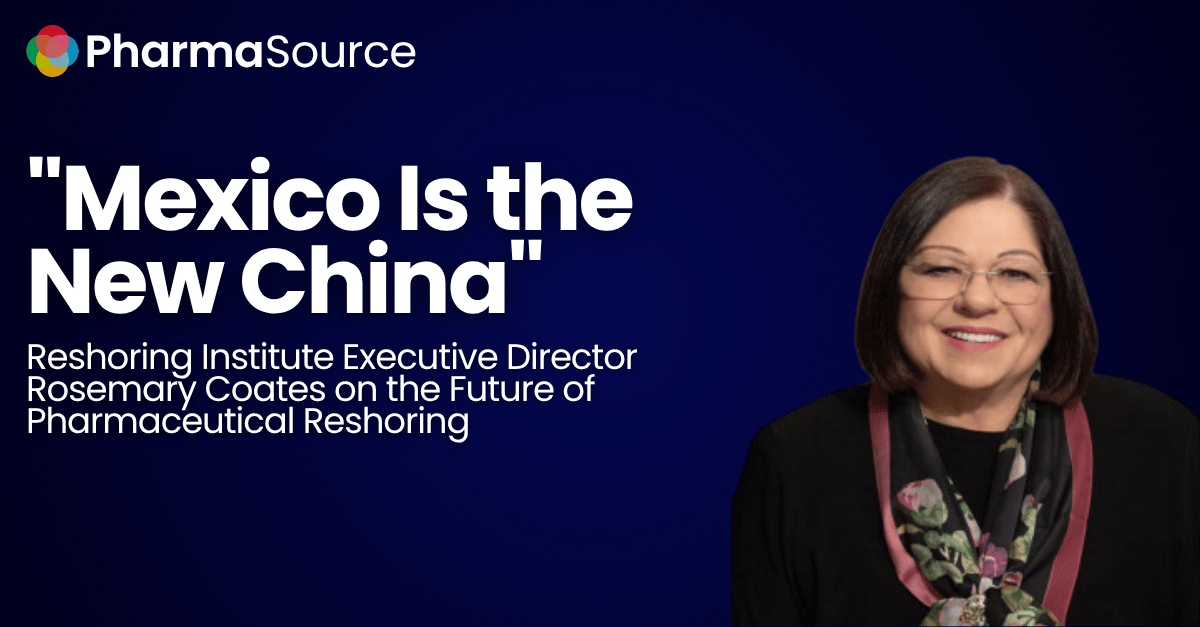
“If you look at the employment numbers in the manufacturing sector, it’s been absolutely flat for two years. The political noise has not driven that big wave of reshoring that we were expecting.” After a decade of making the economic case for bringing manufacturing back to America, Rosemary Coates says the data tells a very different story from the press releases.
Rosemary Coates is Executive Director of the Reshoring Institute and President of global supply chain consultancy Blue Silk Consulting, with 35 years of experience across industries from healthcare to high tech. She has consulted for over 80 clients worldwide, served as an expert witness in major supply chain disputes, authored five books including the Amazon bestseller 42 Rules for Sourcing and Manufacturing in China, and was named one of the 100 Most Influential Women in Silicon Valley in 2024.
In the latest PharmaSource podcast episode, Rosemary explains what the data really says about reshoring to the US, why tariff volatility has frozen executive decision-making, and how pharmaceutical companies can build manufacturing strategies durable enough to survive an unstable world.
The Political Noise Hasn’t Moved the Needle; Yet
Rosemary founded the Reshoring Institute in 2014, prompted by the China-focused rhetoric of the 2012 US election and clients asking whether US manufacturing was even economically possible. The answer, she found, was a qualified yes, but only under specific conditions.
“We found that there were some cases where a factory was automated, and certain other conditions were present — tax credits, training credits, low-cost labor in, say, the American South and some other parts of the country — and we could put that all together and make an economic case for bringing manufacturing back.”
The pandemic transformed reshoring from a niche consulting question into a board-level priority. But despite years of tariffs and political pressure since, Rosemary says the headline numbers tell a sobering story:
“If you look at the employment numbers, strictly employment in the manufacturing sector, it’s been absolutely flat for two years. So none of the political noise, the tariffs — nothing has really driven that big wave of reshoring that we were expecting and hoping for. There are some bright spots for sure, particularly pharmaceuticals and semiconductors, where there is new build happening in the US. But overall, the manufacturing sector’s been lukewarm for a while.”
Pharma is one of those “bright spots”. PharmaSource tracking of 732 CDMO announcements in 2025 found $24.86 billion in disclosed capacity investment, 74% of it flowing to the US. But Rosemary notes the underlying desire outstrips the economics: “Most manufacturers will tell you they’d rather manufacture in the US. It’s a less risky environment. It’s safer… It’s close to the market. However, it’s really hard to make the economic case to do that.”
Tariff Whiplash has Frozen Decision-Making
The theory behind tariffs is straightforward, Rosemary explains: make imports look more expensive to offset America’s structural cost disadvantage. “Our whole cost structure, not only the cost of labor, but the cost of land, permitting, all kinds of things, make US manufacturing more complex and more expensive.”
The reality has been different, because the one thing the policy hasn’t delivered is stability:
“The one thing about business is they need stability to be able to plan. If you say the tariff’s gonna be 60% for two years, you can plan for that. You can figure out what to source, how to move things around, how to run your operations. But if you say today it’s 145%, and tomorrow it’s gonna be 28%, and maybe next week it’ll go back up to 100%, that’s very frustrating for companies and executives, and it really makes it impossible to plan.”
The Reshoring Institute tracked this paralysis in a study commissioned by the state of New York, interviewing 18 executives from mid-sized businesses across roughly 16 industries. Every single one reported the same thing: they were doing nothing — no capital investment, no hiring — until the environment stabilized.
“It isn’t that they don’t want to, or there isn’t a lot of pent-up demand, which I think there is. The problem is that if you are in an unstable environment, it’s just too difficult to make that decision.”
The 50% Labor Rule
When advising clients on where to manufacture, Rosemary’s methodology begins with a full cost breakdown of the product — the bill of materials and, critically, the labor that goes into making it. The share of manufacturing cost tied up in labor largely determines which geographies are viable.
“If more than 50% of the cost of manufacturing is labor… then you have to look for a low-cost environment. There’s just no way we can compete in the US if more than 50% of your product’s cost is related to labor. So we look at the labor cost first of all. We examine that bill of materials, try to figure out if you can take any labor out of it through automation.”
Labor-intensive assembly work belongs in low-cost labor countries, she argues. But automation changes that calculation:
“For example, making the textiles that go into a shirt is a fully automated process. There’s nobody weaving cloth anymore for shirts. That’s all done by machinery. So if you can automate your manufacturing process (although it takes a bigger capital investment up front) and eliminate that labor, you can usually make a pretty good economic case for at least some places in the US, including the South.”
In Rosemary’s opinion, the default alternative of the last three decades no longer holds. “China is no longer the low-cost country manufacturing that it was twenty years ago,” Rosemary says. “Their labor rates are now dead square in the middle of low-cost and high-cost countries… They really can’t be considered low cost anymore.”
“Mexico is the New China”
Asked for her biggest prediction for global manufacturing strategy over the next five years, Rosemary doesn’t hesitate:
“The biggest trend that we see is manufacturing in Mexico. Mexico is the new China in a way. The labor costs are low. The business environment is very positive. The new president, Claudia Sheinbaum, is very supportive of the business environment. She’s promised to build one hundred industrial parks, these big-footprint manufacturing sites around Mexico.”
With a minimum wage of $3.12 an hour, developing infrastructure, and proximity to the US market, she believes nearshoring to Mexico is a realistic option for pharma, as well as industries like automotive and assembly: “Pharmaceutical production in some of these places like Mexico, I think, is a real possibility.” At the same time, she points to major pharmaceutical companies including AstraZeneca and Eli Lilly building new capability in the US.
Proximity also carries an ESG dividend, an increasingly important factor in pharmaceutical manufacturing strategy:
“If you think about manufacturing in Mexico, for example, and your major market is the US, then that proximity allows you to make a smaller carbon footprint… You can just drive your product across the border versus putting it in a container and on the ocean, and the trucking that’s involved and so forth.”
How contract manufacturing relationships end up in court, and how to avoid it
Rosemary’s expert witness work in global supply chain disputes led her to co-author Legal Blacksmith: How to Avoid and Defend Supply Chain Disputes with attorney Sarah Rathke — a book built around “failure alerts” explaining how companies end up in litigation. In contract manufacturing, one recurring flashpoint is inventory:
“Contract manufacturers buy raw material in advance, and they’re supposed to buy only enough for your production, but you’ll find that contract manufacturers will buy in bulk. Sometimes they have too much inventory. They’re not paying attention to how quickly they’re manufacturing goods, and as a result, they end up with excess inventory, and they try to sell it off to you.”
Contract language protecting IP and ownership of molds and supplied equipment is essential, she says, but so is cultural fluency, especially when negotiating in Asia. A standard Western NDA, for example, won’t protect you in China: “In China, you need what’s called an NNN agreement, which is more extensive than an NDA,” covering issues like whether a supplier can subcontract part of your production.
Negotiation style matters just as much as clauses:
“The way the Chinese think about it is that nothing is done until everything is done. So you go down the list, and you’re at number 18, think you’ve taken care of all the rest of it, and the Chinese start over again… It’s not that they’re trying to annoy you. It’s the thought process that things are interconnected, and they’re not going to agree to any kind of contract until everything is agreed to.”
Her advice: put someone on your team, a local attorney or consultant, who knows the local laws and culture. The alternative is expensive: “You’re gonna get stuck, you’re gonna get sued… you’re gonna lose money.” For a structured approach to getting agreements right from the start, see PharmaSource’s guide to cutting CDMO contract negotiations to 12 weeks.
Build Plan B and Plan C: Durable Strategy in a Volatile World
The sourcing decision that once took a single sentence — “Just get me to China” — now involves capital availability, geopolitical conflict, climate risk, and market proximity. Rosemary argues this complexity is forcing companies to become genuinely more thoughtful:
“It’s no longer ‘just get me to China.’ Now it’s: what’s our risk exposure? Where in the world could we alternate manufacturing? What’s the cost of materials around the world? Where are markets developing? What’s the economic situation and geopolitical situation?… All these things now are taken into consideration, which makes the decisions better, I think.”
Durable strategy means alternate scenarios, not a single bet: “Now it’s thinking about plan A and plan B and plan C depending on what’s gonna happen.” And that need for optionality, she says, is itself driving the second major trend she sees: a decisive shift toward outsourced manufacturing:
“Companies are now very forcefully moving to contract manufacturing. They’re getting out of manufacturing themselves and putting it in the hands of a contract manufacturer that’s more flexible… specifically because they’re more global and have more alternatives available to you than you would if you opened up your own shop.”
Because in Rosemary’s view, the next disruption isn’t a possibility — it’s a certainty: “A lot of that is looking at your long-term risk: what are the alternatives? How do you mitigate risk if something happens? And something is going to happen.”