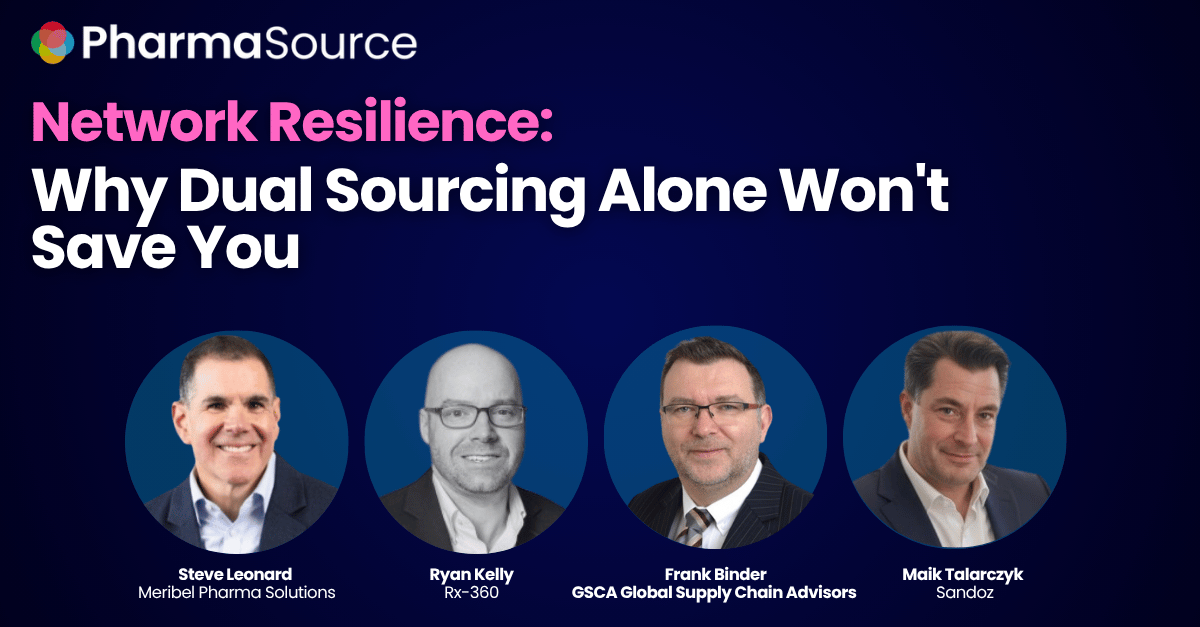
At CDMO Live Europe 2026, a panel of pharma and CDMO executives examined how supply chains must be redesigned for a world of sustained geopolitical pressure, regulatory fragmentation, and accelerating demand, and where contracts, governance, and visibility fit in.
This panel brought together Steve Leonard, COO, Meribel; Ryan Kelly, Interim CEO, Rx-360; Frank Binder, Managing Director, GSCA; and Maik Talarczyk, Head PMO ESO, Sandoz.
Geopolitical Exposure
Frank Binder, a pharma supply chain consultant with senior roles at Santen and Celgene, set the frame. Pharma networks were built on two assumptions: a stable world and free commerce as the dominant paradigm. Neither holds anymore. “This world does not exist anymore,” he said, “and it will not come back.” The consequences are structural. Single-source manufacturing, optimized for efficiency, now carries geopolitical exposure. Countries are no longer incentivizing onshoring; they are punishing companies that do not comply. Binder warned that at least one country appears to be moving toward requiring that products for all global markets, not just the domestic one, be manufactured on its soil, creating a potential compliance conflict if other governments adopt the same position.
Maik Talarczyk, PMO Director, Small Molecule at Sandoz Technical Operations, described what this looks like from inside a large generics network. Managing approximately 2,000 product families across more than 350 finished dosage form suppliers, Sandoz faces disruption as a daily reality. The challenge is not responding to any single shock but managing complexity at scale while preserving the speed to move from supplier A to supplier B when needed. “To have flexibility is quite heavy to achieve these days,” he said.
The Dual Sourcing Trap
The panel converged on a point of tension: dual sourcing is the obvious resilience play, but it is prohibitively expensive to apply universally. As Steve Leonard put it, “the world can’t afford to have two or three sources for everything.” Tech transfers are long and costly, and governments are simultaneously pushing for lower drug prices, a goal in direct conflict with the investment required to build redundancy. The near-term reality, he argued, is safety stocks and targeted second-source qualification, not a wholesale realignment of manufacturing networks over the next five to 10 years.
Talarczyk described the decision framework Sandoz uses. It is risk-adjusted and value-based, with patient criticality as the first filter. After that, the analysis considers supply risk by region, market criticality, commercial value, and competitor count. If a drug is essential but several other suppliers are already serving the market, the risk calculation shifts. The key question is whether the market can absorb a disruption from one supplier without patient harm.
Ryan Kelly, Interim CEO at Rx360, added a further structural pressure: an aging global population. By 2050, the number of people aged 60 and over will roughly double, increasing drug demand across every category at the moment supply chains are under strain. He also flagged the growth of direct-to-consumer distribution via parcel networks, with FedEx, DHL, and UPS expanding healthcare infrastructure in ways that outpace regulatory models built for manufacturer-to-distributor-to-dispenser flows.
What Contracts Can and Cannot Do
On contract design, the panel’s advice was consistent: simplicity, fairness, and active maintenance of any backup provisions. Binder described a case in which a backup manufacturing site was activated during a capacity crisis, only for the site’s management to discover the arrangement had never been communicated to them. The packaging line for the relevant product had been sold six months earlier. “A cold backup will give you some big surprises if you try to activate it,” he said.
Talarczyk’s advice was not to put volume commitments in contracts. “You cannot put in the contract what you don’t know.” He advocated for scaled pricing structures tied to volume bands, transparency about long-term product intentions from the outset, and contracts short enough that people will actually read them. Leonard agreed that the contract matters less than the ongoing relationship. “There’s the contract, and then there’s running the business,” he said. Kelly recommended building in service level agreements and metrics so both parties have concrete targets to work toward.
Crisis Governance and Preparation
On crisis response, Talarczyk outlined a cross-functional tiger team model: quality, supply chain, regulatory affairs, the supplier, and the CDMO around one table, with a clear action plan, a defined escalation path, and a graded assessment of actual criticality rather than commercial alarm. For smaller companies without that resource depth, Binder recommended a simpler substitute: put supply chain scenarios on the management agenda regularly, so leadership is mentally prepared when something goes wrong.
Leonard emphasized cadence over crisis planning. The communication structure between a CDMO and its customer should be tiered: weekly tactical reviews, monthly rolling forecast discussions, quarterly and semi-annual business reviews. If that cadence is not in place, convening a crisis team when something goes wrong feels unnatural and slow. “If the first time a team like Maik described is around the table when something goes horribly wrong,” he said, “it’s really too late.”
Kelly referenced Sun Tzu to frame the problem: “The battle is won or lost before it’s ever fought.” Resilience is not responsiveness; it is preparation. That means visibility into the supply chain, known escalation pathways, and, critically, decentralized decision-making. When disruption happens, speed matters more than perfection. Empowering field teams to act without waiting for central approval should be part of the operating model.
Takeaways
- Map one critical product end-to-end before tackling the portfolio: the exercise will reveal risks you did not know existed.
- Define your top products and build contingency plans for those only; trying to cover the entire portfolio is a setup for failure.
- Treat risk assessment as a dynamic, ongoing process, not a one-time exercise. The risk environment is changing faster than most static models can track.
- Active backups only. Cold backups frequently fail on activation: the site does not know the arrangement exists, components are missing, or the process is out of date.
- Build your CDMO relationship before a crisis, not during one. A tiered communication cadence creates the trust and speed that crisis management requires.
- Structure contracts around metrics and service level agreements, keep them short and readable, and then focus energy on running the business, not on the contract terms.