China’s revised Implementing Regulations of the Drug Administration Law took effect on May 15, 2026. They put the marketing authorization holder (MAH) at the center of drug quality, open the door to segmented manufacturing across several sites, and require foreign MAHs to name a China-based agent. Outsourcing stays legal, but the MAH stays accountable for every batch a CDMO makes.
China Drug Administration Law Implementing Regulations: latest updates
- May 15, 2026: The regulations took effect. The NMPA is still issuing the detailed rules, including eligibility for segmented manufacturing.
- Apr 14, 2026: The NMPA told contract manufacturers to vet MAHs before signing, end projects whose risks cannot be controlled, and fix any gaps within a year.
- Jan 27, 2026: The State Council published the revised regulations as Decree No. 828.
- Jan 6, 2026: The NMPA issued an announcement tightening the supervision of contract manufacturing, with immediate effect.
China Drug Administration Law Implementing Regulations at a glance
| Region | China |
| Instrument | Implementing Regulations of the Drug Administration Law (State Council Decree No. 828), 9 chapters and 89 articles |
| In force | May 15, 2026, with no express grace period |
| Who it binds | MAHs, domestic and foreign, plus the manufacturers they contract in China |
| Main changes | MAH lifecycle chapter; segmented manufacturing; foreign MAH agents; pre-approval batch sales; data and market exclusivity |
| Legal status | In force; NMPA subordinate rules still being issued |
| Key date | Biologics segmented production pilot runs to December 31, 2026 |
| Most exposed | Foreign sponsors with China supply or China market access, and Chinese CDMOs serving them |
| Source | Ropes & Gray summary of Decree No. 828 |
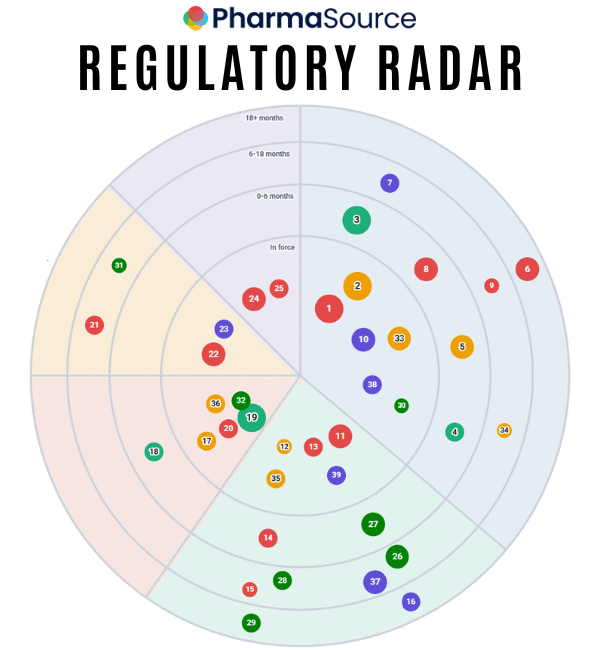
| PharmaSource Score | 225 (rank 10) Impact 5, Reach 5, Likelihood 9 Download the PharmaSource Regulatory Radar |
What the China Drug Administration Law Implementing Regulations are
China’s 2019 Drug Administration Law made the MAH, the company that holds the product license, responsible for a drug’s quality and safety. The 2026 Implementing Regulations turn that principle into detailed duties, and pull rules scattered across NMPA and market regulator measures into one binding framework covering R&D, registration, manufacturing, sales and post-market supervision.
The regulations work through six levers:
- MAH accountability: MAHs need an independent quality department, a production lead, a quality lead and a “quality authorized person” who releases each batch.
- Contract manufacturing: MAHs must use a qualified manufacturer, audit it, manage process changes and oversee it continuously. The manufacturer may not subcontract. Blood products, narcotics, psychotropics, toxic drugs and precursor chemicals cannot be outsourced.
- Segmented manufacturing: Different stages can run at different contracted sites for innovative drugs with special process or equipment needs, clinically urgent drugs, emergency and reserve drugs, and other products the NMPA names. All sites sit under one MAH quality system.
- Foreign MAHs: Overseas MAHs must appoint a China-based agent, named in the package insert, that shares joint and several liability for quality and safety.
- Pre-approval batches: Commercial-scale batches made before approval, in China or overseas, can be sold once the drug is approved if they pass GMP compliance checks.
- Exclusivity and data: Up to six years of data protection, two years of market exclusivity for qualifying pediatric drugs and seven years for rare disease drugs, conditional on a supply commitment.
Where the China Drug Administration Law Implementing Regulations stand
- 2019: The revised Drug Administration Law creates the MAH system.
- May 2022: A draft of the Implementing Regulations goes out for comment.
- October 2023: NMPA Announcement No. 132 tightens oversight of contracted production.
- December 31, 2025: The State Council adopts the regulations, published in January.
- January to April 2026: The NMPA issues two notices on contract manufacturing.
- May 15, 2026: The regulations take effect.
The April notice puts the duty on both sides. Contract manufacturers must evaluate an MAH’s qualifications, quality system and technology transfer before signing, and should favor MAHs with their own R&D and process know-how. For sterile drugs, the MAH must inspect validation on site at least once a year, and either party needs at least three years of commercial experience with the same dosage form.
What the China Drug Administration Law Implementing Regulations mean for manufacturing and outsourcing
The regulations keep outsourcing in China open and make it more formal. A sponsor can hold the license, contract a Chinese CDMO and, for some products, split production across sites. It cannot hand over accountability. The exposure differs by company:
- Foreign sponsors selling in China: A China-based agent now shares liability, so choosing that agent carries real legal weight.
- Sponsors using Chinese CDMOs: Quality agreements need to cover supplier audits, change control, batch release by the MAH’s authorized person and a ban on subcontracting. Sterile programs need annual on-site validation checks.
- Chinese CDMOs: CDMOs must vet clients before signing, and virtual biotechs without process know-how may find fewer partners willing to take them on.
- Licensing and deals: A new 20-working-day channel for changing a clinical trial sponsor, down from up to 60 days, speeds the handover of China rights in licensing deals.
- Launch planning: Pre-approval batches and acceptance of overseas clinical data, where it meets NMPA standards, can bring China launches closer to global timelines.
Former Gilead SVP Reza Oliyai told the PharmaSource Podcast that for oral products, “we would have no issue making drug products in China.” For outsourcing leaders, the practical step is to update quality agreements with Chinese CDMOs to the new MAH duties, confirm the China agent arrangement, and check whether any program qualifies for segmented production.
Why supporters back the China Drug Administration Law Implementing Regulations
“Transform policy incentives into legally cognizable assets.”
Legal commentary on the regulations, via The Legal 500
- Clear accountability: One responsible party per product makes quality failures easier to trace and fix.
- Flexibility for innovators: Segmented production lets biotechs use specialist sites for each stage without building their own plants.
- Stronger incentives: Data protection and market exclusivity, now in an administrative regulation, give innovators protections they can enforce.
- Faster deals: Arnold & Porter calls the rules “streamlined and sponsor-friendly,” citing the faster sponsor-change channel.
Criticisms of the China Drug Administration Law Implementing Regulations
“The implementation of segmented production in a cross-border context remains unclear.”
Arnold & Porter, on the 2026 regulations
- Rules still to come: Eligibility and procedures for segmented production, pre-approval sales and the sponsor-change channel depend on NMPA rules that are still being issued.
- No grace period: The regulations took effect with no express transition, while sites were still closing gaps from the January and April notices.
- Heavier burden on small MAHs: Virtual biotechs must build quality departments, authorized persons and audit programs of their own.
- Liability for agents: Joint and several liability raises the stakes for local partners acting as a foreign MAH’s agent.
- Undefined terms: “Other eligible products” for data protection is not defined.
What’s next for the China Drug Administration Law Implementing Regulations
- NMPA rules: Detailed rules on segmented production, exclusivity and the sponsor-change channel are due, with no dates set.
- December 31, 2026: The pilot for segmented production of biological products ends. Watch whether the NMPA makes it permanent under the new regulations.
- Self-inspections: Contract manufacturers must close gaps found under the April notice within a year.
- PIC/S accession: China’s application to join PIC/S, pending since 2023, would align these rules more closely with Western GMP.
- Our score: Impact 5, Reach 5, Likelihood 9, giving 225 and rank 10. The rules are in force, so Likelihood stays high; Impact rises if NMPA rules open segmented production to foreign sites.