
DOWNLOAD
Sustainability by Design in API Manufacturing
Download Case Studies Showing 85% Reduction in the Carbon Footprint
Download the White Paper
A Practical Blueprint for Sustainable Small Molecule Manufacturing
The pharmaceutical industry accounts for 4–5% of global greenhouse gas emissions. API manufacturing alone contributes around 25% of that footprint. This white paper outlines Merck’s real-world process improvements using green chemistry principles, smart synthesis design, and advanced analytical frameworks such as DOZN™ and GreenSpeed.
Inside This White Paper:
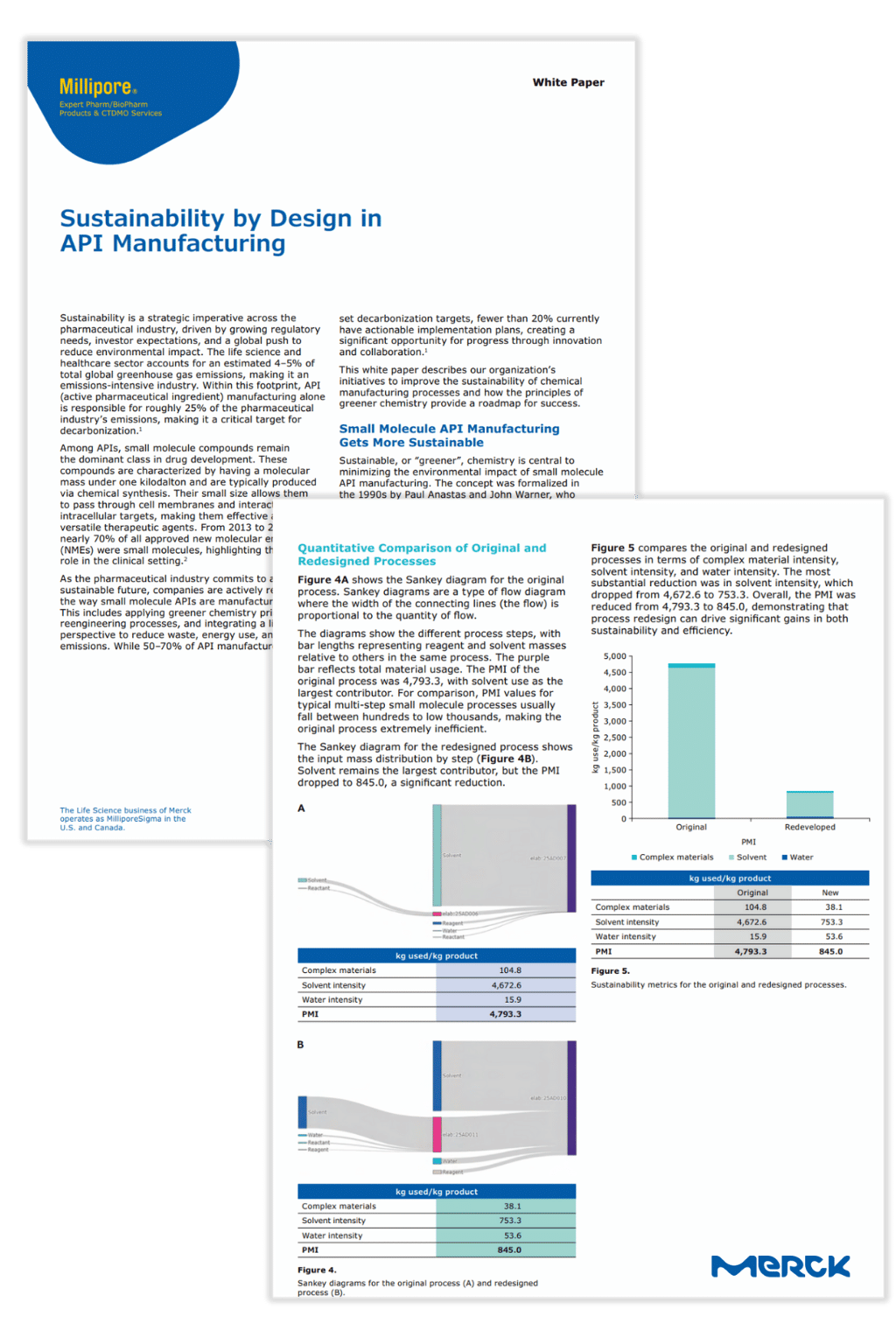
- Case studies showing PMI reduction from 4,793.3 to 845.0 and from 12,339.5 to 181.0.
- How continuous flow manufacturing reduced carbon footprint by 20% and 85% in different processes.
- DOZN™ Quantitative Green Chemistry Evaluator and GreenSpeed platforms.
- The 12 Principles of Green Chemistry framework and application.
- Process redesign approaches, including synthetic route optimization and column elimination.
- Yield improvements from 39% to 66% and from 65% to 75%.
25%
API Manufacturing’s Share of Pharma Emissions
70%
New Drugs are Small Molecules (2013-2023)
12
Principles of Green Chemistry Applied
Proven Results from Real Projects
These case studies demonstrate the dramatic improvements possible through strategic process redesign and green chemistry implementation.
Process 1
Multi-Step Synthesis Redesign (Original vs. Redesigned Route)
PMI Reduction 4,793 → 845
Overall Yield 39% → 66%
Solvent Intensity 83.9% reduction
Product Purity >99.5% maintained
Process 2
Column-Free Purification Strategy (Original vs. Redesigned Route)
Continuous Flow
Process Intensification Examples
Tools Driving Sustainable Process Innovation
- GreenSpeed: Real-time PMI, water, solvent, and CO₂ analysis linked to electronic lab notebooks.
- DOZN™: Quantitative green chemistry tool measuring alignment with the 12 Principles of Green Chemistry.
- Synthia™ Retrosynthesis: AI-enabled smart route design supporting greener synthetic pathways.
Get the Full White Paper
Access Merck’s real-world sustainability improvements, quantitative case studies, PMI analysis, and continuous-flow redesign insights — all backed by rigorous experimental data.
The life science business of Merck KGaA, Darmstadt, Germany, operates as MilliporeSigma in the US and Canada.