“We need to strive to be an easy client. Being an easy client with clear goals and internal alignment is key for successful long-term relationships with CMOs. Equally important is how we manage internally – how we align internally and bring that one message to the CMOs.”
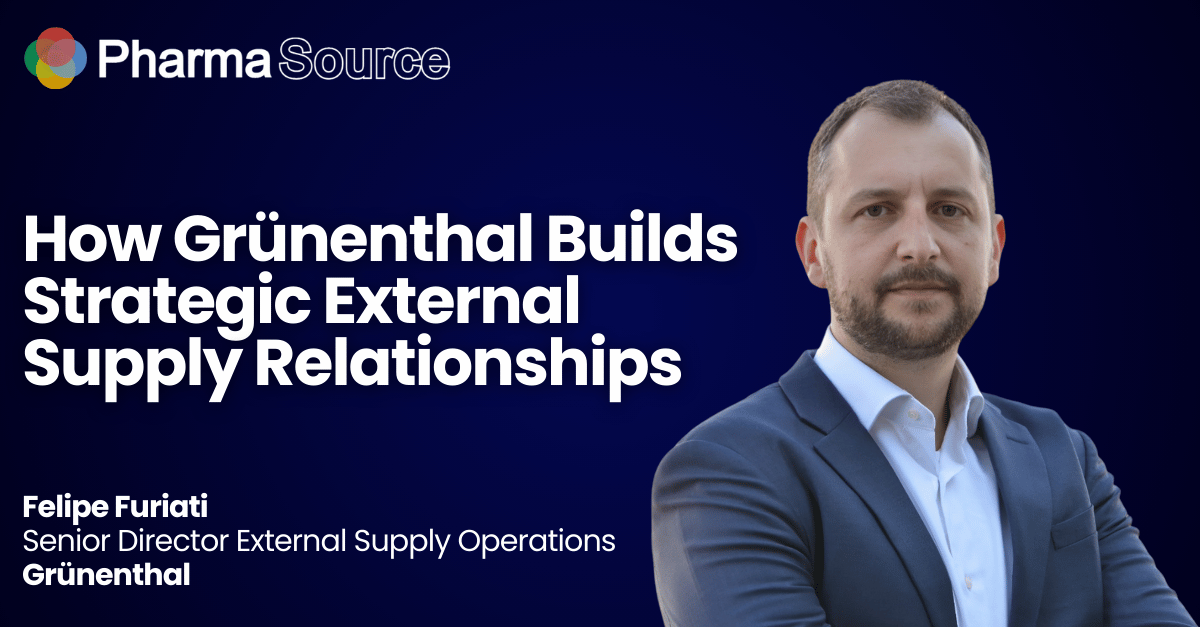
Felipe Furiati, Senior Director External Supply Operations at Grünenthal, manages external supply operations across a €2 billion portfolio whilst leading crisis management and M&A integration activities.
Felipe brings a distinctive background to external manufacturing, having started as a pharmacist in QA at Johnson & Johnson, spent time in management consulting at Bain & Company, and returned to pharmaceutical operations with experience spanning both technical and strategic functions.
In the latest PharmaSource podcast episode, Felipe shares practical insights on building strategic partnerships without volume leverage, implementing product-centric supply chain management, and using digital tools for supplier selection – approaches that are particularly relevant for mid-sized pharmaceutical companies navigating complex supplier networks and geopolitical uncertainty.
Crisis Management Through Multi-Stream Coordination
When acquisitions reveal unexpected supply chain challenges, Felipe recommends taking immediate action whilst maintaining strategic perspective. His experience managing a crisis task force for a major product portfolio demonstrates how complex supply disruptions require coordinated responses across multiple functions.
“Sometimes, once it lands inside your doors, the reality is quite different,” Felipe explains. “We had a supply disruption with a specific product that required a crisis management task force.”
The crisis involved multiple sub-streams across different CMOs, requiring coordination between CMC teams, regulatory affairs, manufacturing science, and quality assurance. Felipe’s approach balances urgent firefighting with longer-term relationship building.
“On crisis management, it’s almost stop what you’re doing and go there and put down the fire,” Felipe notes. “But we need to have the longer view – who we want to partner with, who we want to strengthen relationships with.”
The methodology involves dividing complex challenges into manageable components whilst maintaining oversight across all workstreams. Felipe emphasises that crisis management becomes an opportunity to strengthen supplier relationships through transparent communication and collaborative problem-solving.
The Product-Centric Philosophy: Beyond Traditional CMO Management
Felipe advocates for a fundamental shift in how external manufacturing professionals approach supplier relationships – starting with the product rather than the CMO. This philosophy transforms how teams identify and address supply chain vulnerabilities.
“We don’t manage CMOs – we start with the product,” Felipe explains. “As external manufacturing professionals, we can say we are managing CMOs. But when we have that view, you can easily lose the bigger picture of what is your product and what are the criticalities of the product itself.”
This product-centric approach enables teams to identify weak spots across the entire value chain, from logistics to process robustness. Traditional CMO management often misses critical interdependencies that could jeopardise supply reliability.
“You might be managing a CMO, but you might completely miss how the logistics part of that CMO is getting to your plant or customers, or process robustness that you can influence,” Felipe notes.
The methodology involves comprehensive end-to-end value chain analysis to systematically identify potential failure points. “Taking the view from CMO management into product management allows you to gather a team and evaluate the end-to-end value chain of that product and identify the weak links that can jeopardise supply reliability.”
Felipe emphasises that this approach enables more focused discussions with suppliers: “You can go to your CMO and be laser-focused on what are the issues and what are the important things you need for your product. That allows you to not lose focus and really focus on what matters.”
Smart Supplier Segmentation: Managing Complexity Without Scale
With approximately 90 suppliers across its network, Grünenthal faces the classic challenge of managing a diverse supplier base without the volume leverage of larger pharmaceutical companies. Felipe’s segmentation strategy goes beyond simple volume or spend metrics to consider strategic product importance.
“The transactional suppliers are not necessarily just driven by volume,” Felipe explains. “Sometimes you have a supplier or CMO that you have little spend and little volume, but that CMO impacts a very important product for the organisation.”
The risk of misclassifying suppliers based purely on commercial metrics can have serious consequences. “If you treat it as transactional and something goes wrong, you might have an impact down the line to your product.”
Grünenthal employs different engagement levels based on strategic importance rather than just commercial value. Priority suppliers receive twice-yearly business reviews and monthly virtual site operating team meetings. Preferred suppliers receive regular meetings based on product importance and project activity. Transactional suppliers are managed on an as-needed basis with minimal touch points.
“For priority suppliers, we might have twice a year business review meetings on site. For preferred suppliers, we have monthly meetings. With transactional suppliers, we might not have regular meetings at all – just as needed basis.”
Felipe emphasises that product criticality can override volume-based classifications: “Sometimes you have little spend and little volume, but somehow that CMO impacts a very important product for the organisation. In that case, you need to treat that maybe low volume, low spend supplier in a priority way.”
Building Strategic Partnerships: The “Easy Client” Philosophy
For mid-sized pharmaceutical companies like Grünenthal, building meaningful CMO relationships requires different strategies than those available to Big Pharma. Felipe’s approach centres on internal alignment and transparent communication rather than volume leverage.
“We need to strive to be an easy client. Being an easy client with clear goals and internal alignment is key for successful long-term relationships with CMOs,” Felipe explains. “Equally important is how we manage internally – how we align internally and bring that one message to the CMOs.”
The challenge involves managing complex matrix organisations where multiple functional areas interact with CMOs. Felipe advocates for a facilitator role rather than a filtering one within the organisation.
“We’re not a filter, but we do have the entire visibility,” Felipe notes. “As an external manufacturing professional, you need to develop an understanding of the functional areas and internal challenges of the functional areas you need.”
Transparency proves crucial, even when making difficult decisions about insourcing or product transfers. Felipe believes honest communication strengthens rather than weakens supplier relationships.
“I work with transparency. If our goal is to insource a product, we need to be upfront in order to build long-term relationships with that CMO,” Felipe explains. “Sometimes we’re taking volume out, but we’re going to bring another product from a new acquisition. That’s how you build bridges even when you’re taking volume away.”
Felipe uses virtual site operating teams to coordinate cross-functional engagement and prevent mixed messages reaching suppliers. “Once the organisation and the functional areas see you not as a burden, not as a filter, but actually as a tool to facilitate the relationship with the CMOs, everything follows.”
Digital Transformation: From Knowledge-Based to Data-Driven Supplier Selection
Felipe led a transformative digital initiative that moved Grünenthal from relationship-based supplier identification to a sophisticated PowerBI database system. The project addressed a fundamental challenge in pharmaceutical procurement: how to identify the right CMOs for RFPs without relying solely on personal networks.
“Before this tool was developed, it was very analogic – knowledge-based,” Felipe explains. “Who knows, based on technology, who are your contacts? You send out RFQs and do searches.”
The transformation required careful taxonomy development, working with internal manufacturing sites and engineering teams to create a comprehensive technology classification system. The challenge lay in balancing complexity with usability.
“The balance between complexity and your needs – focus on your needs,” Felipe notes. “We did that quite successfully to avoid over-complication of the tool.”
Critical success factors emerged during implementation. Having dedicated resources proved essential for maintaining project momentum. “We had one dedicated person – I led this project with support of a graduate. This is the type of project that took time from early conception in 2023 to actual implementation middle of last year.”
The project also required early platform planning and migration strategy. “At an early stage it’s important to think about what is going to be the user interface. We started with a database, then migrated to PowerBI during the project.”
Felipe emphasises focusing on deal-breaker criteria rather than attempting to capture every variable: “How important is cold chain to define as a requirement for a CMO? If you try to consider every single variable, that gets super complex.”
The results have transformed RFP processes across the organisation: “Once we have this tool, we’re able to quickly identify CMOs for RFPs. We’re starting from a long list that is much easier than scattering business cards.”
Geopolitical Risk Management: Scenario Planning in Uncertain Times
As Grünenthal expands into the US market amid volatile trade policies, Felipe employs sophisticated scenario planning rather than reactive decision-making. The company faces multiple geopolitical challenges, from US tariffs to Middle East tensions to Taiwan-based API suppliers.
“On the tariffs, unfortunately every day is news,” Felipe explains. “We have new tariffs, but the next day we don’t, and then next day we do. We’re trying to navigate that with ‘what if’ scenarios.”
Rather than making hasty decisions based on uncertain policies, the company maintains a strategic “standby mode” for various contingencies. Timeline considerations prove crucial in pharmaceutical risk management.
“Any action in the pharma industry that requires movement of a product takes time – maybe two, three, four years to implement,” Felipe notes. “You’re committing to large-scale projects that will take time, so you need additional certainty of the impact of these actions.”
For specific risks like Taiwan-based API suppliers, Felipe employs targeted mitigation strategies based on product characteristics. “We evaluated the threat and decided on stock build-up because API has long shelf life. It’s not very high risk, but could be an issue, so we decided to build up stock.”
The approach emphasises preparation over premature action: “We don’t have anything active, but we have standby mode to activate ‘what if’ scenarios. If uncertainties materialise into something more certain, we can activate those plans.”
Key Takeaways
- Product-centric approach: Start with the product rather than the CMO to identify critical vulnerabilities and conduct end-to-end value chain analysis to focus supplier discussions on specific product needs.
- Strategic supplier segmentation: Segment suppliers based on strategic product importance, not just volume or spend, recognising that low-volume suppliers can still impact critical products and require priority treatment.
- Partnership building without scale: Strive to be an “easy client” through clear goals and internal alignment whilst acting as a facilitator rather than a filter, maintaining transparency about strategic decisions including potential insourcing.
- Digital transformation for supplier selection: Develop comprehensive CMO databases using tools like PowerBI for data-driven supplier identification, focusing on deal-breaker criteria rather than attempting to capture every variable.
- Crisis management excellence: Implement multi-stream coordination across CMC, regulatory, and quality functions whilst balancing immediate firefighting with long-term relationship building, using crises as opportunities to strengthen partnerships.
- Geopolitical risk management: Employ scenario planning rather than reactive decision-making for uncertain trade policies, maintaining “standby mode” contingency plans whilst considering pharmaceutical timelines (2-4 years) for tech transfer decisions