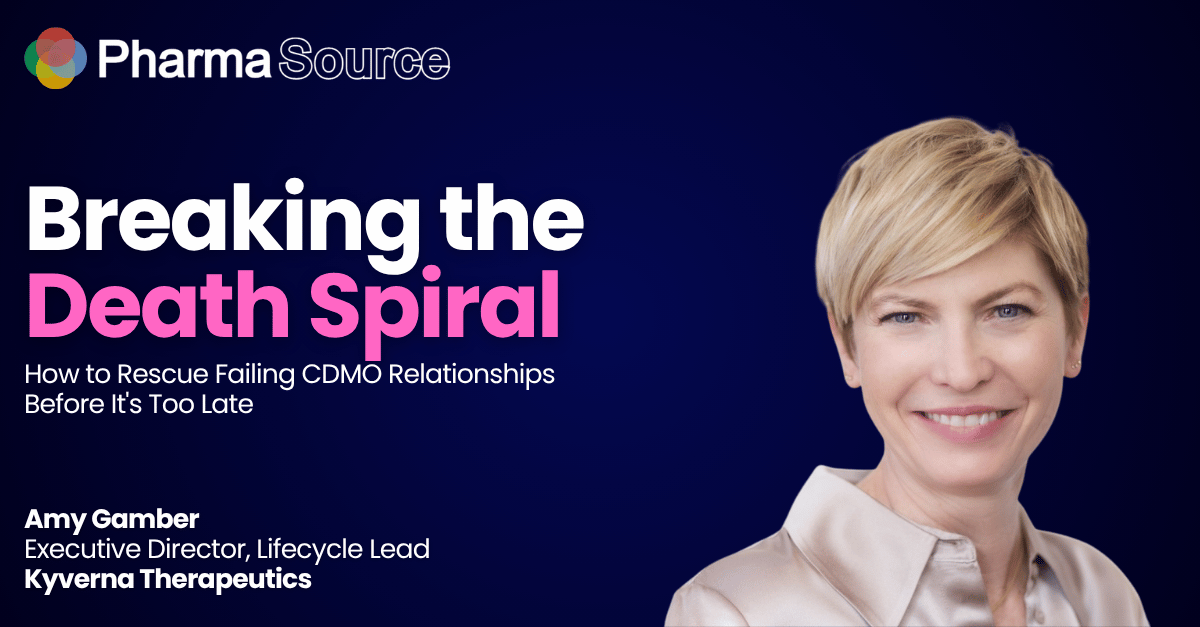
“When I walked into the tech transfer, we were a million dollars over budget, six months behind schedule, and struggling to make a single successful batch,” says Amy Gamber.
Amy Gamber, Executive Director, Lifecycle Lead at Kyverna Therapeutics, specializes in crisis recovery for late-stage biotech and cell and gene therapy programs. With 20+ years of CMC leadership experience at Atara Biotherapeutics, CSL Seqirus, and Amgen, she’s built a career fixing what others couldn’t.
In this PharmaSource podcast interview, Amy shares how to identify warning signs before minor issues become million-dollar problems, strategies for rescuing failing tech transfers, and what it takes to restart a manufacturing facility dormant for two years.
The Real Cost of Failed Tech Transfers
When tech transfers fail, the financial and timeline impacts threaten company survival.
“At that point, you’re not talking about a technical problem. You have a business risk that you’re trying to manage”
In one tech transfer, engineering runs failed to replicate development results. The root cause wasn’t incompetence. “The development team had a lot of what we needed in their head, but they hadn’t put it down on paper. The CDMO didn’t understand what was critical and they were working blind.”
For small biotechs, this means delayed funding rounds. “You can’t get product made, you can’t get it in the clinic, you can’t get your data.”
Knowledge Transfer: Beyond the Document Dump
Complete tech transfer packages require more than documentation stacks.
“It’s sort of like you’re walking through a new house,” Amy says. “Here’s the things that go smoothly, here are the things we often struggle with. This is what good looks like, this would be a warning flag. That context takes it from being just a set of documents to helping them understand.”
Process parameters aren’t created equal. “You need to call out the parameters that are more critical to the process, and the ones where you have some flexibility. That way you’re setting your CDMO up for success.”
Amy advocates for on-site knowledge transfer despite cost concerns.
“It is much less expensive to pay for that travel than to pay for six months of delayed tech transfer and failed batches and all the materials.”
Person-to-person transfer captures what documentation misses. “That’s where you pick up those things that got missed because it’s locked in their head and not on the paper.”
CDMO Selection: Why the Lowest Bid Often Costs Most
For cost-conscious biotechs, selecting the lowest bidder is tempting. Amy warns this approach frequently backfires.
“If you have one bid that is significantly less than everybody else, you need to understand why,” she cautions. “What often happens is they don’t fully understand your scope. You’re going to get a bunch of change orders once you get into the tech transfer.”
Extremely low bids might signal financial instability. “Maybe they’re keeping costs down because they want the business and are concerned about their own longevity, which is also a red flag.”
Amy recommends prioritizing technical platform experience and proven tech transfer track records. She pays close attention to responsiveness during the RFP phase. “The RFP phase is the dating phase—that’s when everybody’s on their best behavior. If you’re having a hard time working with them in this phase, that sends a signal you’re probably going to have even more of a struggle once you sign on the dotted line.”
One overlooked area is analytical capabilities. “Analytical methods can often make or break a tech transfer. Usually there’s more methods to transfer, the transfers take a long time, and the QC lab is often the bottleneck. You can’t release batches, and you don’t have a product.”
Warning Signs Before the Death Spiral
Amy describes several red flags indicating a CDMO relationship is deteriorating.
- Timelines that don’t make sense. “If people can’t explain how they came up with particular timelines, that’s a problem. If you ask for a plan and they say, ‘I’ll get back to you’—particularly if you’ve asked a couple of times—that’s also a problem.”
- Glossing over issues. “You have a batch failure. Everyone talks it up—’It’s operator error.’ We close it quickly, we move on, and then it happens again, and then it happens a third time. At that point, you’re losing months.”
- People talking at each other instead of with each other. “Talking at each other looks like, ‘It’s not my responsibility, somebody else fix it.’ Talking with each other is ‘Let’s figure out how we’re going to solve it first, then we’ll figure out the contractual issues later.'”
- Leadership disengagement. “Where’s the site leadership? Are they showing up? If they’re not, that’s a signal that you are not a priority. That makes teams less likely to escalate when they have issues.”
Rebuilding Broken Relationships
When Amy inherited two external manufacturing partnerships that weren’t yet in routine production and were facing ongoing tech transfer challenges, technical issues were symptoms of deeper systematic problems. Her approach focused on internal accountability first.
“I looked internally and said, ‘What do we not have that is preventing us from being successful?’ I need to deal with that before I can go to my CDMO partner.”
She examined whether fundamental policies and procedures existed—not high-level documents, but practical guidance on roles, responsibilities, and decision escalation. The company had changed their manufacturing operating model, but their guidance documents hadn’t been updated.
Next came relationship assessment. “Are people working together, or is everybody in CYA mode?” When batch failures occurred, instead of collaborative problem-solving, “everyone’s like, ‘Well, we followed the procedure and we did what you said and it didn’t work. So it must be your fault.'”
Amy emphasizes understanding both perspectives. “The sponsor company’s position is, ‘This is my only product. This is my lifeline.’ But from a CDMO perspective, you’re one of several clients. They’re not going to drop everything.”
To break the death spiral, Amy goes directly to CDMO leadership. “I say, ‘Look, I understand that we are not working well together. Here’s what we own, here’s what we think we can do to fix this. Help me understand what you need to make this successful.'”
She asks sponsors to be realistic. “Asking for 24/7 dedicated coverage without paying for that—that’s not realistic. But from a CDMO perspective, be clear and transparent in your communication. If you don’t have the data, say so, but tell me when I can expect it, and then follow up.”
Both sides need to manage their internal teams. “You have to break those patterns internally. It’s amazing how easy it is for one or two comments, when you’re trying to rebuild that trust, to set everything back very quickly.”
Effective Governance Without Bureaucracy
Amy recommends a three-tier governance structure that operates “like gears in a machine.”
1. Technical teams meet weekly for day-to-day execution and decision-making.
2. Operations-level teams include people empowered to make decisions and guide working teams. They meet weekly to bi-weekly depending on program phase, reviewing schedule adherence, quality issues, and production problems.
3. Executive steering committees meet quarterly for strategic discussions. “That’s where you’re sharing what’s the strategy for this program, what’s the regulatory outlook, what’s the business outlook. CDMOs should be bringing ideas about how can we enhance this program.”
Navigating Contract Enforcement in Crisis
Contract enforcement during crisis requires delicate balance. “You’re in a long-term relationship with the CDMO, and you can’t afford to burn the bridge because you still need them. But you can’t ignore non-performance and just keep paying for it.”
Amy starts with direct conversation.“I have been paying X amount, I am not getting my deliverables, and this is not sustainable. . I’m burning cash, I’m burning materials, and we’re not progressing. So how are we going to address this?”
She asks diagnostic questions rather than making accusations. “What is preventing us from being successful? Is it a technical issue? Is it a resource issue? Are we not communicating?”
Amy recommends finding negotiation points. She worked with one company that successfully negotiated for an out-of-contract report in exchange for payment on other items.
“Don’t withhold full payment until you get everything you want, because that’s going to create this death spiral again. Find the points that you can negotiate on and come to a reasonable solution.”
Four Steps to Avoid Crisis
For biotechs outsourcing manufacturing for the first time, Amy offers four priorities.
1. Choose expertise over price. Look for CDMOs with technical platform experience and strong tech transfer track records. “If somebody’s not willing to give you any references, that’s a red flag.”
2. Don’t ignore analytical methods. “Methods often set the pace for a tech transfer. There are usually more of them, they take longer to move, and they can become critical path. Make sure you’re inquiring about analytical capabilities, what the labs look like, how they are staffed.”
3. Invest in expertise. “A lot of people think, ‘We’re smart, we’ve managed vendors, we’ll figure it out.’ But I’ve worked with a lot of people who have made expensive mistakes doing that.”
4. Invest the time upfront when it’s still relatively cheap to fix. “It’s much more expensive to fix it later.”
“The transfers that tend to go better are the ones where there’s a relationship, there’s understanding, and there’s good communication.”