“We became an analytical powerhouse before we started offering integrated process development and manufacturing. That’s what differentiates us.”
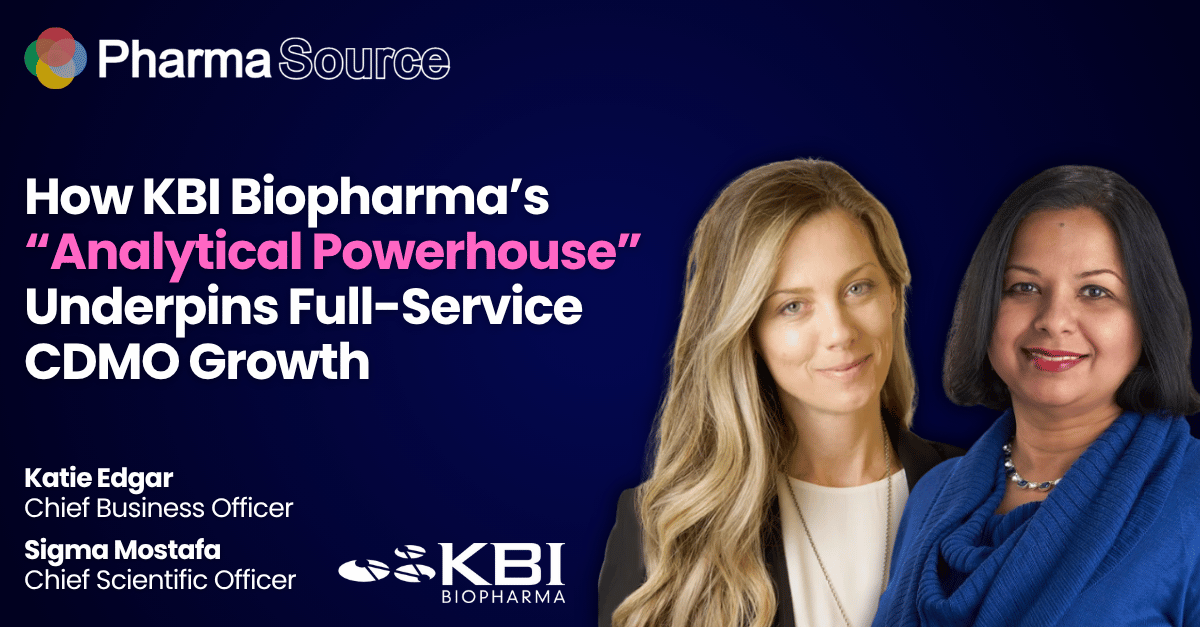
Sigma Mostafa, Chief Scientific Officer, and Katie Edgar, Chief Business Officer at KBI Biopharma, explain how technical depth in analytics and proprietary cell line technology create competitive advantage in an increasingly crowded CDMO market.
Sigma brings 15 years of experience with KBI, joining as Director of Process Development in 2010 and advancing through the company’s exponential growth. Katie leads business strategy, focusing on long-term partnerships and proactive risk mitigation for customers ranging from virtual biotech startups to global pharmaceutical companies.
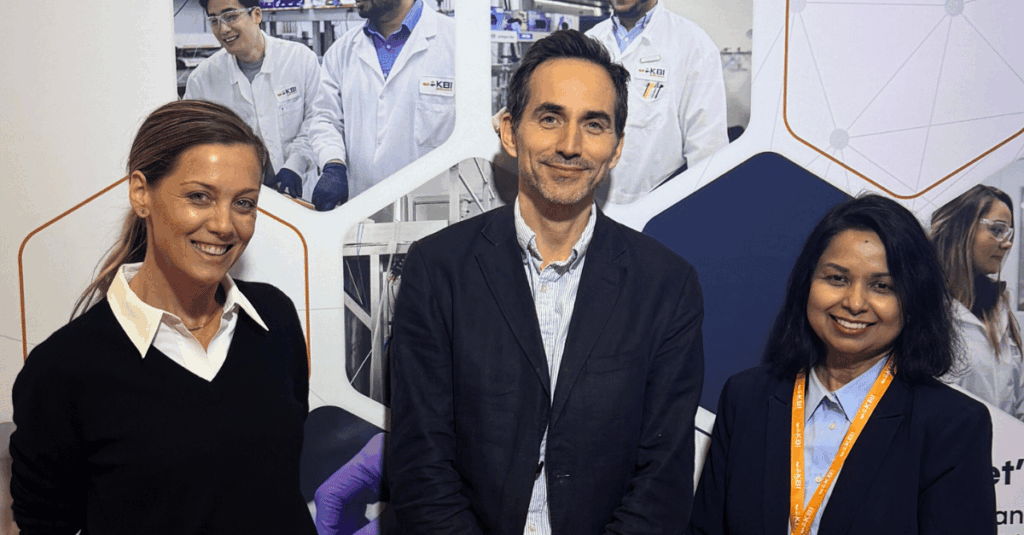
In this PharmaSource podcast recorded live at CPHI Frankfurt 2025, Sigma and Katie reveal how KBI’s analytical foundation, combined with high-touch customer relationships and digital integration tools, supports molecules from early development through commercial manufacturing.
Building From an Analytical Services Foundation
KBI Biopharma launched 29 years ago as an analytical services company before expanding into integrated process development and manufacturing. This origin story shapes the company’s competitive positioning today.
The company operates six facilities across the U.S. and Switzerland. Three North Carolina sites handle mammalian development and manufacturing, including a 100,000-square-foot Venture Center for process development and two GMP facilities with four 2,000-liter and six 2,000-liter reactor capacity. Two Colorado locations; with Boulder focusing on microbial manufacturing at a 300-liter or 2,000-liter scale and standalone analytical services in Louisville.
This analytical depth attracts customers with complex challenges. Other CDMOs contract with KBI for specialized testing even when handling their own process development.
“In the whole world, there are only a handful of companies that can do analytical container closure validation testing. We are number two in the world for GMP testing in that area,” Sigma explains. The company operates centers of excellence for mass spectrometry, particle analysis, and cell-based assays.
“We are really good at problem solving. Customers come to us when they have a tough challenge”
Sigma Mostafa
Proprietary Cell Line Technology Drives Differentiation
Beyond analytics, KBI’s cell line capabilities provide another competitive edge. JSR Life Sciences, KBI’s parent company, acquired Selexis, a mammalian cell line provider from Switzerland, and developed the SUREtechnology Platform™, for premium, stable and integrated CHO-based cell line development. JSR Life Sciences announced the operational consolidation of KBI and Selexis in 2023.
“On the microbial side, we have PureColi, an E. coli cell line from BL21 strain where we engineered 1,000 genes out of 5,000 genes. The productivity is exceptionally high,” Sigma explains.
The Selexis platform evolved from random to targeted integration technology. “We moved from random integration to targeted integration with our own landing pad technology,” Sigma says.
KBI continues investing in next-generation capabilities including CRISPR, transposon-based systems, and specialized cell lines that reduce product quality issues like fucosylation.
The microbial platform tackles historically difficult molecules. “We are looking at producing biologics in E. coli which historically has been challenging because of product degradation, and we are able to solve some of these problems,” Sigma notes.
Balancing Modular Projects With Integrated Programs
Managing capacity across different project types requires strategic planning. KBI serves customers seeking standalone services and fully integrated programs.
“We look at integrated programs versus modular programs as a way to manage flow,” Sigma explains. “Modular programs, especially analytical programs where we are a powerhouse, feed nicely as smaller-scale, shorter-timeline programs within our integrated timeline.”
This creates conversion opportunities as customers learn about KBI’s full capabilities. “A program initially knows us for analytical services, then realizes we are an integrated shop and converts. And vice versa,” Sigma says.
This flexibility proved valuable during market uncertainty. “That modeling is complex, but we have been able to successfully protect ourselves from some of the geopolitical changes and the impact that other companies have seen,” Sigma notes.
Strategic U.S. Positioning With Global Risk Mitigation
KBI’s U.S. facilities in Research Triangle Park, North Carolina, and Boulder, Colorado, helps them to capitalize on the current reshoring trends while maintaining global capabilities.
“There is certainly a tremendous push for onshoring in the U.S. We recognize that,” Katie says.
“Markets are often reflective and reactionary. Our job is to be proactive and provide the best risk mitigation strategy for our customers.”
Katie Edgar
The company maintains a global quality system with a Qualified Person in Europe to support worldwide regulatory filings. “While we feel fortunate to have U.S. manufacturing, maintaining a global footprint is important for meeting customer needs,” Katie explains.
RTP’s biotech ecosystem helps attract talent despite intensifying competition. “Healthy competition is good. Competition brings out the best of us,” Katie says. “Onshoring isn’t just about tech transfer into the U.S. It’s about creating opportunities and educating people here.”
Building Trust Through Technical Continuity
KBI recently announced a multi-year contract renewal with a global pharmaceutical company, demonstrating how the CDMO builds lasting relationships.
“Why customers choose us and what makes partnerships successful is trust and reliability. Those are the two key pillars,” Katie says.
The company serves customers across the spectrum from virtual biotechs to major pharmaceutical companies. “Our portfolio comprises large, mid, and small biotech opportunities. Having the right balance is the sustainability model for long-term success,” Katie explains.
The recently announced commercial deal represents years of collaboration. “What’s often missed is all the work our scientists did in partnership with their teams to achieve that success,” Katie notes.
Technical continuity strengthens relationships. “The customer experience of talking to the same team they talked to five years ago, and now the molecule has moved to late phase, is unique,” Sigma says. “It doesn’t feel transactional.”
This drives customer loyalty. “The stickiness of customers staying with us for extended periods is very high. We have customers where we do two to three PPQs per year, where we started with screening work,” Sigma adds.
Data Transparency Through Digital Integration
Commercial partnerships require structured oversight. Katie emphasizes well-defined governance as critical for meeting customer expectations.
“What gets measured gets managed,” Katie says. “Their expectation, especially with a commercialized product, is that we have a very well mechanized, managed, and measured approach.”
The company invested in a proprietary digital tool to provide real-time data access. “There’s been a tremendous amount of investment in a proprietary tool called PROGRAMview™,” Katie notes. “This is real-time access. Customers can log onto a portal and see on any given day, at any given moment in time, exactly what is happening in the labs.”
The platform moves beyond email-based communication. “We wanted to move away from email-based information exchange. All communication lives on that platform, so it’s traceable. You can flag items, look at data, and provide comments,” Sigma says.
Katie believes digital capabilities will become essential rather than optional. “I hear more about AI than manufacturing. This is a differentiator that will become more relevant in the industry,” Katie observes. “Data transparency and reliability is the most important thing we can provide. If we’re not accurate in the data, our customers won’t be successful in filing or meeting performance expectations.”
Proactive Supply Chain Planning
Supply chain disruptions and geopolitical uncertainty concern biopharma companies. KBI invested in procurement and supply network operations planning to provide customer assurance.
“We’ve built out an extensive supply network operations planning and procurement network to have long-term plans, relationships, vendor management, and procurement strategy,” Katie explains.
Customer concerns extend beyond supply availability to pricing predictability. “What customers are concerned about amidst geopolitical issues and tariffs is whether they can have foresight and planning for necessary materials. Are we able to secure not just supply but pricing so they can have the right cost model, meet margins, and stay competitive in their markets,” Katie says.
“It’s about having the right relationships and agreements with vendors to get security we can then provide to customers,” Katie adds.
Automation and Predictive Analytics
KBI’s automation journey supports its efficiency and growth strategy. “We’ve always heavily invested in high-throughput technology and automation as our way to gain efficiency and scale,” Sigma says.
The company adopts new technologies early to gain competitive advantage. “We were the first company to use Ambr automated bioreactors for process characterization, using 250 milliliters to mimic a 20,000-liter reactor,” Sigma explains.
The goal extends beyond automation to predictive capability. “We’re looking at data transformation and visualization, creating predictive profiles of molecules based on our knowledge base,” Sigma says. “Being able to predict process conditions and expected performance from a molecule—you can reduce wet work in the lab. That’s the holy grail.”
Expanding Into ADCs and Next-Generation Conjugates
The biologics landscape evolves rapidly, with antibody-drug conjugates and complex modalities creating new opportunities.
“We’re seeing almost an explosion in the diversity of molecule types,” Sigma observes. “Biologics needs chemists and biologists because you’re constantly conjugating proteins or peptides with different small molecules. It’s not just ADCs, but oligonucleotides and different other types of conjugations and chemistries.”
KBI has experience with conjugated products across clinical development. “We’ve done about 20 such conjugated products and taken them to clinical. But we’re focusing on that significantly,” Sigma says.
The technical breadth in analytics and problem-solving capabilities positions KBI well for these complex molecules.
Customer Success Defines Long-Term Strategy
When asked about KBI’s future direction, both leaders frame success through customer achievements.
“Our success is based on our partners’ success,” Katie explains. “Success for us looks like success for our customers. As our portfolio grows into later-stage and commercial programs, seeing that market success over long-term tenure, while watching the earlier-stage portfolio grow in parallel, is how our long-term success will be demonstrated.”
Investment decisions must align with market needs. “The investments we make, making the right choices about what the market asks for, listening to customer needs and making the right decisions at the right time in technologies and operational improvements will afford us that strategic and competitive edge,” Katie adds.
Sigma emphasizes continued technology leadership. “We’re focusing significantly on conjugations and looking at data transformation, visualization, and creating predictive profiles. Being able to predict process conditions and expected performance from a molecule—that’s what we’re heading towards,” Sigma concludes.