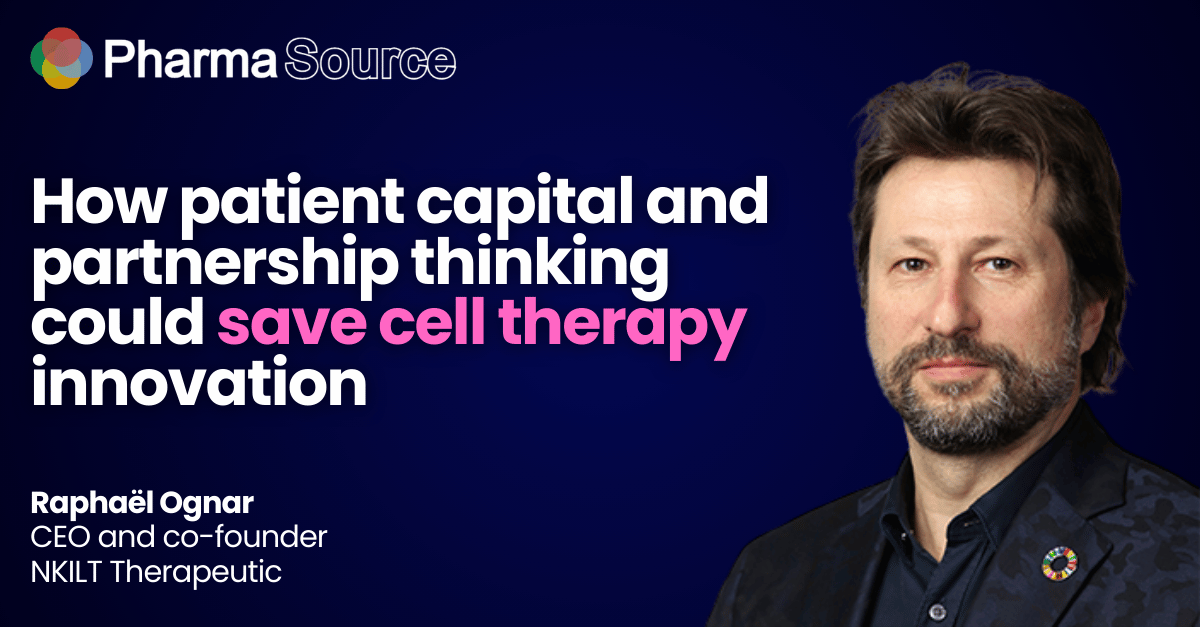
“CDMOs and Biotechs will both die,” warns NKILT Therapeutics CEO as he talks candidly about the funding crisis stalling cell therapy development, predicting widespread consolidation across biotechs and CDMOs unless the industry shifts toward risk-sharing partnership models that align manufacturing economics with capital constraints.
Raphaël Ognar, CEO and co-founder of NKILT Therapeutics, brings 29 years of pharmaceutical and biotech experience spanning marketing, drug development, and corporate strategy at major pharmaceutical companies. After launching a consulting practice focused on early-stage immuno-oncology biotechs, Raphaël co-founded NKILT Therapeutics.
NKILT’s off-the-shelf allogeneic approach (as opposed to patient-specific autologous therapies) targets HLA-G, an immunosuppressive molecule expressed across major cancer types including colorectal, breast, prostate, and kidney cancers, providing access to substantially larger patient populations while improving manufacturing scalability and economics.
His company’s 12-month IND delay exemplifies the systemic pressures that continue to threaten cell therapy innovation, and both sides of the CDMO-biotech relationship.
Capital Drought Meets Manufacturing Economics
The sector that once commanded immediate capital based on scientific promise alone has now faced systematic investor skepticism for several years. “You would raise your hand, say, ‘Hey, I need money.’ And investors would say, what are you doing? Cell therapy? Oh, yeah, here are a few million dollars,” Raphaël recalls. “Times have changed.”
According to Raphaël, while autologous CAR-T therapies achieved medical breakthroughs, they revealed serious economic challenges. High manufacturing costs combined with inability to scale (each therapy must be manufactured individually for each patient) made profitability elusive. “Most of the CAR-T therapies that survived, though perhaps not to say all of them, are managed by big pharma,” Raphaël observes. “The reason is because it’s not profitable.” Only large pharmaceutical companies with substantial resources can sustain these programs despite unfavorable economics.
Investors now demand proof of viable economic models before committing capital. When Raphaël presents development budgets to reach clinical milestones, he hears: “There’s no way you can do that at that cost.”
The Catch-22 Trapping Innovation
This creates an impossible dynamic. Biotechs need clinical data to validate their economic models, require funding to generate that data, yet cannot secure funding without proven economics first.
The collision between investor skepticism and manufacturing realities has produced tangible consequences. NKILT’s IND filing has been delayed over a year, not due to scientific challenges, but economic ones.
“There is no way I can start this if I don’t have $5 million in the bank,” Raphaël states, referencing the capital required to initiate GMP manufacturing partnerships. “Not so many early stage biotechs can say they have $5 million in the bank.”
The $5 million figure reflects legitimate CDMO economics: specialized capabilities, process validation, and regulatory requirements demand substantial investment. For biotechs working with emerging modalities, the capital barrier becomes even more pronounced. NKILT’s approach uses gamma retroviral vectors, a technology platform where specialized CDMO capacity remains limited, as most manufacturing partners in the space have concentrated capabilities and infrastructure around lentiviral systems.
After engaging with over 30 CDMOs, Raphaël identified partners with appropriate technical capabilities. But bridging the gap between their pricing requirements and available capital remains the critical constraint preventing clinical advancement.
Industry Oversupply Meets Demand Collapse
Raphaël argues that the easy-money era that funded numerous biotech launches also supported CDMO capacity expansion, creating oversupply across both sectors. “Instead of talking to 10 people, you have 50 people in front of you that you can talk to,” he notes of the fragmented CDMO landscape.
Reduced biotech funding translates directly to fewer manufacturing contracts, creating downward pressure on an already oversupplied market.
“If I don’t get money, I don’t contract the CDMO. If CDMOs cannot contract, they’re gonna die. So we are gonna die. They’re gonna die,” Raphaël warns.
The consolidation is already underway. “Many biotechs are disappearing. Unfortunately, some good technologies, some may be not as good. But also in the CDMO field, I think some will disappear because there’s just not enough opportunities to feed all the mouths.”
This creates a reinforcing negative cycle. The very companies developing next-generation approaches designed to solve cell therapy’s economic challenges, allogeneic platforms targeting larger patient populations with improved manufacturing scalability, cannot access the manufacturing partnerships needed to prove their models work.
Patient Capital and Partnership Thinking
Raphaël advocates fundamental reframing of CDMO-biotech relationships from transactional contracts to aligned partnerships. “I hate the term CDMO because it has that contracting aspect,” he explains. “The level of complexity of what we’re managing requires much more than just a contract.”
This partnership mindset must extend to the investment community. Raphaël’s proposed solution requires patient capital willing to fund multiple quality companies through appropriately-sized rounds. “We need to restimulate the smaller money earlier stage, multiple bets,” he argues, contrasting this with the current focus on “mega deals” delivering faster returns.
Rather than the prior scatter-shot approach funding numerous unvalidated concepts, this model would support larger portfolios of quality post-consolidation survivors with validated science and realistic economic plans.
Why This Matters for Patients
The investment strategy directly impacts patient access. Current approved CAR-T therapies target “really niche, really small” patient populations, leaving major cancer types underserved. “I don’t see any cell therapy targeting breast cancer. I don’t see cell therapy targeting colorectal,” Raphaël notes.
Multiple funded programs pursuing different approaches would give patients more therapeutic options. Instead of limited approved therapies that work for narrow populations, a diversified portfolio could address broader cancer types through varied mechanisms.
For gastrointestinal cancer patients, Raphaël puts it plainly. “Once they progress under the first couple of rounds of treatments that we can give them, they’re done. If they don’t respond to the treatment, they will die.”
Raphaël explains that allogeneic approaches like NKILT’s could theoretically address these larger indications with improved manufacturing economics through scale. Raphaël’s “multiple bets” philosophy, funding several next-generation approaches rather than concentrating capital in mega deals, would increase the odds that at least some reach patients who currently have no options.
“Give a chance for new science to fail or succeed,” Raphaël urges. “Let us have only that question on the table and not all the others. This is not about NKILT. It’s not about even the specifics of our technology,” Raphaël emphasizes. “It’s about identifying a way to commonly believe that what we’re doing can get to a patient.”