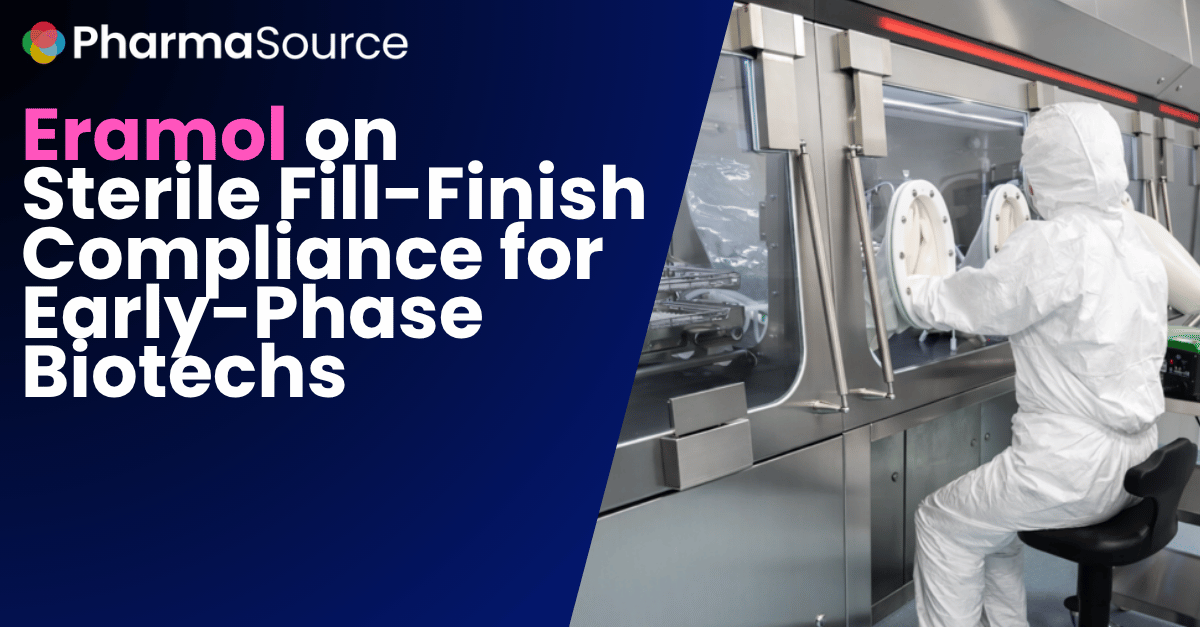
“One in every ten batches is going straight into the bin, and most biotechs have simply built that into their planning.”
Peter Mollison and David Cox are, respectively, Co-CEO & Co-Founder and Site Director at Eramol, a UK- and Ireland-based sterile fill-finish CDMO founded and led by Qualified Persons. Their new Sevenoaks facility was purpose-built to challenge the 10% material losses that have thus far been accepted as standard in sterile manufacturing.
The regulatory environment facing sterile fill-finish has rarely been more demanding. Annex 1 revisions have sharpened contamination control expectations across the industry. Post-Brexit dual UK/EU release requirements have added a layer of logistical and documentary complexity that many early-phase teams don’t fully anticipate until it causes delays. And FDA scrutiny on aseptic manufacturing continues to intensify. A biotech running a Phase I programme with limited API cannot afford compliance gaps that surface late, or a fill-finish partner quietly losing 10% of their drug substance to avoidable process inefficiencies.
Why the 10% Benchmark Was Always a Legacy Problem
The Mindset That Let Waste Become Standard
“Historically, sterile manufacturing was geared towards larger batches, lower-cost small molecules and more predictable supply chains,” says Peter Mollison, Co-CEO and Co-Founder of Eramol. “In that world, losses were acknowledged, but they weren’t a major concern. Over time, they became baked into how processes were designed, through overfill assumptions, equipment hold-up, and transfer inefficiencies, and eventually accepted as standard.”
The priorities of aseptic manufacturing reinforced this. Sterility assurance has always, correctly, come first. Yield was treated as secondary.
That trade-off made sense when you were filling large volumes of affordable small molecules. It makes much less sense for a Phase I biologic where you may have a single batch of API and no practical path to rapid resupply.
“When you step back, the cumulative effect is clear,” says David. “A 10% loss rate reduces optionality. It limits how far your API can stretch, increases dependency on additional manufacturing, and introduces avoidable risk into timelines and data packages.”
A 10% batch loss can force a biotech company to prioritize between supplying clinical trials, maintaining stability studies, and retaining samples, rather than fulfilling all three from a single batch. Such losses can delay first patient dosing and may necessitate an unplanned upstream manufacturing run at a critical stage, precisely when program momentum is hardest to regain
What Actually Drives Loss And How Eramol Designed Against It
Engineering Sub-1% Loss Into the Facility From Day One
When Eramol designed its new Sevenoaks sterile facility, the starting question was “why should any of this loss be treated as inevitable?”
David led the engineering thinking on the build. The decisions that drive sub-1% material loss, he explains, are not the product of any single innovation. They are the accumulated effect of questioning assumptions that most fill-finish setups simply inherit.
“In many conventional setups, product may move through longer tubing runs, more connection points, and larger hold-up volumes than are really necessary,” he says. “Each of those interfaces creates an opportunity for residual product to be left behind. By designing for a shorter, simpler product path, you reduce the amount of material sitting in the system at the end of a batch.”
Equipment sizing matters just as much. Standard commercial fill-finish systems are optimized for efficiency at volume. At small-batch scale, the hold-up volume that makes no practical difference at 10,000 units becomes a disproportionate loss at 200.
The third factor is the combination of QP oversight and engineering input at the design stage before anything is built. “The best solution is not simply the one with the lowest loss; it has to work within a compliant sterile manufacturing environment,” says David. “Having that regulatory and quality perspective in the room early meant we could challenge design assumptions without creating downstream compliance risk.”
The Questions Biotechs Should Ask Their Fill-Finish Partners
What to Interrogate Before You Sign
When biotechs evaluate a fill-finish CDMO, the conversation typically covers capacity, timelines, compliance track record, and cost per batch. What is almost never on the agenda, according to Peter, is a direct interrogation of yield.
“Yield is rarely positioned as a primary decision factor and that’s where many early programmes lose value before they’ve even started,” he says.
The specific questions that should be asked, but almost never are:
- “What is your typical line loss and how is it measured?” A partner who cannot answer this in detail does not have it under control.
- “Where exactly does material loss occur in your process?” Understanding whether loss happens at transfer, filtration, hold-up, or filling reveals whether the process has been examined or simply accepted.
- “What overfill assumptions are built into your batch design?” Overfill is sometimes used as a buffer that masks inefficiency rather than addresses it.
- “How do you balance yield optimization with Annex 1 compliance?” The right answer is that they are not in conflict, and a credible CDMO should be able to explain how.
Biotechs, Peter notes, tend to treat fill-finish as a downstream execution step (important, but not strategic). The reality is that it is the point in the programme where API is either preserved or permanently lost.

The QP-Led Difference: Quality at the Point of Decision
Eramol was founded by Qualified Persons. Peter and Co-CEO Eric Che are both QPs, and that has structural consequences for how programmes actually run.
Often in CMO environments, quality sits downstream of operations. Processes are designed, timelines are set, and then quality is applied to ensure compliance. That model works until something goes wrong. At which point, quality is in the position of challenging decisions that have already been made.
“In a QP-led environment, that dynamic shifts,” says Peter. “Quality and regulatory thinking are present at the point of decision-making, not after it. When a programme is being planned, the questions a QP would typically ask at release are being asked at the very beginning: Is this approach defensible from a regulatory perspective? What will this look like at the point of QP certification? Are we creating future risk in how this is being designed?”
The practical result is fewer surprises late in the programme, less rework, more predictable timelines, and a tighter alignment between what is commercially committed and what is operationally deliverable.
This matters particularly in the current regulatory environment. Annex 1 revisions have sharpened expectations around Contamination Control Strategy. Post-Brexit dual UK/EU release requirements add logistical and documentary complexity that many early-phase teams underestimate. Eramol holds in-house QP release capability for both UK and EU territories, with a dedicated Dublin site handling EU release, storage, and distribution. This eliminates the handoffs between organizations that most commonly cause late-stage delays.
“Batch documentation, QC data, and deviation management are all reviewed within a single, aligned system,” says Peter. “That can be the difference between days versus weeks when moving product into the next stage of the supply chain.”
“Think about QP release at the start. Manufacturing a batch and being able to release it are two very different things,” he stresses.
Actionable Takeaways
- Reframe yield as a programme metric, not an operational detail. Ask your current or prospective fill-finish partner for their documented line-loss data before you sign anything.
- Map where loss actually occurs in your intended process. Transfer steps, filtration, tubing hold-up, and vessel residuals each have different solutions. A vague answer about “standard overfill” is not an answer.
- Right-size the partner to your batch. A facility designed for commercial volumes will not automatically perform well at Phase I scale. Ask how their equipment is configured relative to the batch sizes you intend to run.
- Bring QP or quality expertise into CDMO selection conversations. The questions that surface compliance gaps, around Contamination Control Strategy, documentation readiness, and batch certification, are not procurement questions. Involve whoever will eventually sign off on clinical supply.
Practical lessons from David Cox’s (Site Director) presentation at CDMO Live Europe 2026: https://eramol.com/annex-1-and-quality-by-design-in-sterile-fill-finish-eramol/
Eramol will be at CDMO Live 2026. To discuss your sterile fill-finish programme, contact Na******@****ol.com and explore more: https://eramol.com/clinical-services-category/sterile-fill-finish/