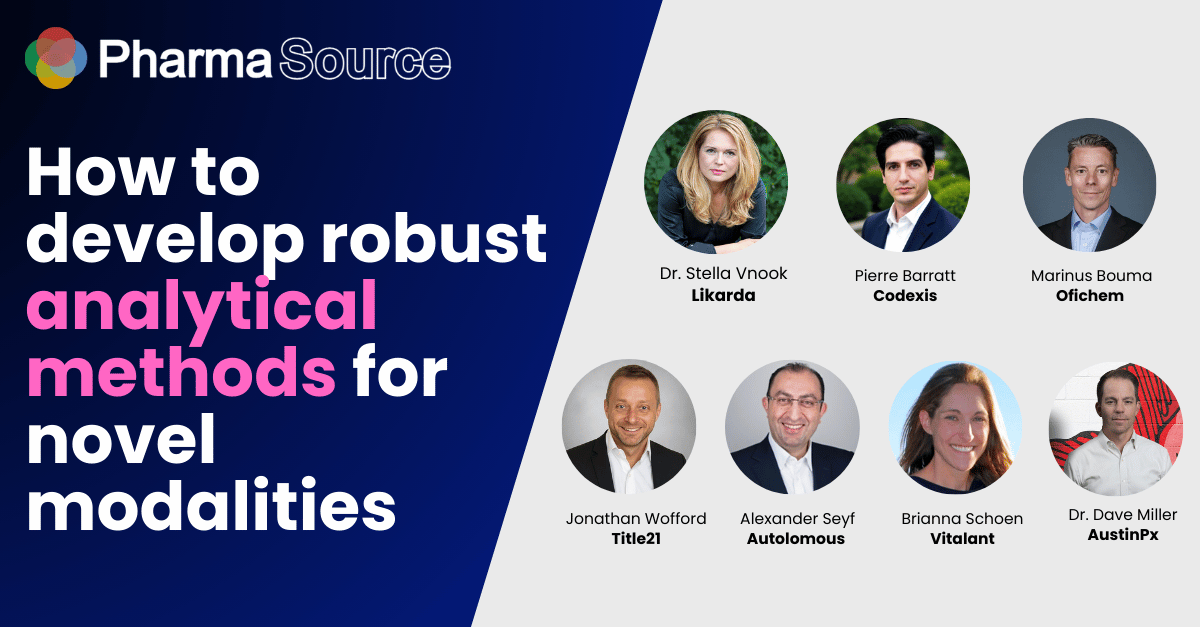
As cell and gene therapies, RNA-based platforms, and antibody-drug conjugates accelerate toward commercialization, the pharmaceutical industry must develop analytical methods robust enough to characterize increasingly complex therapeutic modalities while remaining flexible enough to evolve with emerging science.
PharmaSource asked analytical and CMC leaders across CDMOs, biotechs, and service providers how they’re addressing this challenge. Their responses encompass Quality by Design principles, orthogonal analytical approaches, and AI-enabled monitoring, acknowledging that today’s novel modalities require fundamentally different analytical strategies than those used for traditional small molecules or even first-generation biologics.
Regulatory Framework: ICH Q14 and Q2(R2) as Foundation
Multiple contributors emphasized that robust analytical development begins with regulatory alignment, particularly the ICH Q14 guideline on analytical procedure development and the revised Q2(R2) on analytical validation.
“Developing robust analytical methods for complex modalities such as antibody-oligonucleotide, antibody-peptide, and similar therapeutics is critical not only for regulatory compliance but also for ensuring smooth collaboration with outsourcing partners,” explained Marinus Bouna, Business Development at Ofichem. “As outlined in ICH Q14 and the revised Q2(R2), regulators expect a science- and risk-based approach to method development, with robustness demonstrated through structured studies rather than validation alone.”
Pierre Barratt, VP of Strategy & Program Management at Codexis, described how his organization anchors method development in these frameworks: “The framework is anchored in ICH Q14 (analytical development) and Q2(R2) (validation) and informed by Organic Process Research and Development case studies and the Capaldi et al. papers to ensure analysis complies with the latest guidelines and industry perspectives.”
This regulatory grounding provides essential structure, but leaders stressed that compliance alone doesn’t ensure analytical success for novel modalities.
Early Critical Quality Attribute Definition
Our experts agree that it’s important to define critical quality attributes early in development, well before traditional analytical method validation would typically occur.
For sponsors working with outsourcing partners, Marinus noted that regulatory frameworks “reinforce the need for early definition of critical quality attributes, such as conjugation ratio, linker stability, and sequence integrity. Establishing these parameters upfront allows methods to be designed for both scientific reliability and cross-site transferability.”
Dr. Brianna Schoen, VP of Biotherapies Scientific Development at VITALANT, emphasized that this foundational work must extend beyond basic characterization: “A foundational principle is a deep understanding of both established and emerging analytical platforms. Beyond traditional assays for identity, purity, and potency, advanced technologies such as high-resolution mass spectrometry, single-cell analytics, and digital PCR offer critical insights.”
Orthogonal Methods: Independent Verification for Complex Molecules
Given the heterogeneity and complexity of advanced therapeutics, reliance on single analytical techniques creates unacceptable risk. Leaders consistently advocated for orthogonal approaches that use different measurement principles to analyze the same attributes.
Jonathan Wofford, Chief Commercial Officer at Title21, explained the rationale: “Methods should be applied that use different measurement principles to analyze the same element, providing independent verification of the results and minimizing bias from a single method’s systematic errors.”
Codexis applies this principle systematically to RNA-based oligonucleotides synthesized through its enzymatic platform. “For RNAi built by ECO Synthesis plus ligation, our core panel includes IP-RP-MS/AEX HPLC for identity, purity, and impurity profiling, LC–MS/MS for sequence fidelity, duplex integrity by non-denaturing LC-UV, absence of residual enzyme by ELISA or LC-MS/MS, and endotoxin testing,” Pierre detailed.
This multi-technique approach provides redundancy that catches method-specific artifacts while building confidence in results across different analytical platforms.
Real-Time Analytics and AI
Alexander Seyf, CEO and Co-founder of Autolomous, describes a shift from traditional end-of-process testing toward continuous, in-process monitoring enabled by advanced sensors and artificial intelligence.
“We are moving away from a reliance on end-of-process testing. Instead, we use real-time, in-line analytics to monitor the manufacturing process as it happens. This provides a much richer dataset and allows for immediate adjustments, ensuring the final product meets all specifications.”
The technology enables more sophisticated data analysis than traditional approaches. “You can utilize AI and machine learning to analyze these massive datasets,” Alexander continued. “AI algorithms can identify subtle patterns and correlations that human analysts might miss, allowing us to predict potential quality deviations before they occur.”
Codexis has implemented a similar philosophy through what Pierre termed a “two-team operating model and a shared method-lifecycle mindset,” where Quality Control’s real-world experience “continuously informs analytical development to refine analytical methodology, forced-degradation designs, and tighten system suitability criteria.”
Transferability and Scalability: Designing for the Full Product Lifecycle
A critical consideration unique to outsourced development is ensuring analytical methods transfer reliably between laboratories and scale from research through commercial manufacturing.
“When creating these methods, they need to be transferable to GMP settings, and continuous monitoring should be performed as products and processes continue to change,” Jonathan emphasized.
Marinus noted that “analytical methods must perform consistently across different laboratories and different instruments. Applying Analytical Quality by Design principles, performing stress testing under varied conditions, and using orthogonal techniques provide confidence in reproducibility and robustness.”
Strategic Flexibility: Methods Must Evolve With Science
Perhaps the most sophisticated perspective came from leaders who view analytical strategy not as a fixed deliverable but as a dynamic capability that must adapt throughout a product’s lifecycle.
Dr. Stella Vnook, CEO of Likarda, emphasized this principle: “Novel modalities like cell therapies and regenerative biologics don’t fit neatly into existing pharmacopeia frameworks, yet regulators expect the same rigor… Robust doesn’t mean rigid: methods must be designed to evolve as the science does.”
Brianna made explicit what several others implied: analytical development informed by both successes and failures across clinical progression creates the most resilient strategies. “Delays in BLA (Biologics License Application) approvals are frequently linked to insufficient assay robustness, lack of comparability following process changes, and inadequate potency characterization,” she noted. “These challenges highlight the need for early investment in deep characterization, including the development of alternative analytical options that can be scaled or substituted as clinical programs evolve.”
Integration from Day One
The consistent message across all contributors was that analytical strategy cannot be separated from broader CMC and manufacturing strategy, particularly for novel modalities where the relationship between process and product is incompletely understood.
“Analytical strategies must be designed with regulatory expectations in mind from pre-IND through commercialization,” Brianna advised, emphasizing alignment with FDA guidance documents for gene therapy INDs, potency assurance, and global standards including ICH Q2(R2) and Q14.
Codexis maintains this integration through active participation in the broader scientific community. “We stay current and pragmatic by education and participation in oligonucleotide CMC conferences such as TIDES, RNA Leaders Congress, Oligonucleotide & Analytical Development Summit,” Pierre explained.
Analytical excellence for novel modalities requires ongoing dialogue between sponsors, CDMOs, and technology providers. CDMO Live Europe and Americas will include workshops and panels focused on CMC and analytical strategies, providing forums for manufacturers and sponsors to share best practices and address emerging challenges in this rapidly evolving field.