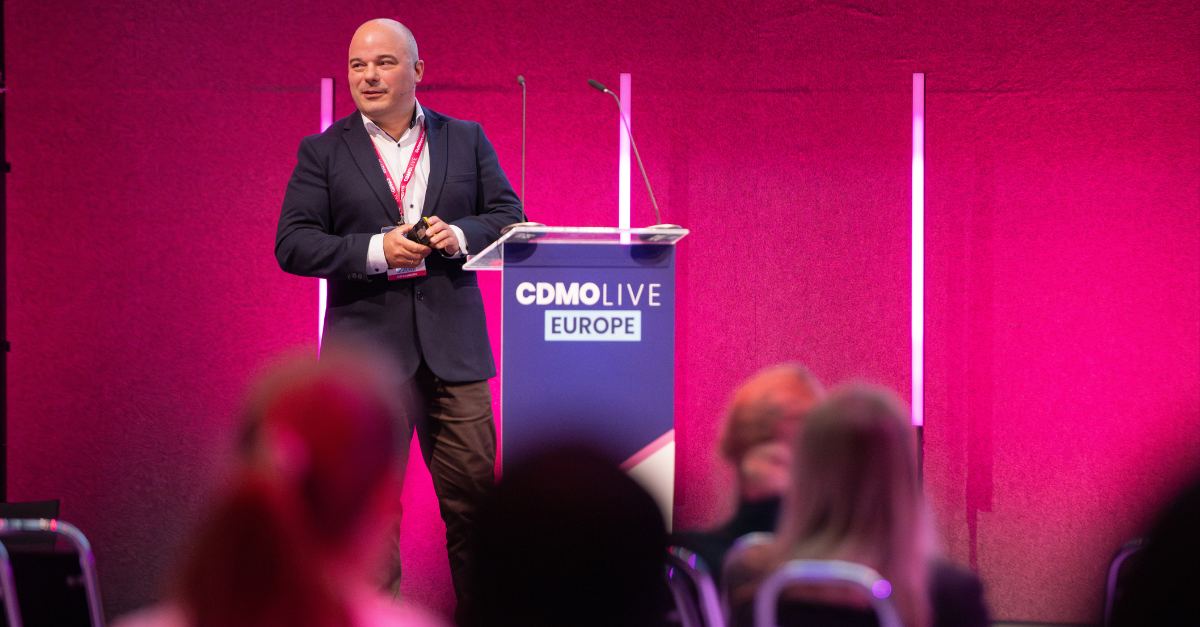
Andrzej Hoczyk, External Supply Operations (ESO) Head at Polpharma, presented the case for treating large-scale tech transfer as a managed program rather than a series of parallel projects, drawing on a five-year, 21-product sterile portfolio migration across five contract manufacturing sites.
When a manufacturing site is exiting and the products it makes cannot afford supply interruptions, the question is not which contract manufacturing organization to pick. The question is how to move an entire portfolio without losing control. That was the situation Polpharma faced, and Andrzej Hoczyk used his Tech Transfer Masterclass to explain what it took to execute a migration at that scale.
The numbers frame the challenge: 21 products, 19 molecules, 108 stock-keeping units (SKUs), 108 marketing authorizations across 4 countries, 3 regulatory bodies, and 5 partner sites — 4 primary CMOs and 2 fallbacks. The program ran from 2019 to 2024, involved 35 contributors, and produced 28 demonstration batches, 72 validation batches, and 64 regulatory procedures. The products were sterile injectables in vials, manufactured across three bottle systems and sold through two market channels. “We were not optimizing costs or shopping for new partners,” Hoczyk said. “We were facing the exit of a manufacturing site with a portfolio that could not afford supply breaks.”
Why Standard Project Logic Fails
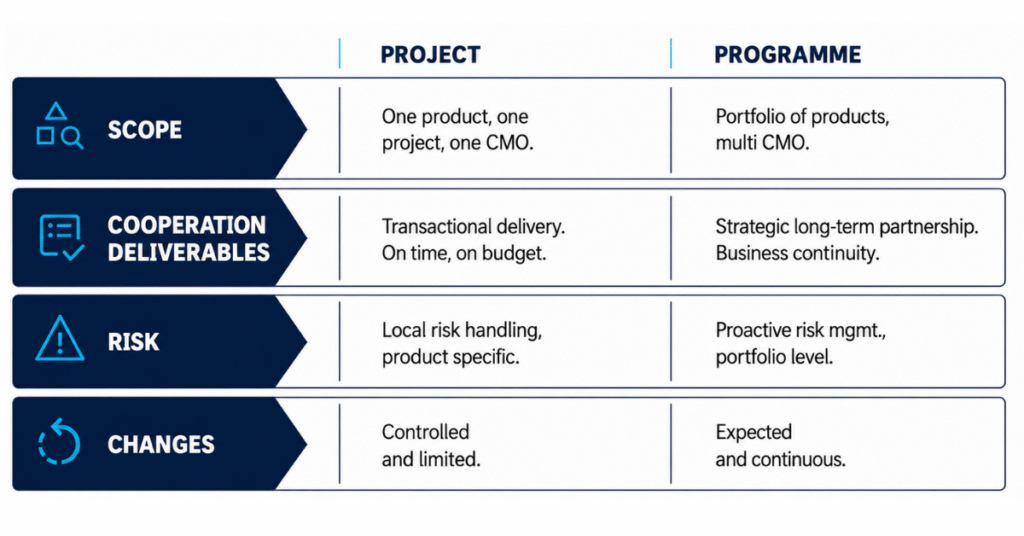
Hoczyk drew a contrast between project and program thinking. A project operates on one product, one CMO, and a transactional delivery model focused on time and budget. A program spans a portfolio of products and multiple CMOs, demands strategic long-term partnership, and requires continuous change management rather than controlled scope. Risk in a project is handled locally and product-specifically. At program level, risk management must be proactive and portfolio-wide. Hoczyk’s argument was that the classic “one product, one CMO, one project” model proved structurally insufficient the moment complexity scaled.
The hurdles the team encountered reinforced that point. On the technical side, these included filter validation, cleaning validation, analytical method transfer, and an API sterilization change from ethylene oxide to thermal. Regulatory complexity layered on top: the EU Medical Devices Regulation (MDR) 2017/745 came into force mid-program, adding separate Good Manufacturing Practice (GMP) lines for MDR-compliant products alongside standard GMP lines. External shocks — war, COVID-19, raw material lead times, and shelf life pressure — arrived on top of an already loaded execution plan.
How The Program Was Actually Run
Polpharma structured the transfer into logical waves rather than running all products simultaneously. Wave-based sequencing allowed learning to compound across the program, improved capacity utilization on both the sponsor and CMO side, and gave the team a mechanism for building predictability under pressure. CMO selection was based on technical and operational due diligence by an experienced manufacturing science and technology (MS&T) team, not cost alone. Products were matched to sites based on technology fit and critical product parameters; where uncertainty remained, testing decided.
The sequencing principle was consistent: optimize first, then validate, then scale. Starting with process optimization before full validation reduced rework and protected timelines. Fallback options were not treated as contingency plans to be activated if something went wrong. They were engineered into the execution model from day one, with defined switch triggers for when to move a product from a primary CMO to a fallback site. “The program stayed on track not because risks didn’t materialize, but because fallback options were engineered into the execution model from day one,” Hoczyk said.
What The Team Would Refine
Hoczyk explained where the program could have moved faster. Feasibility analysis for analytical capabilities and laboratory capacity needed to happen earlier and with greater depth — analytical, quality assurance, and regulatory bandwidth all proved tighter than the team had anticipated. Regulatory scenario planning for MDR and Annex 1 changes should have been modelled as scenarios from the start rather than treated as fixed assumptions. Switch-to-fallback thresholds, though defined, could have been set earlier to reduce execution friction when pressure peaked.
Takeaways
- Run the transfer as a program: one cadence, one integrated risk view, one decision forum.
- Group transfers into logical waves so learning compounds and capacity stays usable on both sides.
- Treat analytics, manufacturing, and regulatory change as the real timeline drivers.
- Engineer fallback options and define switch triggers from day one — optionality only works when it is prepared in advance.
- Follow the sequence: optimize, then validate, then scale, using matrixing, bracketing, and partial filling where justified.
- The critical path is not manufacturing. Identify the actual constraint — analytical capacity, regulatory bandwidth, or documentation load — and manage against it.