“The manufacturing process doesn’t just produce the product — it determines what the product becomes.”
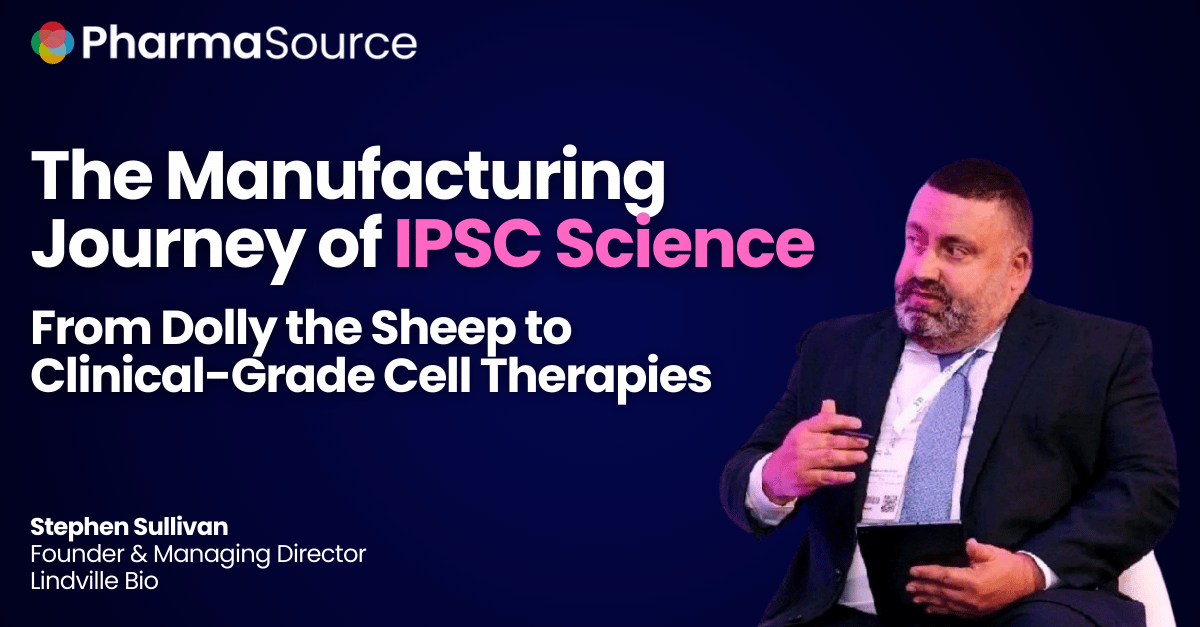
Stephen Sullivan, Founder of Linville Bio, brings more than two decades of experience spanning developmental biology, clinical translation, and manufacturing strategy across organizations, including Novartis and the Global Alliance for iPSC Therapies. Most recently, he led the setup of a first-in-human trial for an iPSC-based cancer vaccine.
In this PharmaSource podcast episode, Stephen discusses the manufacturing challenges involved with induced pluripotent stem cell (iPSC) therapies and why companies that treat it like a downstream operational problem, rather than a core product design decision, are setting themselves up to fail.
Understanding What Makes iPSC Therapies Different
For anyone whose professional world centers on established modalities — antibodies, small molecules, established biologics — iPSC therapies represent different manufacturing considerations, and the distinction begins at a biological level.
iPSCs have two defining properties that make them attractive as a manufacturing platform. First, they can self-renew: a small number of cells can be expanded in bioreactors to the volumes required for clinical applications. Second, they are pluripotent — meaning they can be directed to differentiate into virtually any cell type in the body, from cardiomyocytes to dopaminergic neurons to insulin-producing beta cells.
“iPSCs represent one of the first truly scalable models for regenerative medicine. You can take stem cells, grow them in number outside the body, and differentiate them into different cell types for a whole plethora of indications.”
This scalability is what separates iPSC therapies from other cell therapy approaches, where the therapies hinge on removing material from a patient. With iPSC-derived products, the manufacturing unit is external, renewable, and theoretically unlimited.
The field has reached a significant clinical milestone: Japan recently granted the first regulatory authorization for iPSC-derived medicines — one for heart repair following ischemic cardiomyopathy, and another delivering dopaminergic neurons to treat Parkinson’s disease.
Unique Manufacturing Challenges
The single biggest surprise for professionals arriving from traditional pharmaceutical backgrounds, according to Stephen, is that the manufacturing process and the biology are inseparable.
“In traditional pharma, you’re producing a well-defined molecule. In iPSC cell therapies, the product is a living cell population, and the manufacturing process actually guides the developmental trajectory of those cells.”
In conventional drug development, manufacturing can often be optimized later because the underlying platform technology is well understood. With iPSC therapies, that luxury does not exist. Decisions made in early development — which cell line to use, which growth factors to include, how to handle sterility — directly determine the biological activity of the final product.
With conventional pharmaceuticals, terminal sterilization can be applied to the final packaged product. In contrast, living-cell therapies cannot undergo terminal sterilization because the cells would be destroyed. Therefore, sterility must be ensured throughout the entire manufacturing process via tightly controlled aseptic processing and contamination-control strategies.
The consequence, Stephen notes, is that early developers frequently make decisions without understanding their downstream manufacturing implications. A growth factor used in the lab for biological convenience may render cells unfit for clinical-grade production. A cell line selected without proper consent documentation creates regulatory exposure. These errors, made early, are often difficult or impossible to correct without restarting development.
The Standardization Gap
Stephen identifies the absence of standardization as one of the most underappreciated constraints on iPSC therapy development. The problem came into sharp focus in 2017, when he was working as Program Manager for the Global Alliance for iPSC Therapies.
A survey sent to the organization’s several hundred members revealed that their definitions of cell quality varied widely — and so did the assays they used to measure it. Members working in the same field, using the same terminology, were in many cases measuring entirely different things.
“It really pointed to the fact that unless there was greater alignment and standardization, the iPSC cell field would be unnecessarily held back. We’d seen with other cell therapy spaces that a lack of standardization at a critical time meant everyone was working off their own specifications.”
In response, the Global Alliance established a provisional global standard for critical quality attributes for clinical-grade iPSC lines — covering characteristics like sterility, genomic stability, and specific marker expression — and then organized a series of blinded quality round robins.
In these exercises, identical materials were sent to sites worldwide. Each site tested for quality according to its normal protocols, then submitted blinded data. The aggregated results showed, repeatedly, that laboratories believed they were aligned when they were not. A paper summarizing four years of this work is scheduled for publication in March, and Stephen expects it to be a significant prompt for the field to raise its standards around biomarker expression analysis by flow cytometry.
If one company’s quality test produces a different result than another company’s quality test on the same material, the manufacturing data from each site cannot be reliably compared or combined. That is a fundamental obstacle to scaling.
When to Involve Manufacturing
The answer to when a biotech company should begin thinking seriously about manufacturing, in Stephen’s view, is as early as possible.
This is not simply a matter of operational planning. It is a product design question. The way cells are expanded, the conditions under which they are cultured, the process by which differentiation is directed — all of these affect the behavior of the final therapeutic. Manufacturing is not downstream of the science. It is part of the science.
“Manufacturing is not just a downstream operational activity. Manufacturing is part of the product design. You’ve got to be thinking about it from very, very early on.”
The risk of not doing so is the possibility of investing substantial resources into a therapeutic pathway that cannot be manufactured to clinical grade — or cannot be manufactured reproducibly at scale — by the time regulatory submission approaches.
Navigating the CDMO Landscape
The CDMO ecosystem for advanced therapies is, in Stephen’s assessment, still maturing. The sector has been through significant turbulence — a rapid scaling phase driven by enormous anticipated demand, followed by a contraction as some of that demand failed to materialize or shifted following COVID. The result has been financial pressure on a number of smaller players.
Stephen believes the most likely path forward is consolidation: fewer CDMOs, but with deeper expertise, having absorbed specialists and accumulated meaningful clinical experience. He sees this as ultimately positive for clients, provided they know how to evaluate the remaining options.
The questions he advises clients to ask go beyond capacity, cost, and timelines:
- Does the CDMO genuinely understand stem cell biology, rather than just cell therapy operations generally?
- Is the CDMO active in global standards discussions? Absence from those conversations is a red flag.
- Can they demonstrate a track record of progressing programs not just to clinical trials, but toward commercial viability?
- Are the cells they offer properly consented? Some CDMOs are offering cell lines whose documentation is inadequate.
- Do they have a vision for translation that extends through to commercialization, beyond just early-stage clinical work?
“In this field, the CDMO often becomes a co-developer of the manufacturing process. Working with one that has a holistic vision for translation well beyond just clinical trials is essential.”
Common and Costly Mistakes
When companies attempt to scale iPSC manufacturing from lab to clinical grade, certain failure patterns appear repeatedly. Stephen identifies several:
Misunderstanding What GMP Actually Means
GMP is, at its core, a documentation and process consistency framework. It is not a quality standard in itself. Yet Stephen regularly encounters early developers and some marketing teams, who treat GMP compliance as a proxy for product quality.
“You can make a GMP bucket of muck. If you document it and you repeatedly get a bucket of muck at the end, that’ll fulfill GMP — because it’s consistent and well documented. But it says nothing about quality.”
Understanding what GMP does and does not guarantee is essential for making sound decisions about manufacturing partnerships and release criteria.
Translating Academic Protocols Directly Into GMP Processes
Academic protocols are designed to demonstrate biological mechanisms. GMP manufacturing processes must prioritize reproducibility, scalability, and process control. These are different design objectives, and conflating them creates problems that are expensive to unwind.
Assuming Alignment That Does Not Exist
Perhaps the most insidious risk, in Stephen’s experience, is the assumption of shared understanding. Two parties can use the same language, agree in a meeting, and proceed to execute against entirely different interpretations.
“You’re sitting across from another stakeholder, they’re agreeing with you, and you think you’re on the same page. And then it turns out that even though you’re both using the same language, your understanding of the words is different.”
His recommended discipline is paraphrasing: restating what the other party has said in your own words to verify mutual understanding before acting on it. Combined with detailed, well-constructed SOPs and a painstaking review of assumptions before beginning a manufacturing run, this is the most effective protection against costly misalignment.
Where the Field Is Heading
Looking five years ahead, Stephen expects deeper CDMO expertise, continued rapid clinical development, and advances in the analytics needed to verify cell functionality at scale, particularly around genomic stability testing.
He also sees a significant role for AI in addressing one of the field’s persistent structural challenges: helping early developers communicate more effectively with regulators.
The core problem is contextual. Regulators can only give actionable answers when they have sufficient context. Early developers in novel modalities often don’t know how to frame questions in terms that allow a regulator to respond usefully. The result is non-actionable feedback that developers interpret as obstruction, when in fact the regulator is simply waiting for the information they need.
“Going into a court of law and asking an attorney for a checklist to prove innocence — the attorney is going to turn around and say that depends on what the crime is. Without context, I can’t give you a straight answer. A lot of early developers fall into that trap with regulators.”
Stephen sees AI trained on regulatory guidance documents as a tool that could allow early developers to run a kind of rehearsal before engaging regulators directly — building the vocabulary, understanding the expectations, and learning to frame questions in a way that enables constructive dialogue.
He also notes that in emerging modalities, the responsibility for regulatory engagement is shared, not delegated. It is the developer’s job to engage the regulator proactively, not simply to wait for instructions.