“Aligning development strategy early creates a real competitive advantage. When scalability and late-stage requirements are already considered during Phase I and II, you avoid gaps that cause delays further down the line.”
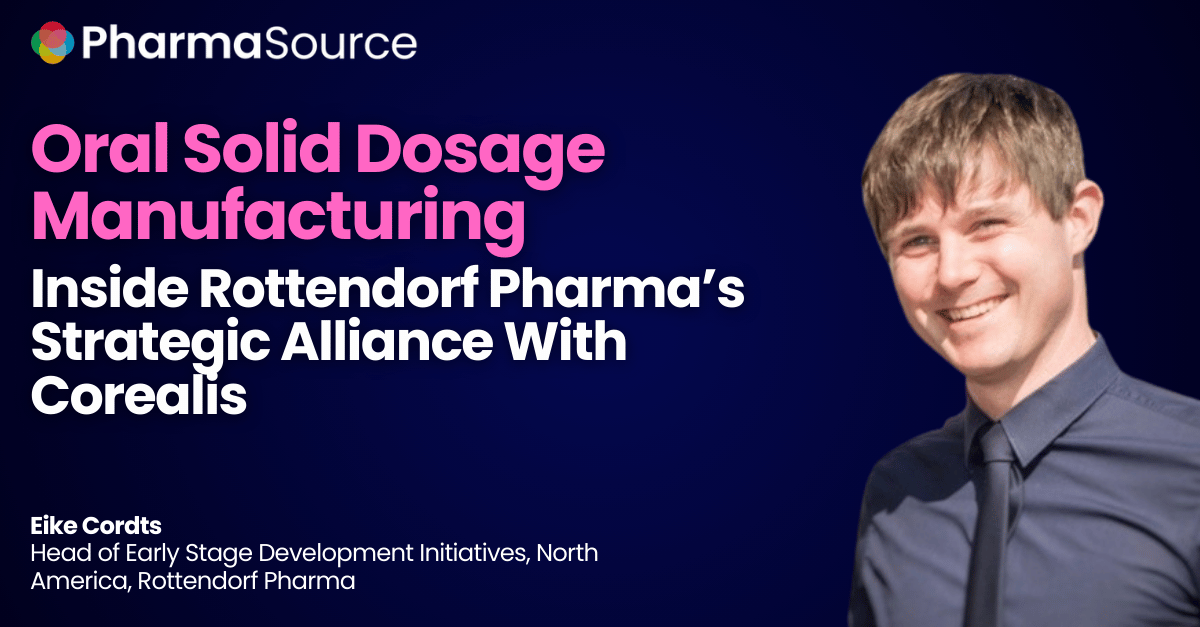
Eike Cordts, Head of Early Stage Development Initiatives, North America, Rottendorf Pharma, leads early stage development initiatives in North America for Rottendorf Pharma, a German CDMO with nearly a century of expertise in oral solid dosage (OSD) forms. Having grown from 800 to over 1,400 employees in the past decade, Rottendorf recently formalized a strategic transatlantic partnership with Corealis Pharma, a Canadian early-phase OSD specialist. In this PharmaSource podcast episode, Eike explains the strategic thinking behind the alliance and what it means for pharmaceutical companies seeking an integrated development-to-commercialization pathway.
Why Early-Stage Partnerships Are Reshaping CDMO Selection
The way pharmaceutical companies choose their development partners has shifted. According to Eike, the defining trend is that a long-term manufacturing strategy must be defined during early development, not after.
Three factors drove Rottendorf’s decision to formalize its alliance with Corealis. First, physical proximity to North America, where a large proportion of early-phase development activity originates. With API material often in short supply and development timelines compressed, having an on-the-ground presence in Canada enables faster decision-making, simplified logistics, and the ability for customers to be on-site during both development and clinical trial activities.
Second, a strong cultural and scientific match. “They share a similar scientific mindset, high-quality standards, and a collaborative way of working,” Eike explains. Both companies are specialized in OSD—a deliberate alignment that means the two teams “speak the same language from day one.”
Third, the competitive advantage of early alignment. Considering scalability and commercialization requirements at Phase I and II eliminates the technical gaps that typically emerge during late-stage transitions—gaps that translate directly into timeline delays and cost overruns.
“Rather than combining unrelated capabilities, we are connecting two OSD experts focused on different stages of the product lifecycle.”
A Sequential, Not Overlapping, Capability Model
The partnership is structured around complementary expertise rather than redundant capability. Corealis leads pre-formulation and Phase I and II formulation development, where speed, flexibility, and scientific iteration are paramount. Rottendorf takes responsibility for Phase III scale-up, process validation, and commercial manufacturing, where process robustness and regulatory reliability are the priorities.
Rottendorf contributes deep technical expertise across the full OSD technology spectrum: conventional processes including direct compression, roller compaction, fluid bed granulation, and high-shear granulation; specialized dosage forms such as pediatric formulations, pellet systems, and mono/bilayer tablets; modified release technologies; and hot melt extrusion (HME) for poorly soluble APIs.
Critically, the model is designed to eliminate the traditional handoff. Rottendorf experts are engaged during early-phase work to ensure manufacturability and scalability are built into formulation decisions from the outset. Staff from Rottendorf are present on-site at Corealis for key development milestones and clinical manufacturing activities. Analytical method validation (an activity that frequently creates bottlenecks) can be initiated in parallel, compressing overall timelines.
“The goal is to avoid thinking about it as a traditional handoff,” Eike says. “The collaboration starts much earlier.” A joint execution and governance team manages each program throughout the full development journey.
Foundation Ownership: The Strategic Enabler
Rottendorf’s longevity—the company is approaching its centenary—is not simply a function of technical capability. It is rooted in an unusual ownership structure. Rottendorf Pharma is wholly owned by the Rottendorf Foundation, a charitable entity whose mission is to ensure a sustainable company that provides stable employment. There are no external shareholders demanding short-term profit optimization.
This structure has practical consequences. It enables long-term investment in staff, infrastructure, and technology. It preserves agility in decision-making. And it sustains a customer-first culture that Eike describes as foundational. “The customer truly comes first—not only operationally, but also in how we design processes, make decisions, and build long-term collaborations.”
The same ownership model has guided growth. Rottendorf expanded from 800 to over 1,400 employees over the past decade—not by diversifying broadly, but by deepening its OSD capabilities. Every additional headcount, according to Eike, was driven by a single goal: to support customers better through greater scientific expertise, stronger project management, and more robust technical guidance across the development lifecycle.
“We never wanted to grow for the sake of growing. The increase in people was driven by one goal: to support our customers better.”
What Pharma Companies in North America Are Asking For
Eike identifies three consistent themes emerging from conversations with North American pharma and biotech clients.
- Speed to clinic and market. Development timelines are tightening, and companies need partners who can move quickly without compromising quality or regulatory expectations.
- Flexibility. Development plans change constantly in early and mid-stage programs. The ability to adapt processes, timelines, and manufacturing approaches without creating additional delays has become a critical differentiator.
- Reliable capacity. Following recent global supply disruptions, companies are placing heightened emphasis on partners who can guarantee long-term supply and execution continuity.
The Corealis partnership is designed to address all three. The transatlantic setup reduces logistics risk for clinical supplies and supports faster decision-making through geographic proximity. The joint governance model ensures flexibility without sacrificing scientific continuity. And Rottendorf’s existing investment in a robust, qualified supplier network—built over several years—provides the supply chain resilience that underpins commercial-scale commitments.
A Customer-Centric Model
One design principle distinguishes this partnership from conventional integrated CDMO models: it is not a binding arrangement. Customers who begin development at Corealis are not contractually obligated to transition to Rottendorf for later-stage work.
The partnership provides a “ready and well-aligned pathway forward—not a lock-in,” Eike explains. For companies whose programs evolve in unexpected directions—a common reality in early-phase development—the flexibility to adapt remains fully intact.
The value proposition is continuity of knowledge and alignment of strategy, not captive volume. Customers gain a seamless route from early clinical work to commercialization if they choose it, while retaining the freedom to make decisions as their program matures.
The Road Ahead: Deepening Integration and Expanding Capability
Eike frames the Corealis partnership as the beginning of a long-term collaboration, not a fixed arrangement. Over the coming years, the two companies intend to deepen technical collaboration, strengthen scientific exchange, and further align quality systems and operational processes—with the goal of operating increasingly as a single integrated team from the customer’s perspective.
In parallel, Rottendorf is continuing to expand development capabilities at its German headquarters, including investment in handling more potent compounds and advancing continuous manufacturing technologies.
The combined effect is a strengthened position in the global OSD CDMO landscape: a seamless pathway from first-in-human studies through Phase III and into commercial supply, underpinned by nearly a century of formulation expertise and a foundation-backed commitment to long-term partnership.