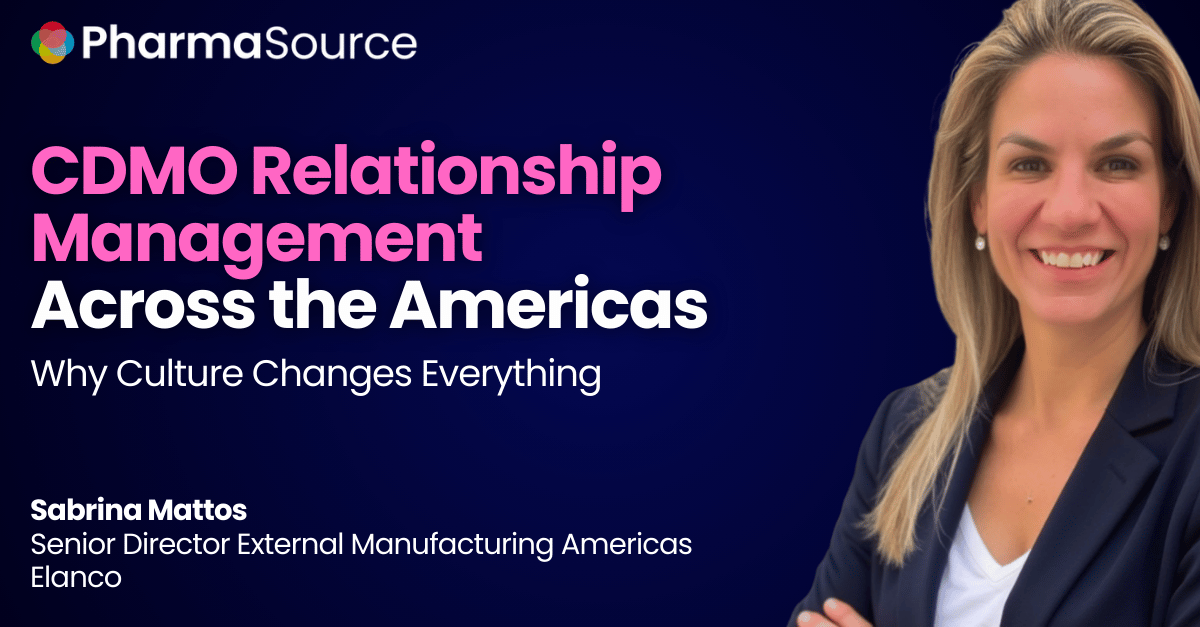
“When we go to an external partner, we need to show up as one single aligned organization. If we’re not aligned internally, the CMO ends up becoming the referee.”
In pharmaceutical manufacturing, the quality of a CDMO partnership is rarely determined by the contract alone. According to Sabrina Mattos, Senior Director of External Manufacturing for the Americas at Elanco, what truly separates high-performing partnerships from dysfunctional ones comes down to two factors: internal alignment and cultural intelligence.
Sabrina brings over 20 years of pharmaceutical industry experience spanning quality, supply chain, and operations leadership across Brazil, Europe, and North America. As a pharmacist who began her career as a QA representative at Eli Lilly in Brazil, she has progressed through site leadership and global roles to now oversee Elanco’s external manufacturing portfolio across the US, Canada, and Latin America — a hub spanning close to 50 CMO relationships.
In a recent PharmaSource Podcast conversation, Sabrina shared how Elanco structures its external manufacturing teams, navigates the cultural differences that shape partnerships across the Americas, and why getting internal alignment right before approaching a CDMO is non-negotiable.
Navigating Cultural Differences Across the Americas
Managing a portfolio that spans the US, Canada, and Latin America requires more than operational coordination — it requires cultural fluency. Sabrina speaks about this, drawing on her Brazilian background and years of working across multiple geographies.
The foundational goals are the same in every market: clarity, trust, and shared objectives. But how those goals are pursued varies significantly depending on cultural context.
Latin America: Relationship-First Dynamics
In Latin America, Sabrina explains, everything starts with the personal relationship. If a CMO partner trusts you as a person, the business follows naturally — and that trust is built through presence, accessibility, and genuine engagement with what is happening in the partner’s world.
“In meetings, before diving into technical topics, partners will walk you through what’s happening around them, what the team is dealing with, local challenges, even what’s going on in the community. That’s not just storytelling — understanding that full picture is part of how decisions are actually made.”
This relational dynamic creates a highly responsive, real-time collaboration style. Issues are resolved in the moment rather than waiting for the next formal meeting. And the time invested in personal connection, Sabrina notes, accelerates the work that follows.
North America: Structure-First Dynamics
In the US and Canada, the dynamic is more structured and process-driven. Expectations are set explicitly, timelines are agreed, and communication flows through established governance channels. Relationships matter — but they develop through demonstrated reliability and consistent delivery.
“In North America, people are very respectful of time and tend to keep communication straightforward. The relationship doesn’t matter any less — it absolutely does — but it grows over time through commitments and deliveries.”
Sabrina’s core insight is that neither approach is superior. Both work. The skill lies in recognizing which cultural operating mode you are in and adapting accordingly — rather than applying a single uniform approach across all markets.
Animal Health: A Distinctly Dynamic Operating Environment
Elanco operates in animal health, a sector that shares many structural similarities with human pharma — GMP standards, reliance on CDMOs, quality and safety requirements — but differs significantly in its commercial context.
In animal health, price sensitivity is higher, volumes are smaller, and product diversity is greater. More importantly, speed matters in a way that is qualitatively different from human pharma. Seasonal demand patterns in food animal health and the potential for rapid disease outbreak-driven demand shifts can change requirements almost overnight.
“The animal health market moves really fast, especially in food animals, where seasonality or disease outbreaks can shift demand overnight. Our CMOs need to be very responsive and flexible for that.”
The regulatory landscape also adds layers of complexity absent in human pharma. In the US, animal drugs may fall under the jurisdiction of the FDA Center for Veterinary Medicine, the USDA, and the EPA simultaneously, depending on product type. Products for food animals must demonstrate that drug residuals in meat, milk, or eggs are safe for human consumption, with defined withdrawal periods — a compliance requirement with no equivalent in human health manufacturing.
This means Elanco’s CMO portfolio itself is more varied. Partners must be equipped to navigate different regulatory frameworks, and the internal team managing them must be flexible enough to adapt its oversight model accordingly.
The Virtual Site Model: Managing CMOs as an Integrated Network
Elanco uses what it calls a “virtual site model” to manage its external manufacturing partners — an approach that changes how internal teams are organized and how they engage with CMOs.
Rather than assigning individual managers to individual CMOs, the virtual site model groups related CMOs together and assigns a dedicated, cross-functional process team to manage them collectively. That team, which includes quality, supply chain, technical services, planning, and sometimes finance, operates as if the CMOs it oversees were a single, integrated manufacturing site.
“Just like a physical site, the virtual site has a process team leader who brings together quality, supply chain, and technical service functions. Instead of each CMO being managed individually, we manage them as a network — with shared KPIs and a single way of coordinating activities.”
The benefit of this approach, Sabrina explains, is consistency and proximity. The same internal team stays engaged with the same group of CMOs every day, which accelerates trust-building, speeds up decision-making, and prevents the communication fragmentation that can develop when management is siloed by function or geography.
“The virtual site is a mindset as much as a structure. We treat external manufacturing as a natural extension of our own operations — and that makes the partnership stronger and more agile.”
An Organizational Evolution: From Legacy Structure to Technical Platforms
Elanco’s current structure didn’t emerge fully formed. Sabrina describes a significant evolution driven by the company’s growth through acquisitions, which left the organization as a collection of legacy teams aligned by region or commercial business unit.
That fragmentation created real problems. Different functions had different priorities, different ways of working, and different expectations of CMOs. As the hub expanded, complexity compounded.
“We realized we needed a structure that truly supported scale and consistency. So we stepped back, reassessed everything, and rebuilt the organization around process teams — dedicated cross-functional teams responsible for groups of CMOs, all aligned to the same priorities and goals.”
A particularly significant shift was moving from organizing the business by commercial unit to organizing it by technical platform. For Sabrina, this was a turning point: it enabled the team to build genuine technical expertise, drive standardization across the CMO portfolio, and provide more predictable support to partners.
The impact was immediate. Communication improved, decision-making accelerated, and supply reliability metrics followed suit.
Why Internal Alignment Must Come Before CMO Engagement
One of the clearest and most emphatic points Sabrina makes concerns internal alignment — specifically, the need to resolve cross-functional disagreements before sitting down with a CDMO partner.
“CMOs can immediately tell when a company isn’t aligned internally. You see it when quality is asking for one thing, supply chain is pushing something different, and technical has a completely different timeline. That creates confusion, slows everything down, and damages credibility.”
The consequences of misalignment extend beyond inefficiency. When conflicting signals reach a CMO, the partner is forced into the role of mediator — navigating competing demands rather than focusing on execution. Over time, this erodes trust, drives up costs, and, in the worst case, leads the CMO to prioritize other clients who are easier to work with.
Elanco addresses this through what it calls Joint Process Teams (JPTs) and rigorous pre-engagement governance. Before approaching a CMO, the process team leader brings together operations, procurement, supply chain, and technical functions to agree on a unified message: what is needed, why it is needed, and what the non-negotiables are.
“When we talk to the CMO, we speak with one voice. The CMO isn’t getting mixed messages — and that’s when the partnership really flows.”
Building a Career in External Manufacturing: Sabrina’s Advice
Asked about career development in this field, Sabrina’s guidance centers on three principles.
First, stay close to the operational reality of the work. Understanding how quality decisions get made, how supply chains move, and how problems are actually solved on the ground is a foundation that remains valuable regardless of where a career leads.
Second, invest in relationships as a professional discipline, not just as a social activity. Every significant transition in Sabrina’s own career has come through partnerships and through developing the ability to influence beyond formal authority.
“Technical expertise matters. But your ability to collaborate, communicate, and build trust is what truly accelerates your development.”
Third, lean into complexity rather than away from it. The experiences that build the most resilience, confidence, and leadership capability tend to come from situations that are unclear, challenging, or simply difficult.