“Rather than saying that there’s a gap from the industry, I think there’s a listening gap from our governments.”
Neha Dave is an independent EU Government Affairs Advisor based in Brussels, with more than 20 years of experience across the EU institutions, agency-side consulting at Weber Shandwick, and government affairs and public policy at MedTech Europe. She advises pharma and medtech companies on entering and navigating the European market, with policy expertise spanning pharmaceuticals, MDR/IVDR, clinical trials, and the single market.
In the latest PharmaSource podcast episode, Neha explains how EU regulation, particularly the environmental and sustainability agenda is landing on contract manufacturers, which legislation is already in force, what arrives in the next 12 to 18 months, and what CDMOs should be doing now to prepare.
The EU’s Power Within Pharma Manufacturing
A common assumption is that because the EU does not control national healthcare budgets, its influence over the industry is limited, but Neha explains otherwise. The EU’s authority runs through the single market, and manufacturing sits squarely inside it. She points to Article 168 of the Treaty on the Functioning of the European Union as the foundation.
“The EU does have that responsibility of providing a high level of human health protection, and that needs to be implemented across policy areas. So it’s not just a vertical line, it is a cross-horizontal aspect. The EU supports, but it does not replace national health systems. The actual treaty does say that the EU’s role is to complement member states and national governments rather than taking responsibility for healthcare. And that is why reimbursement still sits at the national level for therapies.”
Where the EU can legislate directly is on quality and safety (of medicinal products, medical devices, blood, organs and tissues) because these fall under the single market.
“When you have something like a regulation it’s actually going straight down to national level. When you have a directive, it is possible for member states to go to the lowest common denominator and actually be able to have some flexibility in its implementation. And then of course, we have soft policy, which is more about the direction.”
The underlying goal, she says, is equal access across the union: “The fact that a patient in one country should not have to be subject to the postcode lottery because of where they live.”
Mapping the Environmental Legislation That Crosscuts Manufacturing
Asked where environmental policy intersects with pharmaceutical manufacturing, Neha’s answer is that the intersection is now so broad it needs a map. She organizes it into seven clusters:
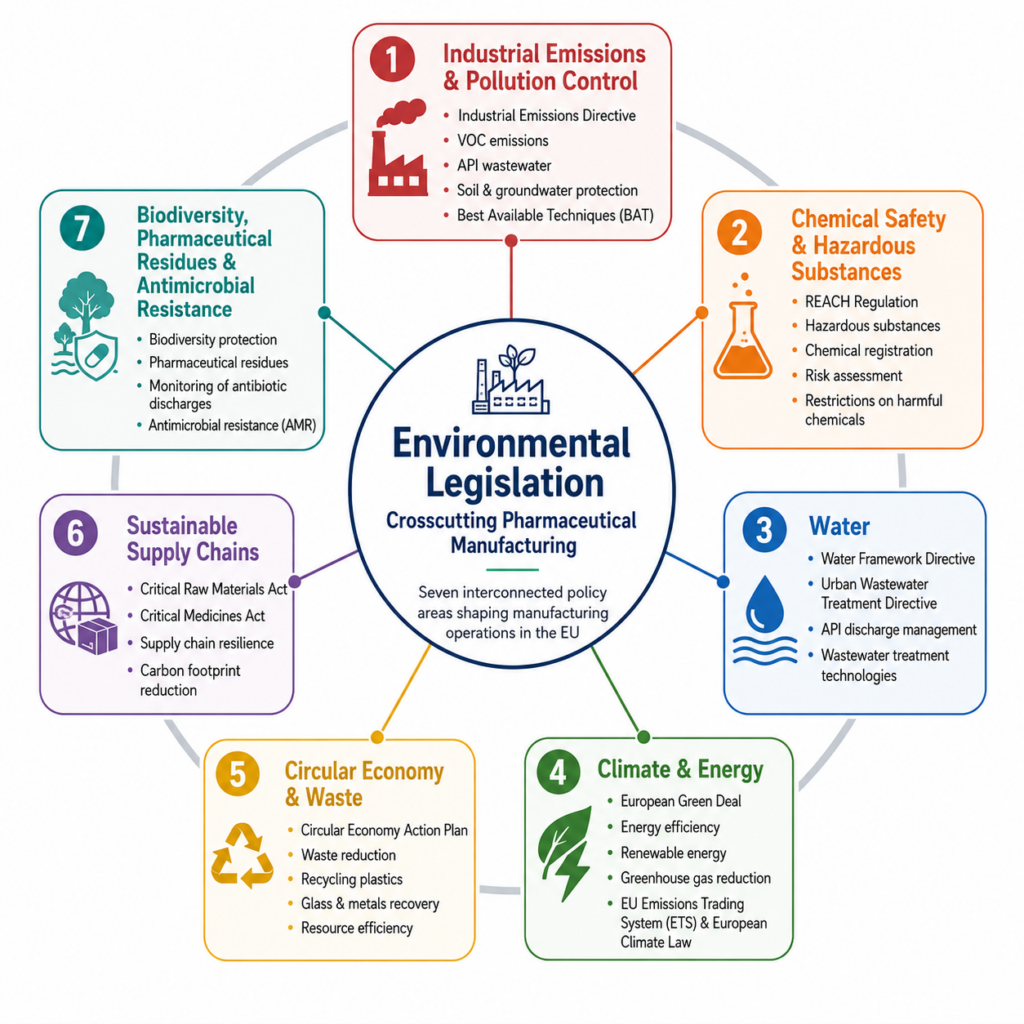
- Industrial emissions and pollution control: Organic compounds, wastewater containing APIs, prevention of soil and groundwater contamination, and best available techniques, largely via the Industrial Emissions Directive
- Chemical safety and hazardous substances: REACH, now twenty years old and heading for a recast
- Water: The Water Framework Directive and the Urban Wastewater Treatment Directive
- Climate and energy: Energy efficiency, renewables, greenhouse gas reduction, the EU Emissions Trading System and European Climate Law, much of it flowing from the 2019 European Green Deal
- Circular economy and waste: The Circular Economy Action Plan and recycling of plastics, glass and metals
- Sustainable supply chains: The Critical Raw Materials Act and the Critical Medicines Act
- Biodiversity, pharmaceutical residues and antimicrobial resistance: Including monitoring of antibiotic discharges
“Industrial emissions and pollution control. That’s a huge part of how the CDMOs are affected.”
She traces the lineage back four decades, to principles set out in the Single European Act of 1986; prevention, pollution at source, and polluter pays, then extended by Maastricht in 1993.
“Isn’t it interesting we’re in the year 2026, and if I get my maths right, that’s 40 years on, how this is actually going to come back and really be a component of what we’re facing today as an industry.”
The integration principle, requiring environmental protection across all major policy areas, is what eventually brings manufacturing into scope. “You can really see how this policy in the environmental area is growing, but then it starts to cross-cut with the pharmaceuticals and the CDMOs, and you can see how much then manufacturing becomes a key part of what will be shaped by the environmental agenda.”
PFAS: The Issue Going Straight to the Core of CDMO Operations
Of everything on the horizon, Neha singles out per- and polyfluoroalkyl substances as a key issue with direct operational consequence for contract manufacturers.
“For CDMOs, this issue of banning PFAS is going straight to the core of the industry.”
“In most cases, they’re not an intentional ingredient; they may originate from manufacturing equipment, processing aids, utilities, packaging, supply chains. This is quite a complex situation we’re in, because pharmaceutical manufacturing demands extremely low levels of impurities. Even trace PFAS contamination can become an increasing area of regulatory and quality concern.”
She walks through where it sits in the system: bearings, tubing, valves and valve seats, chosen precisely because they resist aggressive solvents and acids and tolerate steam sterilization. Abrasion at high manufacturing intensity can introduce PFAS into the process. Tubing, bags and connectors carry the same risk, and residues can end up in purified water or water for injection.
Critically, exposure extends beyond a CDMO’s own boundaries:
“It may even be in raw materials that are used in the manufacturing processes, which of course CDMOs have no control over. They’re actually bringing in the raw material. So again, we see how this affects the industry in so many ways.”
Neha is careful to note the industry is actively mitigating: “The industry is doing everything it can to mitigate that. The industry is working on it. But I think that it’s important to note how this is becoming a very tough issue.” As explored in PharmaSource’s conversation with Novartis on greener drug development, highly regulated substances like PFAS are already affecting how sponsors assess supplier asset value.
Polluter Pays: Why the Urban Wastewater Directive Has Become a Flashpoint
The polluter pays principle, “those responsible for pollution should bear the cost of preventing and remedying environmental damage,” is four decades old. Its application under the Urban Wastewater Treatment Directive is what has made it contentious.
“Under the Urban Wastewater Treatment Directive, pharmaceuticals and cosmetics have been singled out as the industries that will be responsible for paying towards the decrease of pollution within the environment, which is absolutely disproportionate. As you can imagine, there are many industries that are leading towards this situation. So to have the pharmaceuticals and the cosmetics singled out has been a cause of tension and is currently still in debate right now.”
Neha explains that this is not solely an environmental compliance question but a business resilience question, with consequences for cost base and competitiveness. It is a theme running through PharmaSource’s coverage of supply chain collaboration on sustainability, where sustainability requirements increasingly show up inside procurement processes.
What’s Coming in the Next 12 to 18 Months
Neha flags several files arriving within roughly the next year to eighteen months:
“We have a Circular Economy Act coming through later this year, so the Circular Economy Action Plan is now becoming legislation. This could be impactful on the industry, on CDMOs, especially when it comes to packaging, procurement, waste management, recycling, and material availability.”
Also on the list: simplification of corporate social responsibility reporting, which she suggests may benefit the industry; packaging waste regulation, which “will probably directly affect pharmaceutical packaging operations”; possible implications from digital product passports; and the Industrial Accelerator Act.
European preferencing is the structural shift underneath much of this.
“We’ve had, of course, Made in Europe as a policy for some time, but now European preferencing is coming in. We have the EU Industry Accelerator Act coming through, which is also again going to be impacting manufacturing across sectors.”
She notes this reaches beyond EU-based operations: “So this affects also global CDMOs, those who have cross-global regional manufacturing areas and sites.”
Three Things CDMOs Should Do Now
Asked what a CDMO should prioritize in the coming year, Neha gives three actions.
First, assess exposure and plan for it.
“A great one is to actually take stock of some of the issues that are coming up and to look at how does that actually affect our business. Create that industry impact plan, create that contingency plan of how this is actually gonna translate into our business models. What can we mitigate? What do we need to do if we can ensure that the company’s fully prepared. That also has cost savings, of course.”
Second, get to the table.
“Start to think about how it can voice itself at the table as an important part of the pharmaceutical industry. So to have that stakeholder voice, to be present at debates, and to ensure that there’s a voice for manufacturers — crucial when it comes to government relations.”
Third, pursue the funding that exists to offset compliance investment.
“Even though we see all this legislation coming through, to look for those funding streams and to look for those portals where they can access money and support from either national governments or from EU. But wherever they can to support innovation that can help them be ready for these environmental standards, not to have to take on the burden themselves all the time. To be able to access that money and say, ‘No, this needs to be actually supported through grants and schemes.'”
Her summary: “It really is about having a game plan and ensuring how each company can ensure that they remain competitive in this arena.”
“I think the industry is really working very hard to voice itself when it comes to where there are issues. At this moment, rather than saying that there’s a gap from the industry, I think there’s a listening gap from our governments. The industry’s getting hit so hard and, at the end, it is there to deliver innovative therapies to the person on the ground. So really it’s about closing the gap between what’s being said and what’s being heard, and how can we improve that?”