Can an industry that exists to protect human health afford to ignore its own environmental footprint? It’s a question that’s easy to defer — until the regulatory deadlines make it impossible to.
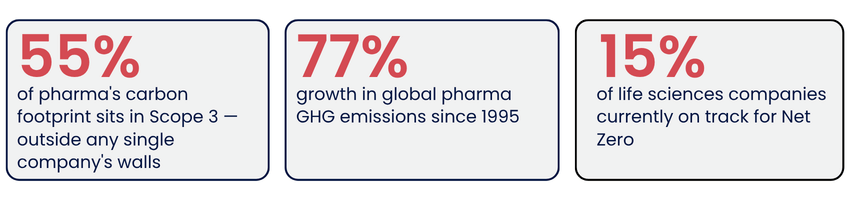
Pharmaceutical companies face a growing carbon challenge, much of which sits beyond their direct operations. Global pharmaceutical greenhouse gas emissions have increased by 77% since 1995. This represents a near-doubling of the industry’s footprint over three decades, during a period of significant sustainability awareness and commitment. Yet only around 20% of life sciences companies are currently on track to achieve net zero by 2050. The gap between ambition and trajectory is widening, not closing.
Despite this, most sustainability investment remains concentrated on Scope 1 and 2 emissions (direct operations and purchased energy), which together account for less than half of total emissions. At least 55% falls within Scope 3, across the supply chain, including the companies responsible for manufacturing, testing, packaging, and distribution. Manufacturing alone is estimated to account for up to 80% of indirect emissions. This places CDMOs in a central position within decarbonization efforts, with significant influence on the industry’s overall carbon footprint.
What this means for your supplier relationships
The emissions generated at your contract manufacturing sites flow directly into your Scope 3 reporting. Energy consumption, water usage, waste generation, and your CDMO’s own Scope 1 and 2 figures all become your liability on paper.
CDMOs that can provide transparent, verified emissions data are partners who help you meet your regulatory obligations. Those that cannot create a gap in your reporting and, increasingly, a gap in your defensible position with regulators, investors, and customers.
The question for external manufacturing teams is: do you know which of your CDMOs falls into which category?
The Coordination Challenge
Scope 3 emissions are inherently complex. They are distributed across large, global supplier networks, often spanning hundreds of companies and multiple regions. No single organization has sufficient control to drive change independently.
Many pharmaceutical companies currently rely on spend-based estimates to quantify Scope 3 emissions. While this approach provides an initial baseline, it is unlikely to meet evolving regulatory expectations. Increasingly, organizations will need to transition toward activity-based, verifiable emissions data.
Regulatory requirements are also advancing. Scope 3 reporting under the Corporate Sustainability Reporting Directive (CSRD) is already mandatory for many European companies, with further expansion expected through 2025 and 2026. This shift will require greater transparency and data accuracy across the value chain.
According to the 2024 Global Biopharma Sustainability Review, 69% of pharmaceutical leaders identify limited value chain collaboration as the primary barrier to sustainability progress. That number matters because it identifies the real issue: this isn’t mainly a technology or investment problem. It’s a coordination problem within the external manufacturing relationship. IQVIA estimates that meaningful change in the pharmaceutical supply chain requires coordinated action from approximately 500 companies, with a significant proportion based in India and China.
This highlights a structural challenge: improving Scope 3 performance depends on coordination, shared standards, and consistent data exchange across the ecosystem.
“Can we heal people while harming the planet? The industry that exists to protect health cannot afford to ignore its own footprint.”
Gijs Vissers, Head of Supply Chain and Procurement, Nordic Pharma
CDMO Data as a Strategic Input
For CDMOs, sustainability reporting is becoming increasingly relevant not only from a compliance perspective, but also as part of broader commercial positioning.
Emissions generated at contract manufacturing sites are incorporated directly into pharmaceutical companies’ Scope 3 reporting. This includes energy consumption, water usage, waste generation, and Scope 1 and 2 emissions. As a result, the quality and availability of CDMO data directly affect their customers’ ability to meet regulatory and reporting requirements.
CDMOs that can provide transparent, verified emissions data are more likely to be viewed as strategic partners. Those without this capability may face increased pressure on pricing and differentiation.
In this context, transparency is not only a reporting requirement but also a factor in supplier selection and long-term partnerships.
Existing Industry Infrastructure
Several industry initiatives are already supporting supply chain decarbonization efforts, and understanding them is increasingly relevant when assessing CDMO capability and commitment.
The Pharmaceutical Supply Chain Initiative (PSCI) includes 81 member companies, representing more than 70% of global pharmaceutical revenue. Across more than 2,100 supplier sites, CDMOs participate in developing and implementing responsible supply chain standards. PSCI provides resources such as the Decarbonization Playbook, supplier capability programs, and the PSCI Link platform, offering a structured starting point for organizations at different stages of maturity.
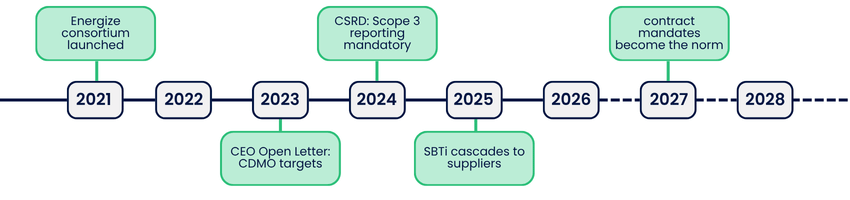
The Energize Consortium provides an example of collaborative action at scale. In 2024, 25 pharmaceutical companies jointly procured renewable electricity in China, resulting in approximately 120,000 metric tons of CO₂ emissions avoided annually. CDMOs supplying PSCI member companies may be eligible to participate in similar programs.
At the same time, sustainability requirements are increasingly reflected in procurement processes. Scope 3 reporting, Science Based Targets initiative (SBTi) expectations, and customer-specific data requests are becoming more common in supplier engagements.
From Individual Efforts to Collective Progress
Decarbonizing pharmaceutical supply chains will require significant investment—estimated at more than $400 billion by 2030. This level of change cannot be delivered by individual organizations acting alone.
However, coordinated approaches—such as shared audit frameworks, joint renewable energy procurement, and harmonized data standards—can enable progress at scale. Industry initiatives demonstrate that collective action can deliver measurable outcomes more efficiently than isolated efforts.
The PSCI model reflects this shift, focusing on collaboration and shared responsibility rather than purely compliance-driven supplier management.
Getting Started
The path forward doesn’t require a completed sustainability strategy, a dedicated ESG team, or a perfectly validated carbon baseline. It requires a starting point. Many organizations begin with relatively simple steps and build capability over time.
Five Things to Ask Your CDMOs
- Can your CDMO provide verified emissions data? Spend-based estimates are a starting point; activity-based data is what regulators and SBTi will increasingly require.
- Are they a PSCI member or equivalent? Membership signals baseline engagement with responsible supply chain standards.
- Do they participate in collaborative programs? Energize-style renewable procurement is one indicator of a proactive rather than reactive sustainability posture.
- What does their decarbonization roadmap look like? A CDMO with no documented plan is a Scope 3 reporting risk.
- How do their sustainability data capabilities factor into your selection criteria? If they don’t appear in your RFP or QTA process yet, add them.
Early engagement can help organizations better position themselves as expectations continue to evolve.
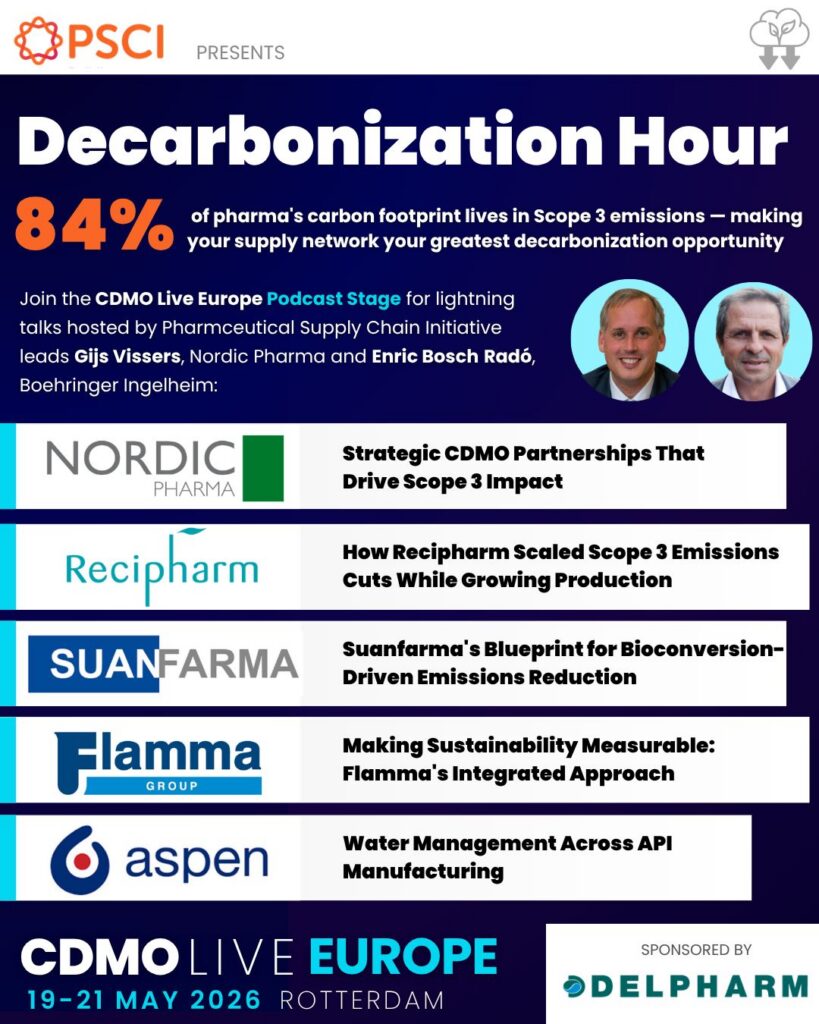
Continue the conversation at CDMO Live Europe
Further discussion on this topic will take place at CDMO Live Europe.
Decarbonization Hour: Lightning Talks
CDMOs and sponsors will present examples of emissions reductions achieved within their operations, including approaches that maintain or improve cost competitiveness. Hosted by Gijs Vissers, Nordic Pharma, and Enric Bosch Radó, Global Third Party Chemicals Manager, Boehringer Ingelheim. On the podcast stage at CDMO Live Europe.
Decarbonizing Pharmaceutical Manufacturing: Partnering for Scope 3 Impact
A roundtable session hosted by Gijs Vissers on behalf of PSCI, exploring how pharmaceutical companies and CDMOs can work together to address Scope 3 emissions through coordinated action.