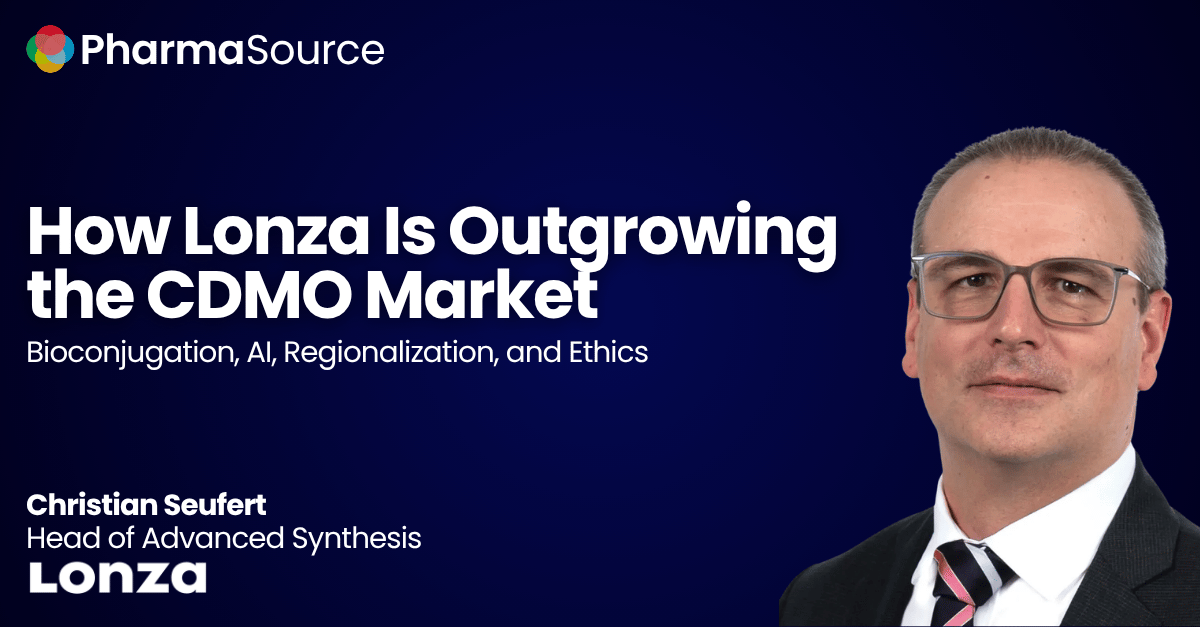
“We want to outgrow the market, and we want to do it ethically.” Christian Seufert
Christian Seufert, Head of Advanced Synthesis at Lonza and member of the executive committee, brings 20 years of experience from BASF’s specialty chemical business. He leads a team applying 125 years of Lonza’s chemistry expertise to manufacturing small molecules, highly potent APIs, and antibody-drug conjugates.
In the latest PharmaSource podcast episode, Christian explains the ‘One Lonza’ strategy that positions the company to capture growth across the fastest-expanding CDMO segments, particularly bioconjugation, while addressing the industry’s most persistent operational challenges: speed, data accessibility, and supply chain resilience.
The One Lonza Engine: Outgrowing an 8–10% Market
The global CDMO market expands at 8–10% annually. Lonza aims to exceed this through five strategic characteristics: a high-performing team of 20,000 associates; a strong scientific, technological, and digital ecosystem; unparalleled customer partnerships; execution excellence; and scalable, plug-and-play investment capabilities.
“This One Lonza engine makes us unique,” Christian says. “One Lonza means across our three business platforms and eight modalities, we want to offer clients a seamless experience.”
Advanced Synthesis is one of Lonza’s three business platforms, focusing on small molecules with complex manufacturing requirements, highly-potent APIs, drug linkers, ADCs, and other bioconjugates. The segment is particularly valuable: bioconjugation is one of the fastest-growing pharma segments, driven largely by the explosive development of ADCs in oncology, and the increasing demand for targeted drug delivery.
“For the ADC and bioconjugation offering, growing 20 percent-plus, we’re connecting the dots,” Christian explains. “We go from cell line development all the way through payload manufacturing, conjugation, and fill-and-finish services.”
Lonza holds approximately 50% market share in bioconjugation and continues expanding capacity at Visp and Stein in Switzerland, positioning itself to grow alongside the modality.
Supply Chain Regionalization Drives Global Expansion
Two primary market trends are reshaping CDMO strategy. First, innovation sources are shifting: biotech startups are driving development, requiring CDMOs to stay agile across all pharma segments.
Second—and more strategically critical—is supply chain regionalization. “Everybody believes robust, strong supply chains are critical for business success,” Christian says. “Customers look for local or regional sourcing solutions to manage economic and geopolitical uncertainties.”
This trend accelerated post-2015 and shows no signs of slowing. Lonza’s response has been decisive: the company acquired Roche’s former Genentech site in Vacaville, California, investing CHF 500 million to upgrade capacity and has completed its first successful tech transfer. It maintains footprints across Asia-Pacific and Europe, with recent expansions at Visp (mammalian and bioconjugation) and Stein (fit-and-finish for ADCs) in Switzerland.
“The United States remains very important,” Christian notes. “We’re looking at capital investments, organic growth, and potential acquisitions.”
Speed, Digital Tools, and Bridging the Data Gap
Three customer pain points drive Lonza’s operational priorities: speed, digitalization, and sustainability.
Speed matters most. Whether early-phase or commercial, reducing timelines directly impacts drug launches. Lonza has deployed value-stream mapping and accelerated capital project execution to compress development cycles.
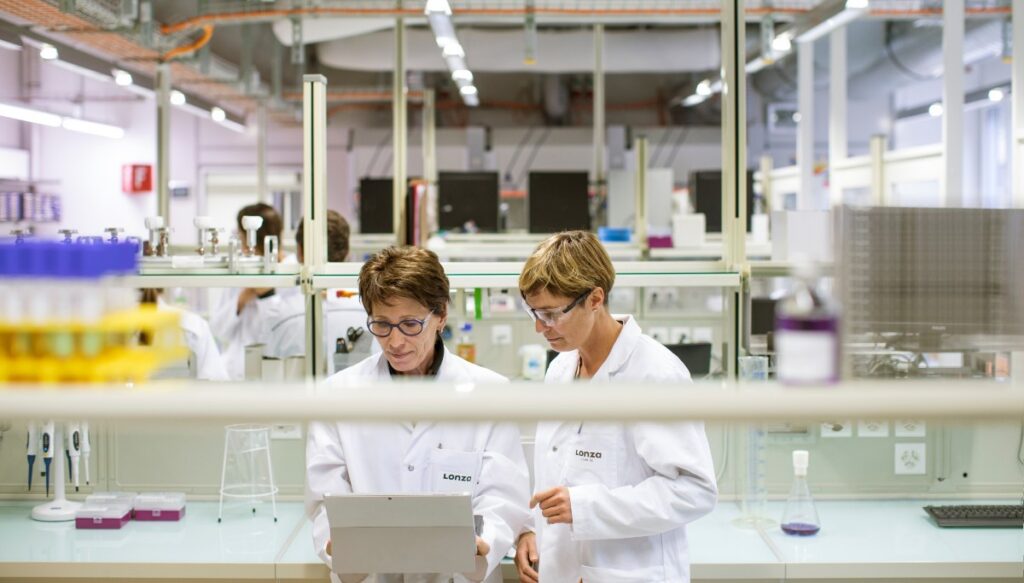
Lonza has rolled out several AI-enabled tools to support this:
AI-enabled route scouting for small molecules is a technology-driven approach to identify the most efficient synthetic routes using AI, Lonza SME expertise, and supply chain intelligence to identify optimal synthetic pathways faster. Design-to-Optimize uses physicochemical models to refine processes with minimal experiments. A digital twin is created to allow further scenarios to be tested in silico.. AI-assisted facility fit assessments accelerate tech transfer timelines in mammalian manufacturing.
But digital twins require real-world validation. “You need empirical data to ensure simulations are actually close to reality,” Christian explains. “It’s a trust-and-verify setup. You develop the model, but run lab experiments and statistical tests to validate the output.”
The data accessibility challenge is acute. Lonza has been in the CDMO space since the 1980s, giving the company deep expertise but also a modernization hurdle. “A lot of data is inaccessible because it exists in paper form or incompatible formats,” Christian says. “Creating accessible data pools and applying AI to historical manufacturing data is a big challenge for established players.”
At the commercial stage, sponsors increasingly demand real-time digital batch records replacing paper-based systems. “This is probably a challenge for every larger established company,” he notes. “We’re digitizing data sources and applying models to our large data pool.”
From Product Business to Service Business: A Cultural Shift
After 20 years at BASF leading API and pharmaceutical excipients businesses, Christian joined Lonza three years ago. The transition from product-centric to service-centric thinking required fundamental reorientation.
“In a product business, decisions center on your product offering—it’s more static,” he explains. “In a CDMO business, it’s much more client-focused. You build flexibility into your offering. You make your capabilities, systems, and processes fit the client’s needs.”
Product businesses naturally focus on late-phase, high-volume manufacturing. CDMO businesses must master both early-phase pipeline development and commercial manufacturing—a fundamentally different business model.
Lonza’s client-first culture is reflected in its Lonza Promoter Score, a metric reported directly to the board. Beyond annual surveys, the company tracks transactional satisfaction after each customer interaction—order processing, logistics, supply chain execution.
“We have to constantly strive to become better, stay relevant, innovate, and reinvent ourselves,” Christian says. “Receiving client feedback couldn’t be more important.”
Ethical Competition and the Universalizability Test
On his LinkedIn profile, Christian references Immanuel Kant’s categorical imperative: “Act in a way that the foundation of your intention can be adopted as a principle of a universal law.”
He applies this as the “universalizability test”, a stress test for strategy. “If a strategy only works when competitors don’t copy it, or would break the system if everybody adopted it, then it’s probably not ethical or sustainable,” Christian says.
Applied practically: if a company gains a competitive advantage through less sustainable manufacturing, that advantage evaporates if every competitor does the same. Sustainability must be embedded in the business model, not treated as optional.
“If you gain a competitive advantage because you’re applying a less sustainable manufacturing process, if everybody did that, it would obviously be bad for the environment and society,” he explains.
Lonza has been recognized as one of the world’s most ethical companies for five consecutive years. “We want to win badly. We want to outgrow the market,” Christian says. “At the same time, we want to do it within a framework that applies to everybody to maximize societal value as a pharmaceutical CDMO.”