“When your patient is your priority—getting them safe, highly pure, quality medicine—you’re aligned with the health agency. That alignment and engagement really help.”
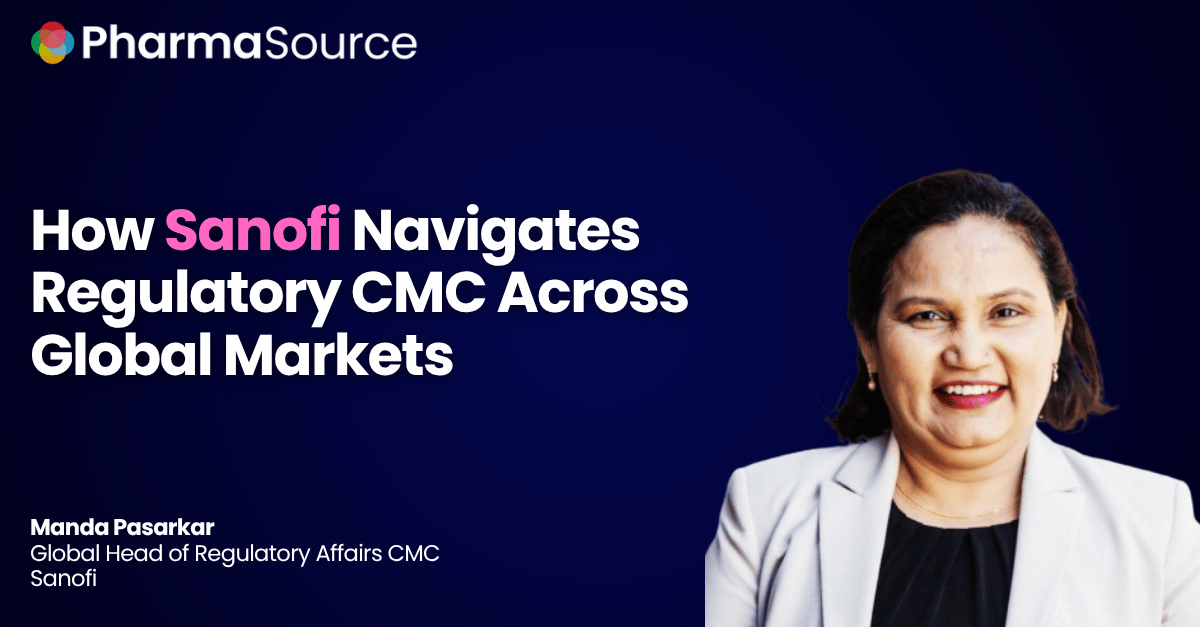
Manda Pasarkar, Global Head of Regulatory Affairs CMC at Sanofi, has spent over 20 years mastering the intersection of chemistry and compliance—a rare combination that positions her at the forefront of pharmaceutical regulatory strategy.
Manda progressed from scientist roles at Teva through regulatory positions at Bayer, and now leads regulatory strategy for Sanofi’s multi-billion dollar portfolio across biologics and small molecules, securing numerous drug marketing approvals in the US, EU, Japan, and China. She’s also a Distinguished Toastmaster (DTM)—a designation fewer than 1% of Toastmasters International members achieve.
In a recent PharmaSource podcast episode, Manda shared insights on navigating complex global regulatory landscapes, building productive agency relationships, leveraging ICH guidelines, working with CDMOs, and preparing for AI’s impact on regulatory CMC.
Why Regulatory CMC Requires Both Scientific and Legal Expertise
Manda’s path into regulatory CMC combined her chemistry background with an unexpected passion for regulations and law.
“I have a master’s in chemistry, so I breathe chemistry. I love the science behind medicinal products. Another natural passion I have is for regulations and law,” she explained.
This dual expertise proves essential because regulatory CMC sits at the crossroads of product science and compliance requirements.
“Not every regulation fits into your product’s requirements. My unique skill of understanding both science and regulations helps me navigate—this regulation applies here, but other regulations apply to other parts of the product’s science.”
Critical Differences Between FDA, EMA, and PMDA
While all major health authorities share the goal of ensuring quality products reach patients, their approaches differ significantly.
“Europe has 30 countries that make the European Union, so there are many more heads in the review process. You may receive tighter specifications in certain areas and end up regulating starting materials at a deeper level,” Manda noted.
The FDA takes a different approach. “FDA drills down into GMP requirements. They look at certain parts of the manufacturing process through a magnifying glass.”
Despite these differences, ICH guidelines provide crucial common ground. “The guidelines are utilized well, and you can navigate with health authorities based on ICH guidance for the CMC aspect of medicinal products.”
Her experience with the FDA recently? “Business as usual. If we submitted something and received a PDUFA date, it has been met.”
COVID’s Lasting Impact: Thinking Outside the Box
The pandemic fundamentally changed how regulatory teams approach agency relationships.
“COVID helped people start thinking outside the box and being more proactive and pragmatic. When your patient is your priority—getting them safe, highly pure, quality medicine—you’re aligned with the health agency. That alignment and engagement really help.”
Building Productive Relationships with Regulatory Agencies
Manda emphasizes that engagement is the foundation of successful regulatory relationships.
“Getting involved is the key. Large pharma have membership with industry associations that work directly with ICH. ICH and health agencies always invite industry to provide comments on guidances and help develop them.”
She’s participated in ICH guidances as well as European guidances, WHO, and FDA initiatives.
The regulatory landscape may be complex, but it’s also collaborative. “I’ve seen my previous bosses reach out to agencies when change is needed. They’ve had the ability to influence and get positive changes.”
Working with CDMOs: Defining the Regulatory Relationship
There’s no one-size-fits-all approach to CDMO regulatory partnerships—it depends entirely on contractual structure.
“Every company operates differently based on their business needs. The involvement of regulatory is crucial,” Manda explained.
The key question: Who owns dossier responsibility?
“If supply chain or procurement works solely with the CRO, who is responsible to get the dossier? Is the sponsor writing the dossier and it’s implemented by the CRO? That relationship needs to be well defined.”
If the CRO handles everything except regulatory responsibility, “the relationship will be give-and-take liaising. But if you’re writing the dossier on behalf of your CRO, you’re part of their quality system. You’ll see the change control, assess it, and review their dossier.”
Her bottom line: “Manufacturing and regulatory need to work together to have compliant information and data that ensures product quality.”
AI and Digital Transformation in Regulatory CMC
Manda sees significant potential for AI to transform regulatory work, particularly agentic AI.
“AI will help write dossiers faster. Agentic AI may help us find guidances and filter information we’d spend eight hours searching for. With prompts, it can deliver answers within 42 seconds.”
For large pharma with complex data ecosystems, the benefits multiply. “Bigger pharma have huge databases and multiple systems. Agentic AI will help deliver the SOPs, guidances, policies, or data you’re looking for.”
She points to FDA’s voluntary use of ELSA as a signal. “That’s a hint to industry that we need to get onto AI platforms faster than we think.”
Looking ahead, she sees system integration as critical. “We need digitization of manufacturing, quality systems, and regulatory systems—and they all need to talk to each other. We can’t function with printed documents or disconnected systems. We need collaboration among our systems to produce harmonized information at your fingertips.”
Emerging Market Challenges: Brazil, China, and India
Beyond major regulatory authorities, emerging markets present unique challenges.
“Brazil follows many regulations from the European Union, but health authorities have their own local requirements. It can get challenging registering products in Brazil.”
China requires particularly careful navigation. “They want products tested prior to registration, which takes time. They have local requirements that can be complicated. While China has adopted ICH, there’s still a lot of negotiation needed.”
India, now the world’s fifth-largest economy, also presents obstacles. “Registering products can be challenging with local requirements that are mandatory—and sometimes negotiable. Regulatory folks need to know what can be negotiated and what cannot.”
The CMC-specific challenges include batch requirements. “Do they need brand new batches, or can they use existing batches already commercialized? All these aspects create challenges in emerging markets.”
Essential Skills for Regulatory CMC Careers
For those looking to build careers in regulatory CMC, Manda identifies several critical capabilities.
“Desire is number one. The ability to read, understand, and grasp the science behind the product. Five years ago I would have said good writing skills, but now AI can help with that.”
Instead, she emphasizes leadership. “You’re not only leading yourself, but leading your product. You need to speak on behalf of your product and liaise with many people. You need to help people realize what the regulations and constraints are.”
Communication remains essential. “Being a good communicator is a top skill. If you’ve developed at least three of these skills, you’ll be a good regulatory CMC professional.”
Manda emphasizes that regulatory success requires cross-functional alignment.
When issues arise “regulatory alone is not responsible—business drives regulatory. Having a good business plan, breakthrough therapies, and amazing research can drive regulatory strategy. When your business plan doesn’t align with the product’s science and regulatory strategy, that disconnect creates problems.”