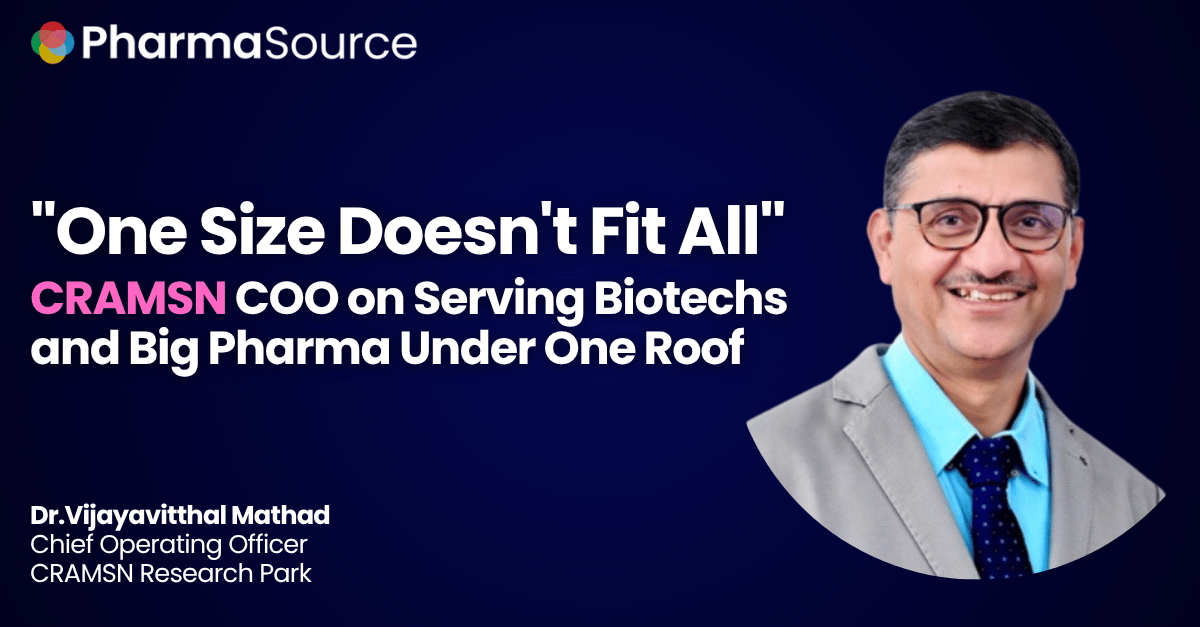
At CDMO Live Europe, Dr. Vijayavitthal Mathad, Chief Operating Officer of CRAMSN Research Park, outlined how a genuine end-to-end CDMO model reduces friction across the drug development lifecycle, from supply chain resilience to sustainability, drawing on 32 years of pharmaceutical development experience.
From Execution to Ownership
The central shift Mathad has observed across his career is the move away from CDMOs as pure executors toward partners expected to take full ownership of a program. Molecules have grown more complex, regulatory and compliance requirements have tightened, and raw material volatility has increased. Clients now expect their CDMO to hold the thread across the entire development lifecycle.
“The biggest shift I have seen over the last 20 years is the evolution of the CDMO relationship from the transactional service model to the strategic relationship model,” Mathad said.
He described drug development as a relay race: the product is the baton, and every handoff between functions (drug discovery, process development, scale-up, commercial manufacturing) carries the risk of a knowledge transfer error. “In the pharmaceutical industry, most of the errors and delays happen at the interfaces,” he observed. The case for integration, in his view, is not about offering more services under one roof; it is about removing those interfaces.
One Roof, Different Operating Models
Mathad explained that integration does not mean a single approach applied to every client. A virtual biotech and a large innovator company have fundamentally different pressures, and a CDMO that fails to recognize this will fail both.
For a small biotech, a single molecule may represent decades of research and the survival of the company. Timeline pressure is existential. For a large pharma client, the challenges are portfolio prioritization, raw material resilience, and regulatory compliance across a network.
“One size doesn’t fit all,” Mathad said. “You have to look at them from a different perspective.”
His answer is to build distinct operating models within the same organization: separate teams, protocols, and processes for drug discovery, process development, and formulation. Drug discovery programs require different people and different infrastructure than process development programs.
The capability to serve both exists, he argued, only when these are treated as genuinely separate disciplines operating in parallel, not interchangeable functions within a single delivery model.

Supply Chain Resilience: Built In, Not Bolted On
Mathad was unambiguous that supply chain resilience must be designed from the start of a program, not assembled in response to a crisis. “It is not an afterthought process,” he said. The pandemic and recent geopolitical disruptions demonstrated the cost of single-region dependency.
CRAMSN’s approach combines two methods. The first is vendor diversification across multiple geographies, informed by a global development mindset paired with regional manufacturing execution. The second is backward integration of chemistry: tracing the synthetic route back 20, 25, or 30 steps to the point where developing an alternative supplier from a different region becomes commercially viable. With 18 manufacturing plants, Mathad said the organization can redirect production when a supply disruption hits. “We have to take a hybrid approach,” he said. “Global in development, regional in manufacturing.”
He was equally clear that this structural shift is permanent. Regionalization versus globalization is not a temporary response to tariff uncertainty or pandemic disruption. It is a change in how the industry manages supply risk, and it applies across company sizes.
Sustainability as Operational Discipline
Mathad framed sustainability as a set of specific operational levers. He identified three areas that determine a CDMO’s carbon performance:
- Raw material transportation, which in some products accounts for more than 50% of the carbon score.
- Process chemistry: applying green chemistry principles such as process mass intensity (PMI) to reduce solvent and water consumption per kilogram of API, and optimizing reaction temperatures to avoid energy-intensive extreme conditions.
- Energy sourcing: transitioning manufacturing operations to solar, wind, and biofuels.
Flow chemistry, he noted, offers a practical route to reducing thermodynamically demanding reactions, allowing conditions that previously required minus 80 degrees Celsius to be replaced with ambient processes. “Without sustainability, you cannot sustain in the pharma business,” he said.
The Scientist-Leader Advantage
Asked how his background as a bench chemist shapes his leadership, Mathad described a specific operational advantage: the ability to read data directly, communicate transparently with clients about the real reasons behind delays, and distinguish between science-led and business-led decision-making.
When science drives the business, decisions follow data. “When a scientist speaks with a client and realistically puts the problem in front of them, they appreciate you,” he said. That transparency, in his view, is the foundation of client trust.