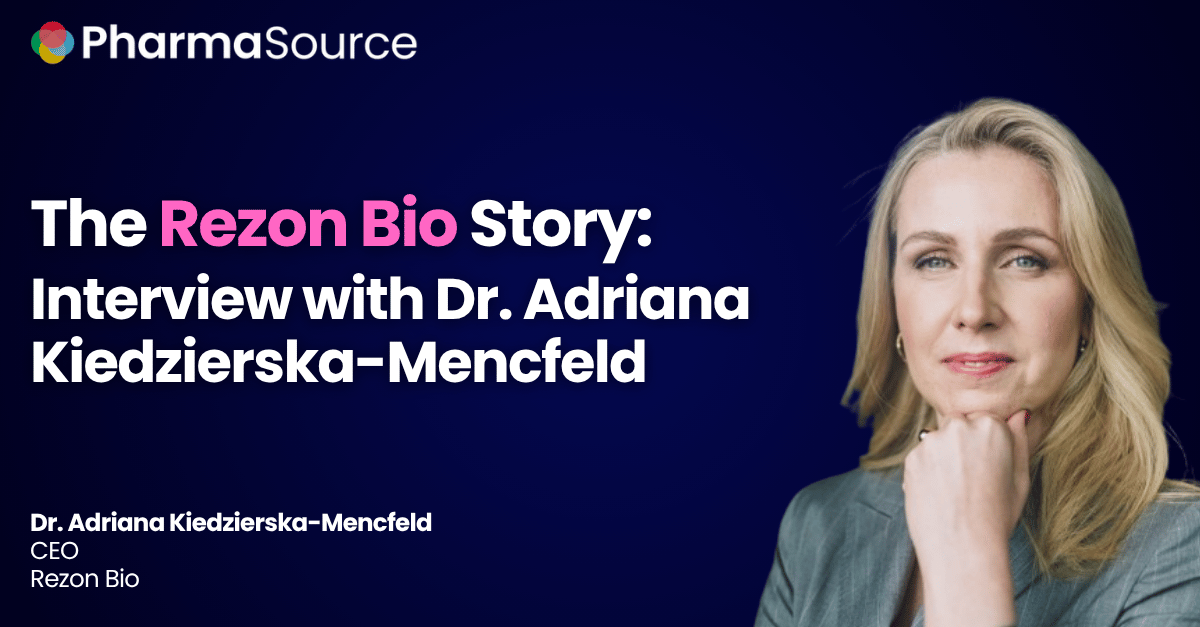
At CDMO Live Europe 2026, Dr. Adriana Kiedzierska-Mencfeld, Chief Executive Officer of Rezon Bio, drew on 11 years leading operations at Polpharma Biologics to explain why biosimilar developers must address cost strategy in process development, long before any product reaches market.
From Polpharma Biologics to Rezon Bio
Rezon Bio rebranded from Polpharma Biologics in October 2024, bringing with it a manufacturing heritage built on biosimilar monoclonal antibodies developed and commercialized for global markets, including the US. Its two sites in Poland hold approvals from the U.S. Food and Drug Administration (FDA), the European Medicines Agency (EMA), and the Medicines and Healthcare products Regulatory Agency (MHRA). Kiedzierska-Mencfeld explained that the company did not build its facilities for clients. It built them for its own products, then opened the doors. “We will not learn on other products,” she said. “We built the facility, we built the system, we built the partnership with big pharma for our own product. That is the difference in comparison to the majority of other CDMOs.”
What Being a Bad Client Taught Rezon Bio to Be a Better CDMO
Before building its own infrastructure, Polpharma Biologics relied on external CDMOs. As a small organization with a single biosimilar in development and no revenue, the company was not a priority. It took available slots, not preferred ones. When a CDMO error caused batch failures, the consequences cascaded into delayed slots, duplicate fees, and fines from the contract research organization overseeing the trial timeline. The company was not generating revenue and was absorbing significant losses. “The time we were spending to fight about the slots, to fight about the attention, to solve our issues was enormous,” she recalled. The decision to build internal capabilities came from that pressure. The team built a parallel development track and, faster than expected, produced clinical batches that met regulatory requirements internally. That same drive, she argued, now defines how Rezon Bio operates for its own clients.
What Clients Need from Transparency
Kiedzierska-Mencfeld pushed back on a common interpretation of data transparency. Clients do not come to a CDMO simply for infrastructure access, she argued. They come for expertise. Raw data access without interpretation is not useful. What clients need is filtered, meaningful information with a clear recommendation attached. Equally important is rapid disclosure when something goes wrong. Over a five-to-ten-year development program, problems are certain. A real partner does not wait. And a real partner, she said, also declines when declining is the right call. “The CDMO who is the partner is not the CDMO who is saying yes to everything. It is the CDMO who in a difficult situation is able to say no, to also protect the client, to not enter into a compliance risk.” The goal is a product that reaches commercial availability. Everything else is in service of that.
Eastern Europe as a Competitive Manufacturing Base
Kiedzierska-Mencfeld acknowledged that Europe has historically carried a price premium for contract manufacturing services. However, central and Eastern European CDMOs can now offer competitive pricing alongside quality systems and regulatory compliance that satisfy FDA, EMA, and MHRA requirements. Rezon Bio’s January 2026 FDA approval for its Duchnice site near Warsaw, achieved with no observations, was presented as evidence. The geopolitical context reinforces the shift. Tariff uncertainty, raw material supply disruptions, and the EU’s Critical Medicines Act all create pressure to reshore manufacturing to Europe. Companies that moved production to Asia on cost grounds now face the challenge of returning supply to European markets without sacrificing quality. “Central and Eastern Europe is the response for that,” she said. The region can supply both European and US markets, and in some cases Asian ones, from within a stable regulatory and intellectual property environment.
The Biosimilars Cost Trap
On the biosimilars market itself, Kiedzierska-Mencfeld was blunt. Price erosion is not a risk. It is a certainty. The question is speed, not direction. Originators are lowering prices further and faster than the market anticipated even a few years ago, compressing margins across the supply chain. CDMOs face client pressure on cost and timeline simultaneously, while remaining commercially viable. The most common and damaging mistake she identified is companies entering biosimilar development without integrating cost modeling from the outset. “If you do not focus on that at the process development early stage, then you pay the consequence in commercial,” she said. A product approved but priced out of sustainable supply is a failed launch by another name. Decisions made at the bench determine whether a product is commercially viable at scale.
Takeaways
- Build cost modeling into process development from the start. Cost structure set at early development stages determines commercial viability at launch.
- A CDMO that refuses when refusal is warranted is more valuable than one that agrees to everything.
- Transparency means interpreted data, not raw data access. Clients need information with direction attached, not unfiltered numbers.
- Central and Eastern European facilities can now compete on price without conceding on quality or regulatory compliance.
- Biosimilar price erosion is structural. CDMOs and developers that cannot operate efficiently at lower margins will exit the market.