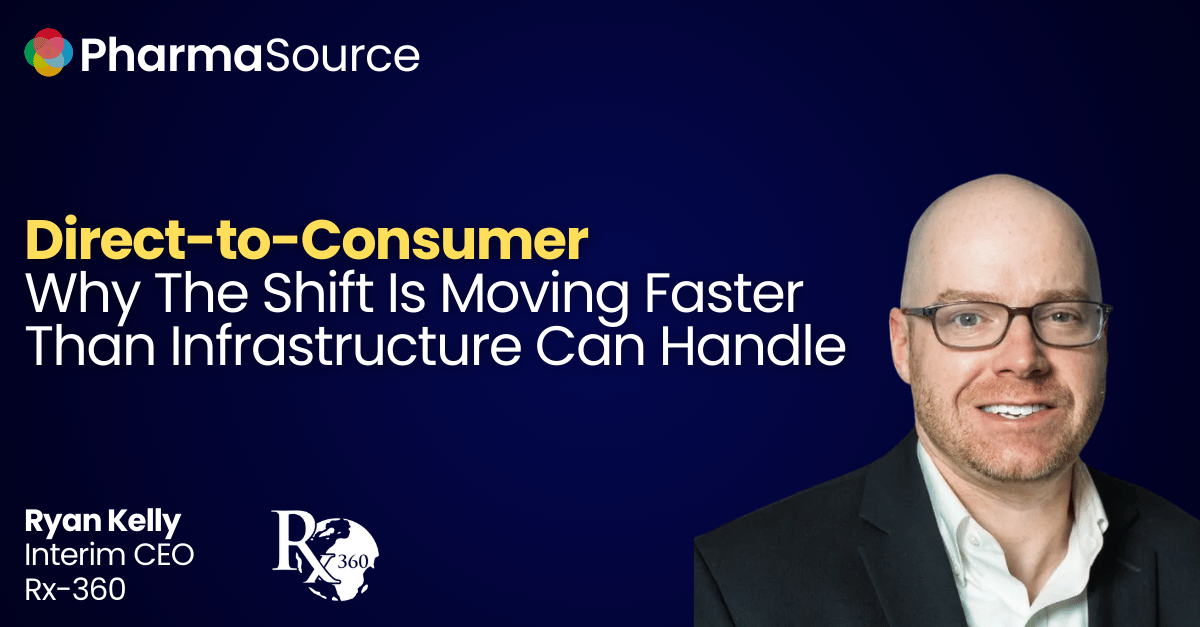
“We’re witnessing what I would consider the most structurally disruptive pharmaceutical moment I’ve seen in my career—and it’s being driven by consumers.”
Ryan Kelly, Interim CEO and Senior Director of Supply Chain Security and Brand Protection at Rx-360, has seen pharma’s direct-to-consumer transformation from multiple angles—building pharmacy operations at Amazon during the PillPack acquisition, scaling the largest cash pharmacy in the U.S. at Chewy, and now leading supply chain security for a 130-member industry consortium. His verdict: the infrastructure isn’t keeping up.
In the latest PharmaSource podcast episode, Ryan explains why GLP-1 demand and the rise of direct-to-consumer platforms such as TrumpRX have become the stress test pharma’s supply chain never prepared for—and what manufacturers need to do before the system breaks.
The GLP-1 Catalyst: Faster Than the iPhone
GLP-1 adoption since launch has now outpaced the iPhone’s trajectory from 2008. Super Bowl ads from Eli Lilly. Hims & Hers pivoting aggressively into the category. Telehealth platforms removing the friction that once stood between patients and prescription drugs.
Ryan draws on a comparison from a recent Wall Street Journal piece. “They compared it to the Napster moment, which I thought was really interesting. It gives you an overview of the considerations in this space—social media and telehealth accelerating demand, supply shortages enabling compounding and copycat products, direct pricing platforms increasing transparency, and then regulatory enforcement and litigation now following.”
The Infrastructure Gap
The U.S. Drug Supply Chain Security Act was built around a linear model: manufacturer to distributor to pharmacy to patient. That model is breaking down.
“We’re seeing a lot more drugs going through the mail. As you push volumes through channels they weren’t designed for, you introduce new risks—theft of high-value GLP-1 products, cold chain failures under speed expectations, data fragmentation across providers.”
The forecasting challenge is equally acute. “GLP-1 demand is exposing how fragile forecasting alignment becomes when patient demand bypasses the traditional controls of payers. In CPG and retail, we’ve had collaborative planning, forecasting and replenishment frameworks for decades. Pharma never got there—but it’s going to need to.”
On governance, Ryan is equally direct. “If you can diffuse information and visibility throughout the organization through technology, you no longer need to centralize every decision. You can empower a pharmacy or fulfillment center to just act—because they know what the right thing to do is anyway.”
Lessons From Amazon and PillPack
Ryan spent years inside Amazon’s pharmacy buildout, and the biggest lesson wasn’t operational—it was philosophical.
“PillPack really owned the entire consumer experience. They would chase a prescription that was ending, reaching out to the prescriber on the patient’s behalf. They would include insert cards informing patients that their drug might be switching from standard to extended release—or connecting diabetes patients with nutrition counseling programs. They understood not just the drug they were delivering, but everything else that patient was likely dealing with.”
That sense of agency is what Ryan believes pharma manufacturers are still missing. “A lot of manufacturers with direct-to-consumer programs are still operating them separately, within commercial and trade. They’re not yet embedded in the supply chain. We’re very early.”
He walks through what a functioning model looks like: a patient visits Lilly Direct, moves through a licensed telehealth prescriber, receives a prescription routed to Amazon Pharmacy, where it goes through data entry, pharmacist verification, and automated fulfillment before being shipped direct to the patient’s home. “Think of pharmacy like manufacturing. You are producing a discrete, individually labeled unit for a specific patient. The quality standards are different from cGMP, but they are rigorous—and manufacturers need to understand them.”
Brand Protection in a Direct-to-Consumer World
Direct-to-consumer creates a brand liability problem most pharma companies haven’t priced in.
“One of our members joked: I wonder how long it’ll take someone to spoof our website. The answer was less than a month.” Ryan’s rule of thumb for patients: “If a pharmacy is not requiring a prescription, it’s probably not legal.”
When a manufacturer puts their name on a direct-to-consumer program and something goes wrong—in telehealth, fulfillment, or last-mile logistics—the reputational consequence lands on the manufacturer, not the third party. “They’re not necessarily going to look to the telehealth name or the pharmacy’s name. If it’s your name they’re buying from, they’re going to look to you to own the entire experience.”
Compounding adds another layer of risk. “These are complicated drugs to make. A lot of compounders have ramped up very quickly. Manufacturers need to audit downstream partners with the same rigor they apply upstream.”
Where Manufacturers Should Start
Ryan’s starting point is supply chain visibility. “Know your supply chain. Map out what it currently looks like. Know where you’re making these drugs, know where you’re sourcing your raw materials. The more you can digitize that visibility, the better.”
That qualification rigor needs to extend downstream. “We qualify our suppliers of raw material, API, excipients, packaging—everything that goes into a prescription drug. We need to take that same lens and look downstream. Know who your pharmacy partners are. Understand their operations, their state-based licensing requirements, their cold chain capabilities, their quality systems.”
On program design, Ryan cautions against the instinct to launch at scale. “Most manufacturers tend to go all at once rather than iterate. In direct-to-consumer, that’s the wrong approach. Move quickly, but in an iterative way. Fail fast, or identify how to tweak it. That’s how the players already in this space operate—whether technologically or operationally.”
For CDMOs, he flags awareness as the immediate priority. “Your manufacturer partners are dealing with a lot simultaneously—direct-to-consumer shifts, tariff volatility, trade and transfer pricing changes. Understanding what they’re facing helps you anticipate capacity demands before they become urgent.”
Ryan Kelly will be speaking at CDMO Live Europe in Rotterdam this May. Download the full agenda