
The European Biotech Act is a proposed EU regulation aimed at transforming the Union into a globally competitive biotechnology and biomanufacturing hub, particularly in health-related biotech, by modernizing rules, boosting investment, streamlining regulation, and strengthening innovation ecosystems. It is part of the EU’s broader industrial and health strategy to close innovation gaps with other global regions.
Core Objectives
- Accelerate Biotech Innovation and Commercialization
- Simplify and harmonize regulatory pathways to reduce time-to-market for biotech products, including medicines and advanced therapies.
- Shorten clinical trial authorization timelines and introduce regulatory sandboxes to test cutting-edge technologies.
- Simplify and harmonize regulatory pathways to reduce time-to-market for biotech products, including medicines and advanced therapies.
- Boost Funding and Finance Access
- Launch a dedicated Health Biotech Investment Pilot in cooperation with the European Investment Bank to mobilize significant public and private investment throughout the biotech lifecycle, from start-ups to scale-ups.
- Launch a dedicated Health Biotech Investment Pilot in cooperation with the European Investment Bank to mobilize significant public and private investment throughout the biotech lifecycle, from start-ups to scale-ups.
- Support Strategic Projects
- Establish frameworks for identifying “strategic health biotechnology projects” and “high-impact projects” that can receive priority regulatory, financial, and administrative support.
- Establish frameworks for identifying “strategic health biotechnology projects” and “high-impact projects” that can receive priority regulatory, financial, and administrative support.
- Strengthen Manufacturing and Ecosystems
- Expand EU capabilities in biosimilars, biomanufacturing, and related infrastructure to ensure industrial resilience and reduce dependency on third countries for critical biotech production.
- Expand EU capabilities in biosimilars, biomanufacturing, and related infrastructure to ensure industrial resilience and reduce dependency on third countries for critical biotech production.
- Encourage Use of AI, Data & Digital Tools
- Facilitate the adoption of digital innovations, including AI and data platforms, aligned with EU data protection and the EU Health Data Space, to improve research, regulatory science, and risk management.
- Facilitate the adoption of digital innovations, including AI and data platforms, aligned with EU data protection and the EU Health Data Space, to improve research, regulatory science, and risk management.
- Enhance Biosecurity and Biodefence
- Introduce safeguards and controls to prevent the misuse of sensitive biotechnologies, balancing innovation with safety and security concerns.
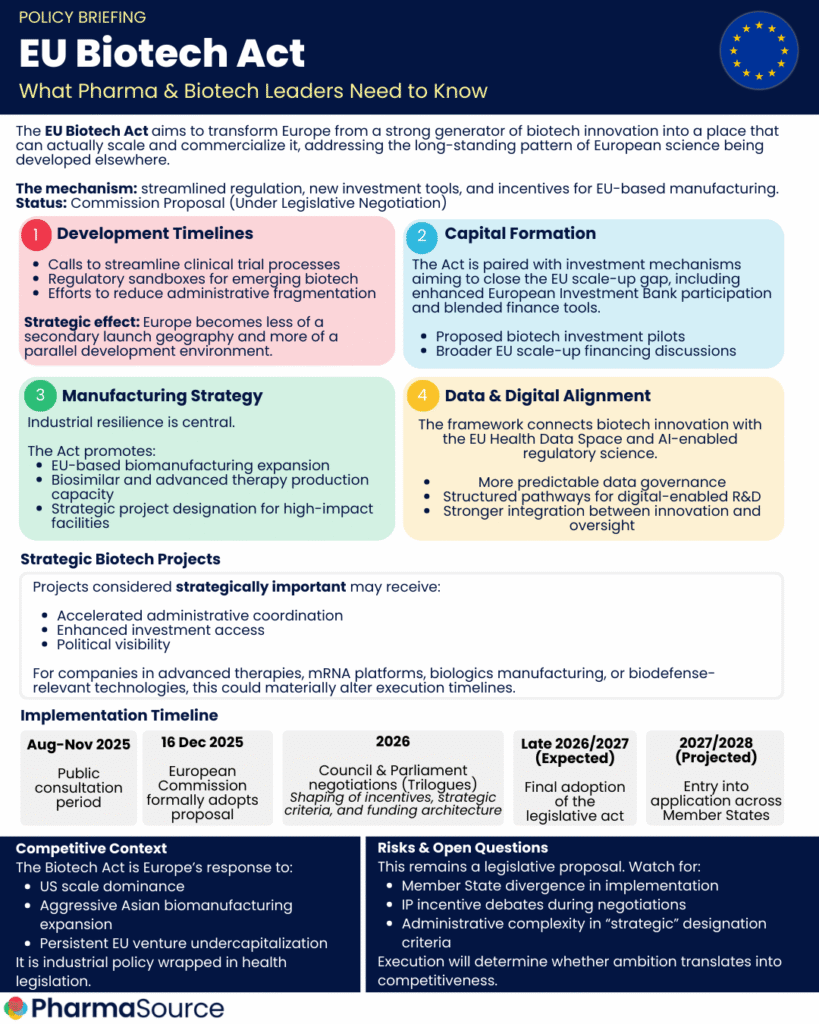
Key Proposed Measures
Regulatory Reform
- Amendments to EU clinical trial rules, advanced therapies legislation, and other key health laws to streamline authorizations and reduce administrative burden.
Investment and Economic Support
- Access to new investment pilots and financing tools for biotech companies of all sizes, focusing on closing the EU’s venture capital and scaling gap relative to other regions.
Market and Competitiveness Enhancements
- Proposals include support mechanisms that may extend intellectual property protections or incentives for manufacturing biotech products in the EU (subject to legislative negotiations), aimed at attracting global R&D and production.
Industrial Policy
- Targeted action to develop biomanufacturing clusters, centres of excellence in advanced therapies, and international cooperation on biosimilar production and distribution.
Expected Impact
If adopted, the Biotech Act is intended to:
- Make the EU a more attractive environment for biotech innovation and investment
- Reduce regulatory fragmentation and accelerate product development and authorization
- Strengthen EU autonomy in key biotech sectors
- Improve access to advanced therapies for patients
- Enhance safety and biosecurity frameworks
Legislative Status
The EU Biotech Act was formally proposed by the European Commission on 16 December 2025 following a public consultation earlier in the year. It now enters the legislative negotiation phase between the European Parliament and Council, with final adoption expected in late 2026 or 2027. Entry into application is projected for 2027–2028. A second, broader “Biotech Act II” focused on non-health sectors is planned for 2026, alongside rollout of the EU Bioeconomy Strategy and regulatory sandbox initiatives.
The Act reflects the EU’s broader ambition to modernize its biotechnology landscape, attract greater investment, and remain competitive with leading biotech regions like the United States and Asia, while retaining high safety and ethical standards.
Industry Response: Support, Cautious Optimism & Early Concerns
Overall, industry associations and companies have welcomed the European Biotech Act for its strategic ambition and focus on innovation, regulatory simplification, and investment support, especially in health biotechnology and biomanufacturing. Stakeholders see it as a necessary step to make the EU more competitive globally and to retain biotech scale-ups in Europe rather than losing them to the US or Asia.
Positive Signals
- Bioindustry groups such as EuropaBio have called for a bold approach to unlocking innovation, harmonizing regulation, and closing financing gaps, emphasizing that simplified frameworks, risk-based regulation, and coordinated capital markets are critical to scaling European biotech.
- National associations like AseBio (Spain) also view the Act as a major opportunity to accelerate the transition from research to market and boost strategic biotech capacity locally.
Constructive Concerns & Nuances
Regulatory scope & clarity
- Some stakeholders caution that outdated and fragmented regulatory frameworks remain a barrier and must be fully addressed for the Act to succeed; inconsistent interpretation across Member States still hampers market access and predictability.
Investment ambition
Industry groups have urged the EU to go further in closing funding gaps, mobilizing private capital more effectively, and harmonizing EU venture markets so that startups can scale without having to relocate abroad.
 Sign up to the free weekly newsletter for all the latest news, resources and podcasts in pharma manufacturing.