“Most people spend their lives optimizing the beach. They make the deck chairs look a little bit better, buy a new brolly, make sure it’s clean. But there’s a great big wave coming — and we spend very little time thinking about what that tsunami looks like.”
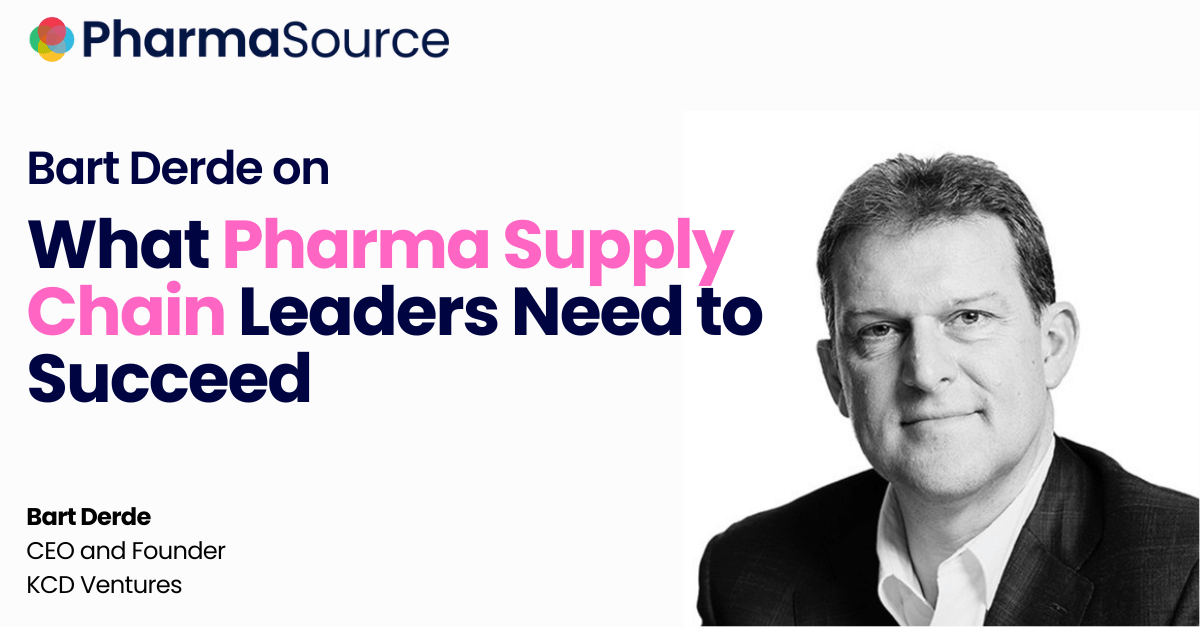
Bart Derde is the CEO and Founder of KCD Ventures, a Non-Executive Director, and former Chief Supply Chain Officer of Haleon — the FTSE top-20 consumer health company spun out of GSK. With 35 years across Unilever, Reckitt, GSK, and Haleon, Bart now invests in healthcare and supply chain companies and co-directs the London Business School and Korn Ferry Supply Chain Executive Leadership Programme.
PharmaSource sat down with Bart at Making Pharmaceuticals 2026, where he was attending in his capacity as an investor in GMP Manufacturing, a UK-based contract manufacturer serving the OTC market. Against a backdrop of tariff disruption, nearshoring pressure, and an accelerating automation agenda, Bart discussed what makes the different between a good supply chain leader, and a great one.
Why Daily Optimization Isn’t Enough
Bart’s starting point is a question to supply chain leaders: Are you spending your time optimizing what exists, or preparing for what’s coming? For most, he argues, it’s overwhelmingly the former.
Most supply chain leaders are excellent at what Bart describes as ‘managing the deck chairs’ — running daily operations, improving processes, and gaining a little ground on the competition next door. The problem is that this mindset can be near-sighted.
“There’s a great big wave coming, and it’s going to transform the beach. It’s a tsunami. And we spend very little time thinking about what that tsunami looks like.”
Bart explained this tension during a talk at Making Pharmaceuticals, where he presented a Korn Ferry survey of CSCOs, which highlighted this tension between performing today and preparing for tomorrow. Leaders were asked to rank the skills most critical to their future supply chain strategy. Agile mindset and business acumen top the list. Cost optimization and process improvement, the traditional pillars of supply chain performance, rank last.
Bar chart showing CSCO priority skills ranked 1st to 10th, with Agile Mindset ranked highest and Process Improvement ranked lowest
CSCOs were asked to rank supply chain skills by priority to their future strategy
Source: Korn Ferry CSCO Survey | Respondents included leaders from Haleon, Unilever, Mars, Pepsico, Maersk, Burberry and others
Bart has been building his thinking about what this shift demands for roughly a decade. The inflection point, he says, came when he started managing ecosystems rather than functions.
"The more senior you get, the more you realize that managing the ecosystem rather than managing the functional system is going to make a bigger difference."
Personalization, Automation, and the Reinvention of the Manufacturing Model
One of Bart's core arguments is that the forces reshaping the supply chain aren't abstract or distant; they're already producing business results at companies paying attention. He points to examples including Ocado (delivery cost parity with in-store), Invisalign (a £4 billion revenue business built on supply chain innovation), and Inditex (€20 billion in revenue created through a fast-response supply chain model).
For pharma specifically, the shift he sees coming is from mass production to personalized medicine.
"Consumers expect personalized products and personalized solutions. The pharma industry will have to change to become much more relevant in that space — to be personal to everybody, to provide personalized solutions."
He describes GMP Manufacturing, one of his investee companies, as already working toward personalized cancer treatments tailored to individual patients. This is a near-term operational reality that will require entirely different batch release processes, operating models, and manufacturing configurations.
The broader driver Bart identifies is the collapse of labour arbitrage. The globalization of supply chains over the past three decades was built on the premise that manufacturing was cheaper elsewhere. Automation changes the economics.
"If you have Tesla robots everywhere, if you automate the future, suddenly the world becomes one that is more sustainable because suddenly you don't have to ship. And a localized solution for many things is always better than a global solution."
From Functional Expert to Enterprise Leader: What the Data Shows
Bart has spent the past two years co-designing and delivering the London Business School and Korn Ferry Supply Chain Executive Leadership Programme, a six-month course aimed at accelerating supply chain leaders toward CSCO and COO-level roles. The programme, which returned a 95% Net Promoter Score in its first year, is built on a clear finding from Korn Ferry's assessment database of over 41,000 supply chain professionals: fewer than 14% of executives qualify as true enterprise leaders.
High-performing supply chain leaders, according to the Korn Ferry data, score significantly higher on commercial exposure (a 28.2% differential versus their peers) than on any other functional dimension. They also score higher on planning breadth (+22.2%), logistics (+18.9%), and manufacturing (+13.9%).
Bart's description of the enterprise leader captures something that data alone can't fully convey. It's a mindset shift from executing within a system to seeing and shaping the system itself.
"You have to move away, as much as you can, from the day-to-day of tariffs today, tariffs tomorrow, and move yourself into a space of what the world looks like in 10, 15 years' time. What are the trends? What isn't going to change? And how do you embrace that future?"
This is not a call to ignore operational pressures; Bart is clear that day-to-day delivery still matters deeply. But he argues that most organizations have the balance wrong. Too much energy is spent on incremental improvement and too little on understanding the shape of the next ten years.
Bart's perspective, rooted in 35 years of frontline supply chain leadership across some of the world's most complex consumer health portfolios, points toward an industry at an inflection point. The rise of automation, personalization, regionalization, and AI will require leaders who can hold operational performance and strategic reinvention simultaneously.
"Leaders need to be bold. Helping people work out how to make transformational change versus incremental change — that is what it's going to require."