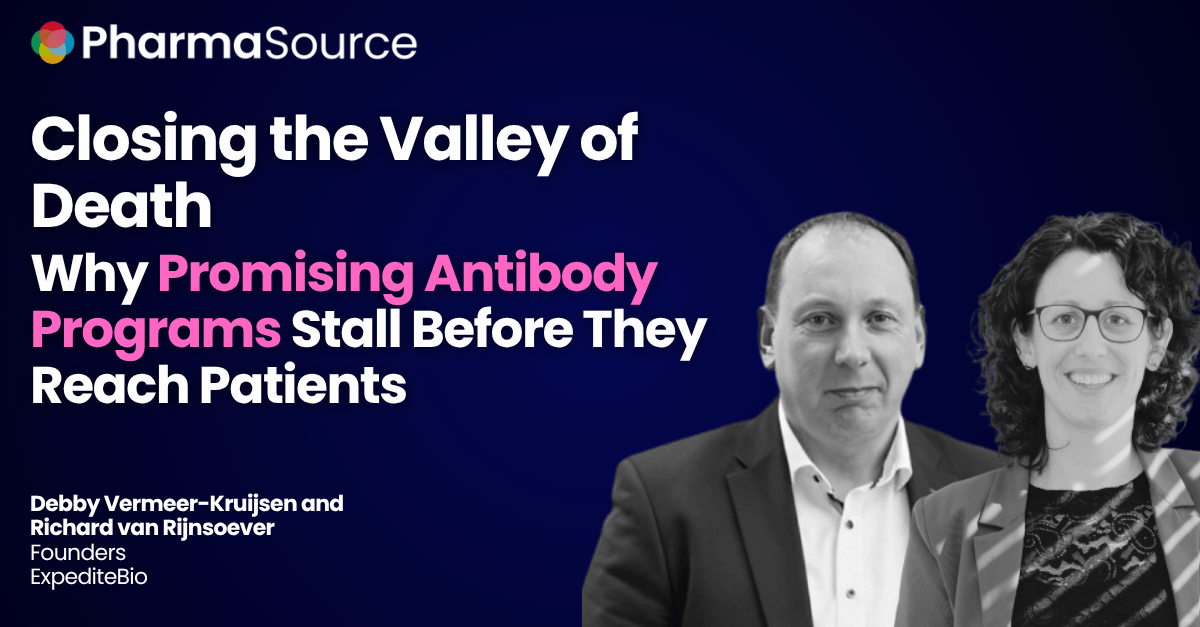
“The challenge is not getting better biology. It’s building a better system to carry the biology forward,” says Richard van Rijnsoever.
Debby Vermeer and Richard van Rijnsoever are co-founders of ExpediteBio, a Netherlands-based venture focused on accelerating antibody and protein therapeutics from discovery to first-in-human study. Debby also co-leads the biologics workstream at Oncode Accelerator, a national initiative working to accelerate cancer therapy development, e.g., by building infrastructure in the Netherlands.
On the PharmaSource podcast, Debby and Richard spoke about the structural reasons biologics programs fail to reach patients, how their ASCEND framework addresses those failures, and what a more functional European biologics ecosystem could look like. Their conversation is a practical guide for biotech CEOs and CMC leaders navigating the most expensive stretch of early-stage drug development.
Where Development Programs Break Down
Most biologics failures are not scientific. What derails programs is a series of compounding bottlenecks that accumulate precisely when teams move from scientific validation toward development readiness.
“It is not one big failure point,” Richard explains. “The valley of death is the stage when programs move from scientific validation toward development readiness — that is when questions about manufacturability, regulatory strategy, or translational evidence suddenly become critical. The issue is that teams start looking at these too late.”
A recurring pattern accelerates the problem. Founder-scientists and investors often do not speak the same language. Investors have expectations around which data milestones should unlock the next development step. Scientists, focused on biology, have not framed their data in those terms. When inexperienced teams do not know which questions to ask or which milestones are critical, programs stall, costs escalate, and investors withdraw.
Why Biologics Are Harder Than Small Molecules
Small molecules are chemically synthesised through predictable, reproducible processes. Debby outlines the layers of complexity that distinguish biologics manufacturing: cell line sensitivity to temperature, media composition and culture conditions; batch-to-batch variability; and the cascading impact of early design choices.
“Decisions already made in the early antibody design phase are really important,” she says. “The framework selected, CDR composition, isotype — together these can significantly impact downstream manufacturability and scalability, which influences cost of goods.”
Quality control adds another layer. Demonstrating stability, homogeneity, and functional activity through validated biological assays is a regulatory prerequisite. For teams transitioning from academic or early discovery settings, the gap between what they have done and what is required for a GMP batch can be wide.
The ASCEND Framework: Strategy Before Infrastructure
When a new client arrives at ExpediteBio, the first gap Debby and Richard typically identify is the absence of an integrated development strategy.
“Scientific teams have very strong data on the target or the biology, or they already have a molecule,” Debby says. “What they lack is a roadmap that connects early science to a development plan that regulators, manufacturers, and investors are expecting — and the next stages they need to take to bring the molecule to patients.”
ExpediteBio addresses this through what it calls the ASCEND model: Align, Strategize, Create, Execute, Nurture, and Deliver. Rather than applying a fixed methodology to every program, the framework builds a flexible structure around each project’s specific questions, gaps, and budget constraints.
The practical output is a development plan that is coherent across technical, regulatory, manufacturing, and commercial dimensions — and one that an investor can evaluate. “We want to create a development plan that fits their budget,” Debby says, “or make clear what the budget actually needs to look like, so investors are not surprised later.”
Shortening Timelines
When asked where to start if the goal is compressing development timelines, Richard’s answer is: stop doing things in series.
“We try to combine activities and make them overlap,” he explains. “Instead of first doing discovery, then pre-development, then process development — we run these in parallel with the right infrastructure behind them.”
The platform technology that ExpediteBio collaborates with Sartorius is central to this. It offers clients a validated, already-scaled process with a small equipment footprint — meaning early production runs use the same process as Phase 1 material, eliminating the scale-up activities and expensive engineering runs that typically separate laboratory work from GMP manufacturing. The team can move from a proof-of-concept hospital setting directly into Phase 1 supply.
Cell line selection is also addressed early. Rather than committing to a single manufacturing mode before commercial requirements are understood, ExpediteBio helps clients select flexible cell lines capable of running as batch, fed-batch, or continuous perfusion. That decision, made at the start of development, can save significant rework and cost later.
Building the Right Partnerships Without an Existing Network
For early-stage teams without established industry relationships, finding the right development partners can be a challenge. Richard’s advice is to start with internal clarity before looking outward.
“First, create clarity on what your own expertise is, what you can do in-house, and where you have the need for outsourced help,” he says. “From those questions, you can identify what expertise and which network you need to tap into.”
On what makes a good partnership work — and what causes it to fail — Richard points to flexibility as the defining variable on both sides. CDMOs and advisors who cannot accommodate the inevitable course corrections of early-stage programs add risk rather than reduce it. But scientific teams that chase perfection too long create a mirror problem.
“80 per cent is good enough. The last 20 per cent will cost you 80 per cent of the time and money — and it does not bring you closer to the market.”
The Academic-to-GMP Mindset Shift
Transitioning from academic discovery to GMP manufacturing requires more than technical knowledge. It requires a different way of framing what success looks like.
“The biggest shift is from interesting science to an actionable development program,” Debby says. “Understanding that difference is critical if you want a product to succeed.”
Scientific depth is not the issue. Academic teams often have highly detailed knowledge of their target biology and molecule. What they typically lack is the ability to translate that data into a development plan that regulators, manufacturers, and investors recognize.
What a Better European Biologics Ecosystem Looks Like
Debby’s parallel role as co-lead of the biologics workstream at Oncode Accelerator, a national Dutch initiative to accelerate cancer therapy development, gives ExpediteBio a direct connection to the infrastructure-building work happening at the system level.
“It is often underestimated how significant the delay and inefficient spending of capital can be in the transition from having a therapeutic lead to a manufacturable molecule or a clinical batch,” she says. The goal for both organizations is the same: reduce the failure rate of novel therapies and increase the rate at which scientific discoveries in academia and small biotech actually reach patients.
For ExpediteBio specifically, the five-year ambition is to have demonstrated, through completed programs, that the path from validated molecule to first-in-human study can be made both faster and more predictable for teams that previously had no clear route forward.
“The challenge is not getting better biology. It is building a better system to carry the biology forward. That is why we set up ExpediteBio.”