“Capacity isn’t the biggest gap. It’s people. And nobody’s talking about it.”
For pharma and biotech companies, manufacturing combination devices means coordinating not just fill/finish manufacturing but also primary container selection, device sourcing, final assembly, and serialization — often across multiple specialist partners.
As CDMOs expand their service offerings to take on more of that coordination, including final device assembly and primary container management, the boundaries of what a fill/finish partner is expected to deliver are shifting.
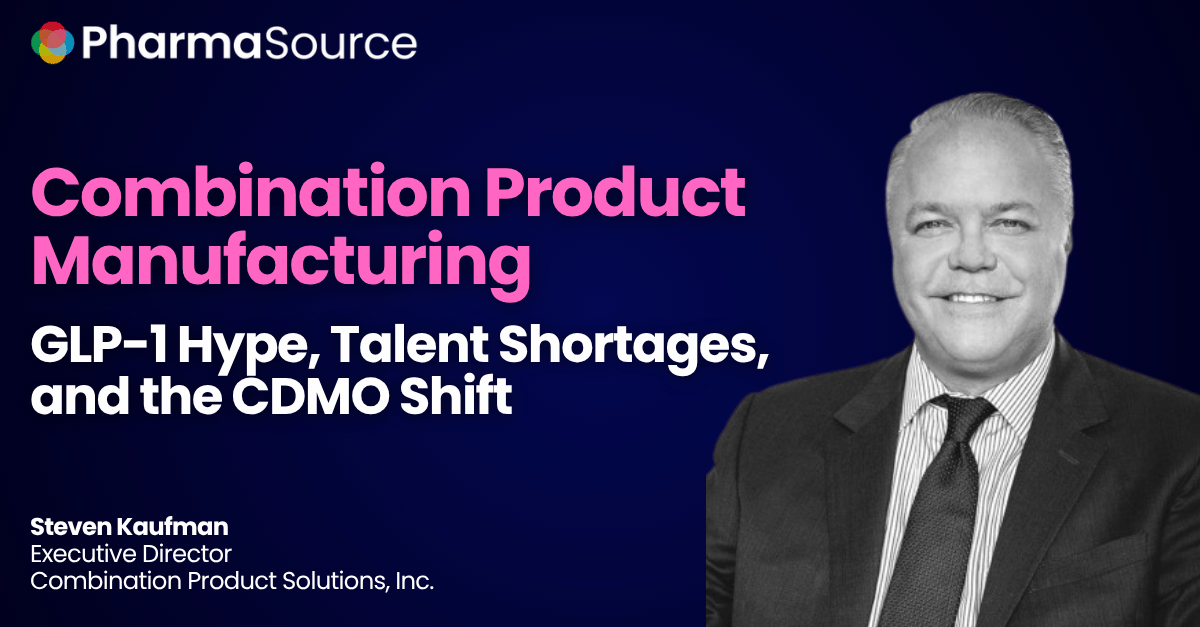
In the latest PharmaSource podcast episode, Steven Kaufman — who has spent over 20 years in the drug delivery device space and now advises biotech companies and CDMOs on combination product strategy — breaks down where the complexity really lies, why fill/finish capacity remains so tight, and what smart companies are doing differently to protect their programs.
Understanding Combination Products
A combination product is a drug packaged within a delivery device — most commonly a prefilled syringe (PFS) inside an autoinjector, pen injector, or on-body delivery system. The PFS itself is technically a combination product, but the full value chain includes the drug product, the primary container, the device sub-assembly, final assembly, release testing, serialization, and distribution.
“When I say combination product, I’m usually referring to something that is a device — an autoinjector, a pen injector, an on-body delivery system — and it has a prefilled syringe. Most people, when they hear the word combination product, think: device, primary container, injectable product.”
Steven notes that even experienced pharma professionals can find the terminology confusing. The word “CMO” alone means different things depending on who is in the room — contract device manufacturer or fill/finish provider. Getting that language right early in a program can save significant time in partner selection.
Fill/Finish Capacity: What Is Really Driving the Crunch
GLP-1 medications dominate the conversation around fill/finish capacity pressure — and for good reason. The scale of demand from companies like Novo Nordisk and Eli Lilly is reshaping how CDMOs allocate slots. But Steven argues the picture is more nuanced than GLP-1 demand alone.
“Even before the GLP boom, it was difficult to get capacity at some of these sites. There are still so many other injectable drug products coming to market — and because they’re all competing for the same space, you have to make a choice.”
Steven shared an example: a fill/finish CEO told him directly that their site was not pursuing high-volume GLP-1 contracts precisely because they did not want to overcommit their capacity to a single product category. Some providers are making deliberate strategic choices to stay diversified.
The capacity challenge is also regional. Europe and North America remain the most constrained. APAC — particularly China — has seen significant capacity expansion, and some companies are now actively exploring that option. But for most programs targeting Western commercial launch, the pressure is real and unlikely to ease quickly.
The CDMO’s Expanding Role: From Fill/Finish to Full Device Partner
Historically, CDMOs filled syringes. The device work happened elsewhere. That model is changing.
Steven describes a clear shift toward CDMOs taking on final assembly of autoinjectors — receiving sub-assemblies from the device manufacturer, combining them with the filled PFS, and releasing the finished combination product. Some are also managing primary container procurement on behalf of their pharma clients.
“The CMO companies are being more strategic, and the equipment manufacturers are being a bit more creative. We see equipment now designed to handle the most common autoinjectors on the market — which means a fill/finish site can offer clinical and commercial assembly for multiple clients, not just one.”
The economics are driving this evolution. Managing PFS supply is not highly lucrative for CDMOs. Final device assembly, by contrast, can be profitable — and it is increasingly a competitive differentiator. For biotech companies, it means a single partner can now take a program from fill/finish through to serialized, labeled product ready for distribution.
But that integration comes with complexity. Needle gauge, PFS mechanical tolerances, injection time, and drug-device compatibility all have to align. Steven explains there will always be challenges. The question is whether your partner is equipped — technically and culturally — to work through them with you.
How to Select a Fill/Finish Partner for a Combination Product Program
When a biotech client approaches Steven for fill/finish guidance, his first question is about cultural fit.
“Cultural fit means I can feel comfortable talking to this partner, that they can work well with us, and it’s not transactional. Taking a combination product to market always surfaces challenges. You need a partner that will work through those problems alongside you.”
For Steven, cultural fit has a geographic dimension too. A partner in the same region means similar time zones, easier site visits, and the ability to have executive conversations without a 12-hour lag. That access matters when decisions need to move quickly.
He also emphasizes executive engagement. For smaller biotech companies especially, having a senior-level contact at the CDMO — someone who can advocate for your program internally — can make a difference.
Common Mistakes in Fill/Finish Partner Selection
Steven identifies three patterns he sees repeatedly:
- Casting the net too narrow. Many biotechs default to the top three or four names in fill/finish and never seriously evaluate the growing mid-tier players who may be hungrier for the business and more flexible on timelines.
- Moving too slowly after identifying a partner. Once you have the right cultural fit and site visit behind you, hesitation is expensive. Slots get filled while teams are waiting for internal sign-off.
- Failing to lock in final assembly alongside fill/finish. If you need device assembly at the same site, negotiate and contract that simultaneously. Treating it as a separate decision can leave you with capacity for one and not the other.
“Engage early, find that cultural fit, pay the money to reserve the slot, sign the agreement, and lock it in. Don’t lose capacity because your internal approval process took too long.”
Will Oral GLP-1’s Ease Capacity Pressure?
Novo Nordisk’s first approved oral GLP-1 therapy has renewed questions about whether injectable capacity pressure will ease as patients switch to pill-based alternatives. Steven is measured in his view.
“I don’t think it really covers the entire market. You have the first oral, the second coming soon — but you still have so many other GLP variants that won’t easily move to oral form. And in some cases, the API cost to produce the oral version could be more expensive than the injectable with device and primary container combined.”
His broader argument is that upcoming patent expirations in 2030, 2032, and 2035 will bring new players into the injectable market. Those players will compete for the same fill/finish capacity and order the same devices and primary containers. The net effect on available slots is uncertain, but it is unlikely to produce a meaningful surplus anytime soon.
For private equity investors in the device and tooling space, Steven acknowledges short-term uncertainty around the oral GLP-1 question. But his overall read on the sector is bullish. Combination product demand is structurally driven by a broad pipeline of injectables — not just weight loss drugs — and the industry’s global manufacturing footprint is still catching up.
Supply Chain Resilience and the Geopolitical Factor
Geopolitical tensions, tariffs, and rising shipping costs are creating increasing complexity for supply chain and procurement decisions. Steven also explains that, even as these challenges dominate daily planning, the lingering effects of COVID-19 continue to shape how companies manage inventory, plan logistics, and maintain supply integrity.
“Companies are now more than ever taking a regional approach. If you’re strong in Europe, you have to beef things up in the US. Then, eventually, from North America, you build out APAC. Because if another disruption happens, you need to be able to service your markets locally.”
The Talent Gap: The Constraint Nobody Is Talking About
Asked about the biggest gap in combination product manufacturing today, Steven points to the talent shortage.
“Capacity is the obvious answer. But for me, it’s people. I’m seeing some of the best professionals in this industry retire or move into consultancy. The real challenge is making sure the talented people we have now — in their twenties, thirties, early forties — get the right level of support, experience, and training.”
Steven’s prescription: invest in retention, ensure career progression is visible and rewarded, and grow the next generation of specialists deliberately. The CDMOs that have kept people for decades are, in his view, among the most operationally reliable in the sector — and the reason is not coincidental.