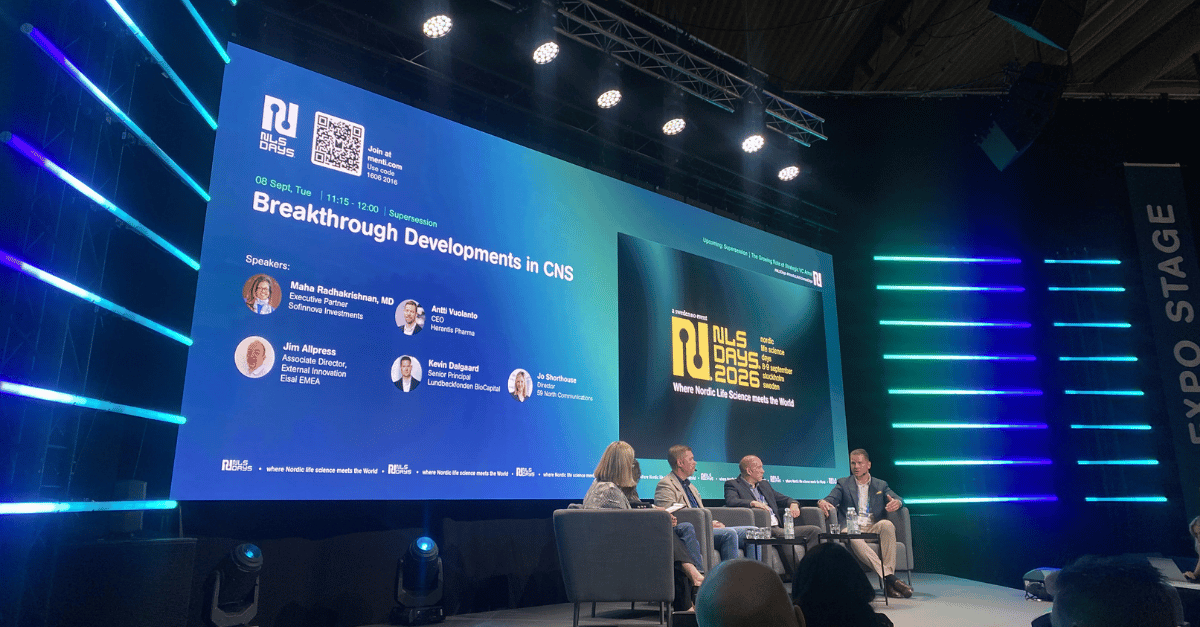
Central nervous system (CNS) drug development has long been considered one of the toughest corners of the pharma industry, but a panel at NLSDays 2026 in Stockholm made the case that the ground is shifting.
In the session “Breakthrough Developments in CNS,” centered on CNS science and dealmaking, moderator Jo Shorthouse of 59 North Communications led a discussion with Maha Radhakrishnan, Executive Partner at Sofinnova Investments; Antti Vuolanto, CEO of Herantis Pharma; Jim Allpress, Associate Director of External Innovation at Eisai EMEA; and Kevin Dalgaard, Senior Principal at Lundbeckfonden BioCapital.
Better Tools, Earlier Confidence
Kevin’s explains the real change in CNS isn’t necessarily a higher probability of technical success; it’s that biology can now be measured much earlier than before. Cerebrospinal fluid exposure, receptor occupancy data, and neurofilament light as a biomarker now give companies and investors answers in early phase two that once required a full phase three trial. “That’s something we can now get addressed much earlier on,” he said, calling it a toolbox that makes CNS more approachable for venture capital than it was a decade ago.
Maha offered a similar read from the pharma side, pointing to approvals like Leqembi (lecanemab) and Kisunla (donanemab) as proof that diagnosing patients by underlying biology rather than symptoms alone is changing outcomes. “Are we there where precision oncology is sitting today? No. But have we come a long way? Most certainly,” she said, citing parallel progress in neuromuscular disease biomarkers like dystrophin levels and video hand-opening time.
Trust Still Decides Long Partnerships
Jim pointed to Eisai’s decades-long relationship with BioArctic, a partnership that began on an unproven amyloid hypothesis, as evidence that science alone doesn’t sustain a long collaboration. What matters, he argued, is a culture of openness: being upfront about problems rather than concealing them. “You need to build that trust… choose a partner who shares your visions and values,” he said. Antti, whose Finnish biotech Herantis is developing a brain-penetrant peptide for Parkinson’s disease, added that the length of that journey, often two decades or more from first data to commercialization, means smaller biotechs need pharma or investor validation early, since that’s often what unlocks financing.
Separating Real Progress from Market Enthusiasm
Kevin also offered a framework for testing whether a “new era” claim holds up: has the base rate of technical success actually improved, are payers and regulators rewarding successful drugs, and is capital simply cheaper right now. He warned that conflating these factors risks paying a high price at the wrong point in the cycle. However, he noted that repeated, consistent efficacy across different companies pursuing the same mechanism, as seen with lecanemab and donanemab, is a genuine signal that something has changed.
Where the Next Breakthroughs Might Come From
Asked where excitement lies beyond Alzheimer’s, the panel pointed to several areas: tauopathies and other neurodegenerative diseases beyond amyloid, novel approaches in major depression and schizophrenia (including psychedelic and non-dissociative compounds), and large unmet need in PTSD and anxiety disorders. Kevin flagged neuropsychiatry and epilepsy specifically as spaces he’s watching. Maha emphasized that progress will depend on biomarkers that not only diagnose but also help prognosticate which patients will respond and cautioned that safety signals like ARIA, first identified in Alzheimer’s studies, are likely to recur elsewhere in neuropsychiatry as new mechanisms move forward.
The Next Wave of CNS Breakthroughs
The panel’s overall tone was one of cautious optimism. CNS isn’t yet where precision oncology sits, but with better biomarkers, more informative translational models, and a combined $28 billion across the ten largest CNS transactions so far in 2026 alone, the field is attracting a level of capital and scientific rigor that simply wasn’t there ten or fifteen years ago. As Maha put it, summing up the panel’s shared view: the industry has come a long way, and there’s a real reason to believe the next wave of CNS breakthroughs will move faster than the last.