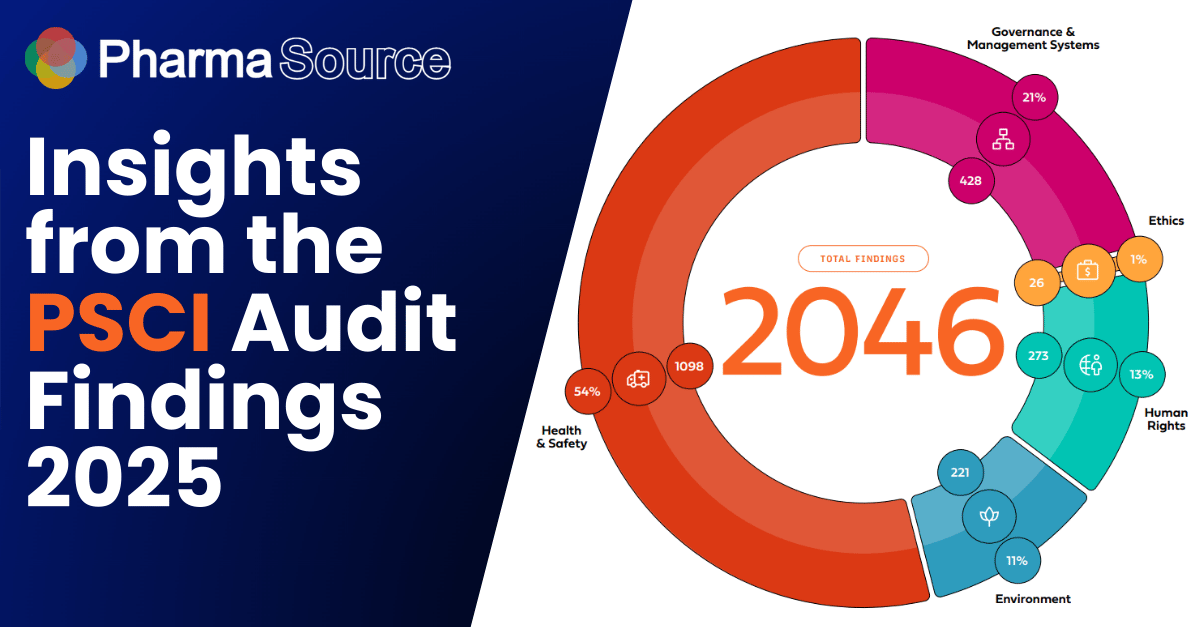
The Pharmaceutical Supply Chain Initiative (PSCI) has released its annual audit findings report, analyzing 2,046 observations from 228 supplier audits conducted in 2024. The analysis, spanning Governance & Management Systems (428 findings), Ethics (26), Human Rights (273), Health & Safety (1,098), and Environment (221), provides pharmaceutical and healthcare companies with critical intelligence on supplier risks, emerging trends, and improvement priorities across the global supply chain.
Each year, pharmaceutical companies conduct thousands of supplier audits requiring two to four days of intensive on-site assessment. PSCI members share these audits to drive transparency and efficiency, then analyze findings against the PSCI Principles to identify patterns and translate insights into practical guidance, training, and peer learning resources that suppliers can implement quickly.
1. Health & Safety: Still the Dominant Risk Area
Health and safety findings accounted for 54% of all observations in 2024. This has remained the largest topic area for the 5 years that the PSCI has analyzed its members’ audits. The largest concentrations appeared in worker protection (29%), occupational health and industrial hygiene (22%), process safety (17%), and emergency preparedness (17%).

Key worker protection findings highlighted widespread electrical safety gaps across all regions, particularly related to lock-out/tag-out (LOTO) systems and arc-flash assessments. Materials handling vulnerabilities (unsecured pallet racking, inadequate overhead storage practices, pedestrian-vehicle segregation) persisted alongside work-at-height issues involving fall protection and rescue planning.
Process safety findings highlighted suppliers’ struggles to identify, assess, and control hazards involving combustible materials and chemicals. Electrical classification and explosion protection gaps remained widespread, as did preventive maintenance deficiencies for safety-critical devices. Emergency preparedness findings centered on fire detection/suppression gaps (including three critical findings), emergency team staffing across shifts, and incomplete training or drill programs.
From 2022 forward, major findings per audit increased, suggesting more detailed investigations and higher expectations. Auditors’ observations also became more granular and technical, encompassing sophisticated requirements like occupational exposure banding (OEB) and specific analytical methods, a signal of both advancing auditor expertise and tightening regulatory landscapes.
2. Governance & Management Systems: The Rising Priority
Governance and Management Systems (GMS) findings rose to 21% of total observations in 2024, overtaking Environment for the first time and reflecting intensified auditor focus on the systems that enable all other compliance areas. Three dominant themes emerged within GMS.
Business Continuity Planning (BCP)
Facilities’ plans frequently showed limited scenario coverage, unclear recovery time objectives, or weak testing protocols. Some sites lacked plans entirely. Where emergency response plans existed, auditors found them insufficiently comprehensive or actionable.
Risk Assessment Scope and Methodology
This revealed that suppliers are missing risks related to business interruption, reputation, ethics, or human rights, or are relying on qualitative rather than systematic approaches. Supplier management gaps appeared in incomplete evaluation processes that didn’t address PSCI principles, insufficient due diligence comprehensiveness, and inadequate communication to suppliers on responsible business conduct.
Internal Audit & Assessment
Sites demonstrated gaps in their internal audit programs, with incomplete documentation of required procedures and missing steps within the audit process itself. Additionally, many facilities lacked structured management review procedures for evaluating internal assessment results—a critical gap that undermines the continuous improvement cycle.
The five-year trend shows GMS focus shifting from “plan exists” to “effective communication and execution,” including customer notification procedures during crises. Incident investigation and root cause analysis strengthened significantly, with findings rising from 4% of Continual Improvement observations in 2020 to 21% in 2024. Specific analytical methods (5-Why, Fishbone) are now required by audit protocols, and facilities increasingly face expectations to establish formal investigation teams.
3. Environment: Growing Granularity in Technical Expectations
Environmental findings comprised 11% of observations, with the largest concentration in Waste & Emissions (50%), followed by Transport, Storage & Spill Prevention (21%) and Environmental Policy/Performance Monitoring (16%).

The five-year trend shows environmental audits becoming more granular: hazardous waste handling, environmental risk assessment for storage, and PiE-specific controls appeared increasingly often, indicating higher expectations and enhanced auditor capability.
Actionable insights for suppliers include building robust PiE programs that quantify APIs in wastewater where appropriate, maintaining updated PNEC assumptions, and integrating controls into wastewater process design and monitoring. Suppliers should confirm secondary containment for tanks and bulk storage meets capacity and integrity requirements, including loading/unloading bays, with maintained inspection and testing records. Hazardous waste programs must demonstrate compliance with storage time limits, proper labeling and segregation, and third-party oversight through pre-qualification and periodic audits. These environmental capabilities increasingly influence regulatory compliance and corporate sustainability commitments.
4. Human Rights: Contract Workers in the Spotlight
Human Rights findings represented 13% of observations, with Wages, Benefits & Working Hours dominating at 47%. This was driven by overtime limits, rest days, and timely payment processes. Policy and implementation gaps (18%) reflected facility-level procedures not matching corporate commitments, while Contract & Migrant Worker protections (7%) highlighted incomplete contracts and onboarding transparency issues.
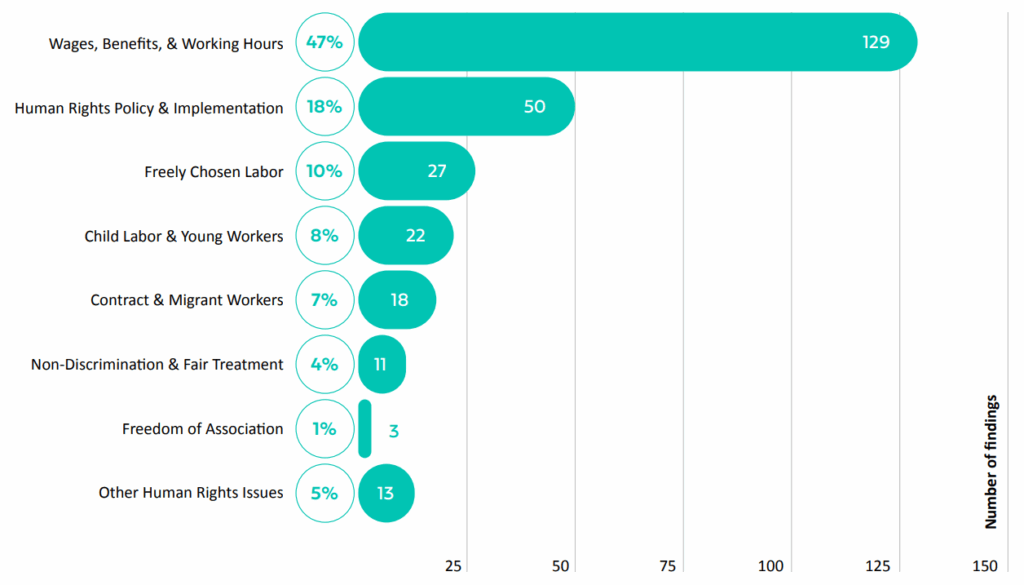
Contract worker treatment rose significantly as an area of concern, with multiple critical findings in 2023–2024 related to benefits, overtime compensation, and contract completeness. Severity spanned from excessive working hours to restricted audit access, preventing worker interviews, blocking verification of hours, benefits, and conditions.
Common findings included legal overtime/monthly limits exceeded, wages or overtime payments below legal minimums, delayed settlement for departing workers, punitive fines for lateness, and incomplete pay slips. Some sites lacked comprehensive human rights policies overall and specifically on freedom of association, anti-human trafficking, and labor broker recruitment fees.
The five-year trend shows alignment with international standards (OECD Guidelines, UN Guiding Principles) appearing more frequently after 2022, demonstrating maturing expectations for due diligence and value-chain coverage.
To find more insights, access the full report here.
Hear more from the PSCI on a recent PharmaSource Podcast episode.