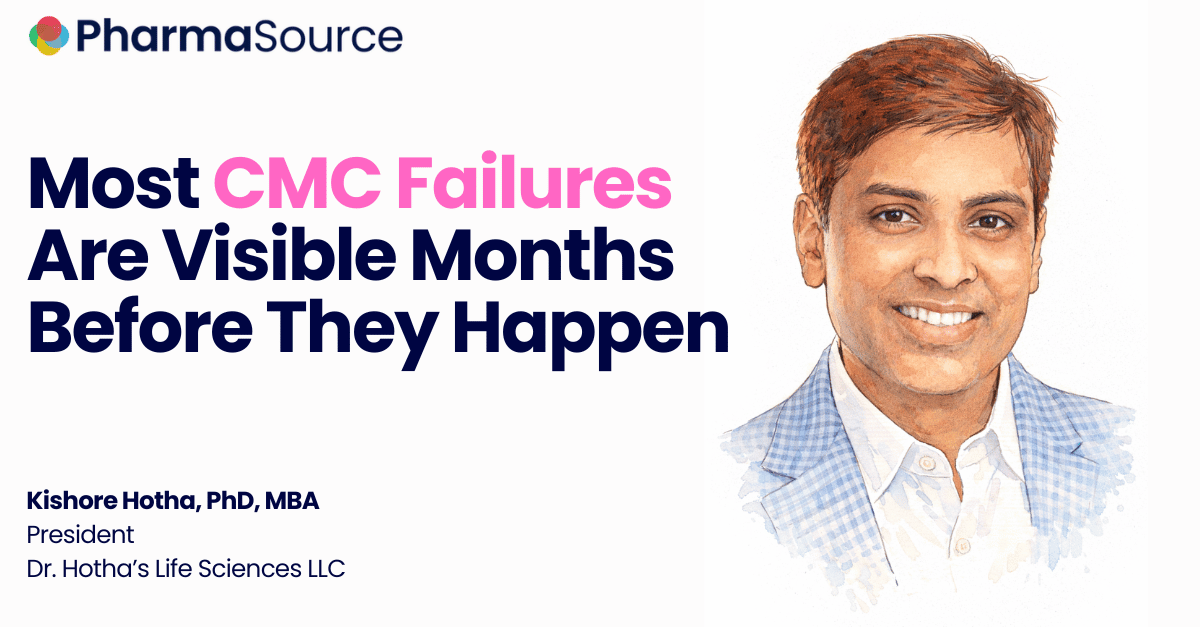
This guest editorial is by Kishore Hotha, PhD, MBA, President, Dr. Hotha’s Life Sciences LLC
Chemistry can fail in drug development. Unexpected impurity profiles, scale-up variability, conjugation instability, containment exceedances—these are real and consequential. Anyone who has led a CMC program through late-stage development knows the weight of a critical deviation arriving at the wrong moment.
But the failure of chemistry itself is rarely unexpected. What surprises teams—and disrupts projects—is encountering failure without a governance structure to identify it early, respond quickly, or contain its downstream effects.
Most CMC failures are evident months before they occur. The signs are there. The question is whether the sponsor-CDMO partnership is structured to detect them early enough to take action.
For external manufacturing leaders, the goal is not to eliminate chemistry risk, that is, development. The goal is to create structural conditions that turn late surprises into early decisions.
Risk Posture Determines What You See, and When
Every CMC program involves risks. The main strategic question isn’t how to eliminate them, but how much risk is appropriate for the current stage—and who is responsible for making that decision when it arises.
Is it the goal to develop a clinical signal with targeted early investment? Or to create a strong, transferable process capable of withstanding commercial review or large pharmaceutical due diligence?
These are fundamentally different programs that demand varying levels of analytical depth, stability commitments, and criteria for when to escalate a finding versus absorb it.
Without clear alignment at the start of the program, teams operate based on different assumptions. The CDMO concentrates on technical thoroughness, while the sponsor prioritizes speed and cost efficiency. Neither approach is wrong. However, this mismatch results in one party viewing an impurity reaching 0.4% as a minor development finding, while the other sees it as a potential risk of clinical hold. The time spent resolving this disagreement is structural, not scientific.
In one ADC program I observed, a CDMO proposed comprehensive ICH stability protocols and extensive forced degradation studies before Phase I dose confirmation. The plan aligned more with internal standards than phase objectives. The original scope would have taken eight months. Once governance clarified the sponsor’s risk posture and phase-appropriate expectations, development was properly staged, and IND-supporting work was completed in twelve weeks.
The chemistry risk did not disappear. It was understood, scoped correctly, and monitored at the right level of rigor. That is early signal detection, not risk avoidance.
Capacity Transparency is a Leading Indicator
Capacity constraints are among the most predictable sources of CMC program failure—and among the least discussed during vendor selection.
Analytical timelines fall behind when teams are overburdened. QA backlogs grow unnoticed. A chemistry finding that would normally take two weeks to analyze and resolve in a well-equipped program instead takes eight—not because the science is more complex, but because the available bandwidth isn’t sufficient.
In a recent case, a CDMO committed to a timeline significantly faster than peer proposals. What was not visible during the selection process was that the proposed team was simultaneously supporting a large number of active programs. Delivery extended well beyond the original commitment, causing the sponsor to miss an IND filing window, lose a preferred clinical site, and be forced into an unexpected financing event.
The chemistry was sound. The capacity wasn’t.
For external manufacturing leaders, capacity validation is more than a procurement formality — it’s a key indicator of whether early signals are caught in time to act, or lost amid competing priorities.
Critical questions before contract execution:
- How many active programs are assigned to this team?
- Is QA review capacity scaled to analytical output?
- What percentage of programs met original timelines last year?
- What is the inspection history of this specific site—not the corporate network?
CDMOs with disciplined capacity planning provide these answers quantitatively. Those who cannot tell you something important about how your program will be resourced when complexity arises.
Decision Velocity Determines Response Time
When an early signal surfaces, such as an unexpected degradant, a process deviation, or an out-of-trend stability result, what happens next determines whether it becomes a manageable development event or a serious delay that threatens the program.
Chemistry is rarely hard to understand. The delay usually stems from determining who drafts the regulatory justification, who approves the response, and whether a formal change order is required or whether it can proceed under existing authority.
In one oligonucleotide program, a new impurity was identified in four days. Determining authorship of the regulatory narrative and coordinating change-control processes took another six weeks. The chemistry was not the obstacle. Decision-making was.
An explicit decision-right framework is established before programs begin, not negotiated during a crisis—reducing the time between signal and response. It clarifies who owns each decision category, the escalation threshold, and what can be resolved at the working level without disrupting momentum.
For portfolio leaders, these frameworks are infrastructure. They don’t prevent early signals from appearing. They prevent those signals from being buried before they compound.
Geographic Sequencing as Risk Strategy
Manufacturing geography is now part of senior management risk discussions. Biosecurity Act implications, onshoring pressures, and regional inspection differences have made geographic positioning a strategic factor, not just an operational one.
But reactive geographic transfers—driven by investor pressure rather than clinical logic—pose risks. Moving an unvalidated process before Phase I data is available does not lower CMC risk. Instead, it shifts the risk and adds complexity to the transfer.
The disciplined approach sequences geographic diversification with clinical de-risking. Early work advances with the most capable partner available. Secondary capacity is set aside for later-phase needs as the molecule is validated. Manufacturing independence grows as clinical confidence justifies investment.
The question is not whether to diversify. It is when.
Structure is the Early Warning System
Chemistry failures will happen. That is part of development. What is not inevitable is facing them unprepared—without clear governance to scope risk properly, visibility into resources to support programs, or decision frameworks to respond quickly.
When those structural conditions are present, early signals emerge. Teams act before a finding becomes a delay, before a delay escalates into a crisis, and before a crisis prompts executive escalation.
Most CMC failures are visible months before they happen. The variable is whether the partnership is built to see them.
Dr. Kishore Hotha is President of Dr. Hotha’s Life Sciences LLC, specializing in CMC strategy and CDMO partnerships for complex modalities including small molecules, ADCs, oligonucleotides, and biologics. With 20+ years of leading pharmaceutical development at Veranova, Lupin, and Dr. Reddy’s Laboratories, he has guided numerous programs from discovery through commercialization. Dr. Hotha holds a PhD in Analytical Chemistry and an MBA in Project Management, and has authored over 100 scientific publications.