“There were hundreds of these programmes being shelved — and many of them could have had a profound impact on children in particular.”
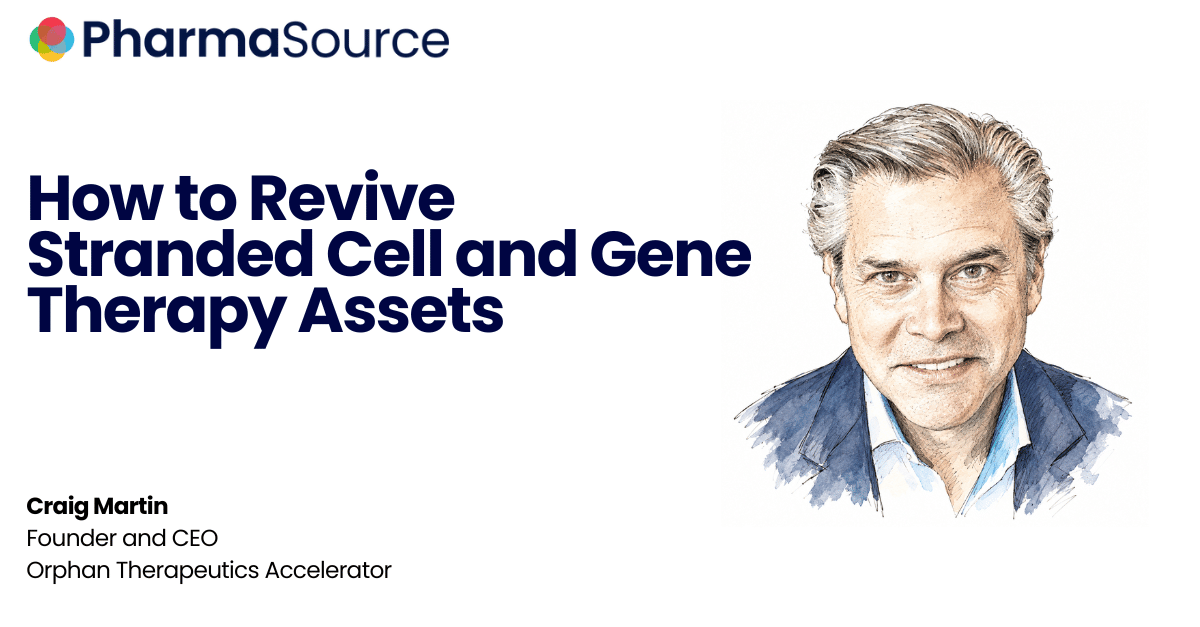
Craig Martin, Founder and CEO of Orphan Therapeutics Accelerator (OTXL), spent over two decades in rare disease and biotech before starting the organization, including two years as interim CEO of patient advocacy group Global Genes, where he watched capital pull back from rare disease programs that had nothing wrong with them scientifically.
In today’s PharmaSource interview, Craig explains why he built a non-profit to rescue clinical-stage therapies that biopharma companies have deprioritized, and what it takes commercially, legally, and on the manufacturing side, to bring those programs back to life.
Capital Pullback
Rare disease has long served as a proving ground for advanced therapies. But between late 2020 and early 2023, Craig had a front-row seat to a very different trend: companies walking away from programs that were already helping patients.
“There were a number of treatments that were in clinical trials that were helping children that were not moving forward — seemingly not for safety reasons, but primarily because the manufacturers of those products were redoing the commercial calculus on whether those therapies could be viable,” he says.
The scale surprised him. One Global Genes impact report identified roughly 40 companies in a single year that had lost funding and abandoned their rare disease portfolios — some with multiple therapies in the pipeline. And that’s likely an undercount: “If you’re a big biopharma, you may have dozens of treatments in your pipeline, and you’re constantly reevaluating which ones are going to move forward,” Craig notes, meaning many quiet cancellations never get reported at all.
A Non-Profit Structure Built to Unlock Stranded IP
Craig’s research into the problem pointed to two financial levers: lowering the cost of late-stage clinical development, and lowering the upfront cost of acquiring a shelved asset. Both led him to the same conclusion — the rescue vehicle had to be a non-profit.
“Through a non-profit model you can provide tax incentives — a company can essentially donate the IP for a treatment and write off the fair market value or tax basis of that upfront,” Craig explains. Donors can also receive “up to 10 years of net sales revenue on a sliding scale on the back end.”
Because OTXL isn’t acquiring the whole enterprise, the arrangement can let originating companies keep their long-term commercial options open. “If they want to take that IP and develop a therapy in a bigger disease area, which is ultimately what their goal is typically, that’s fine — we can ring-fence the IP within the smaller condition area because our interest is in access,” he says.
CGTxchange: AI-Driven Matchmaking for a New Class of Investors
OTXL initially built an AI platform to help its own small team evaluate incoming programs — screening data rooms and running predictive diligence across what has now grown to more than 80 therapeutic candidates. Last year, a conversation with the American Society of Gene & Cell Therapy (ASGCT) revealed a shared problem, and the two organizations turned that internal tool into CGTxchange: a marketplace for shelved cell and gene therapies across the whole field, not just OTXL’s own pipeline.
The bigger challenge CGTxchange is built to solve is who’s willing to fund these assets at all. “It’s not going to be the traditional VCs that are going to be investing,” Craig says. “It’s going to be family offices, impact funds, donor-advised funds, maybe some venture philanthropy. But those organizations don’t have the internal capacity oftentimes to evaluate a therapy… so we’re trying to make that easier through CGTxchange, and then provide the opportunity for some matchmaking and deal-making within that infrastructure.”
While investment in cell and gene therapy continues across the broader sector, orphan CGT assets have historically struggled to attract the same level of capital as therapies targeting larger patient populations — a gap CGTxchange is designed to help close.
Turning Excess CDMO Capacity Into a Manufacturing Network
Rescuing an asset commercially doesn’t mean much without somewhere to manufacture it. OTXL’s answer is Orphan ClinDev, a network of CDMO and CRO partners willing to defer or reduce fees in exchange for a share of future commercial success.
“One of the things that happened when so many of these therapies were shelved or deprioritized is there was excess capacity in the system,” Craig says. “Can we put that excess capacity to good use by covering costs and keeping talented people busy within those facilities… and getting to where there could be a commercial-scale contract that would help, over time, make sure they maintain the utilization of those facilities?”
That network now includes multiple partners lined up by modality — Craig names AGC, Landmark, Viralgen, and SK pharmteco among them — covering capabilities from AAV gene therapy manufacturing to ex vivo lentiviral and small-batch production. It’s a similar dynamic to the wave of CGT-specific facility expansion PharmaSource tracked across the CDMO sector in its 2025 manufacturing roundup — except here, the capacity being absorbed is capacity nobody else wanted to pay for.
On the regulatory side, Craig points to a mismatch that hits rare disease especially hard: standard requirements like multiple process performance qualification (PPQ) batches can be financially untenable “because one batch that you’re running for a rare disease therapy might cover the entire population that needs to be treated… in a given year.” He’s encouraged that FDA has “expressed a desire to have more rationality” around CMC requirements for these therapies specifically, though he doesn’t yet point to a finalized policy change.
Screening Shelved Assets: AI Modeling With Human Judgment
Not every deprioritized program is worth reviving, and OTXL’s screening process combines automated and human review. The AI platform runs predictive modeling against comparable programs by modality, estimating the likely regulatory pathway and associated cost. Human experts, including access to ASGCT’s own network, then evaluate the shortlist.
The two organizations work at different scales. “Within Orphan Therapeutics Accelerator, in a given portfolio, we’re probably only going to take on 7 to 10 therapies,” Craig says, calling it “a more finite universe that we can evaluate on a one-by-one basis.” CGTxchange, by contrast, is built “to do that at a broad scale” across the wider field.
Craig’s model relies on restructuring existing science to determine who bears the cost and who captures the return on therapies the market has previously decided are too small to be worth the standard playbook. If OTXL and CGTxchange can prove that out at scale, they’ll have built a template that other stalled rare disease programs — and the capacity sitting idle waiting for them — can plug into.