- Thermo Fisher Scientific announced October 16 it will integrate OpenAI’s AI models across clinical research and manufacturing operations, following three years of strategic preparation in governance, workforce readiness, and technology consolidation
- The deployment widens the AI capability gap in contract manufacturing, where nearly 80% of CDMOs remain in preliminary implementation phases
Thermo Fisher Scientific has announced it will integrate OpenAI’s artificial intelligence models across its clinical research and manufacturing operations, marking the execution phase of an AI strategy that began three years ago.
The partnership embeds AI-powered tools into workflows spanning drug development through commercialization, targeting faster clinical trial execution and earlier identification of failing drug candidates.
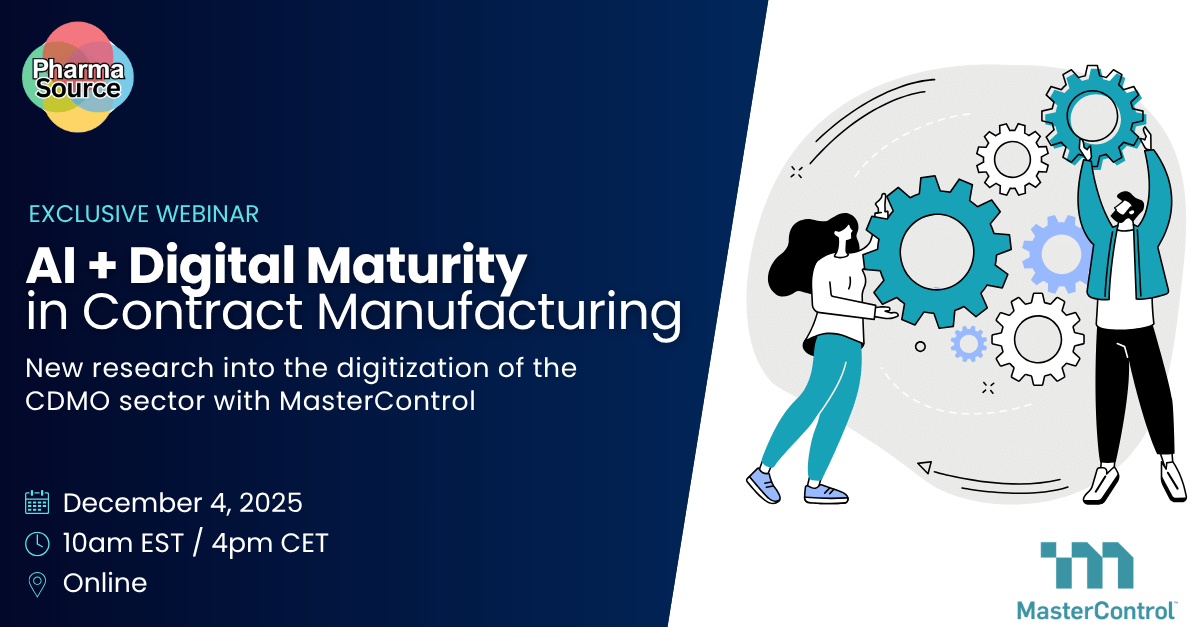
Upcoming research by PharmaSource and MasterControl reveals that the CDMO industry remains at an early stage of AI adoption. Nearly 80% of CDMOs remain in preliminary phases with 24% having no AI implementation and 54% conducting pilot projects. Only 22% have achieved operational deployment: 13% at departmental level and 9% at enterprise level. Sign up to the webinar for full results
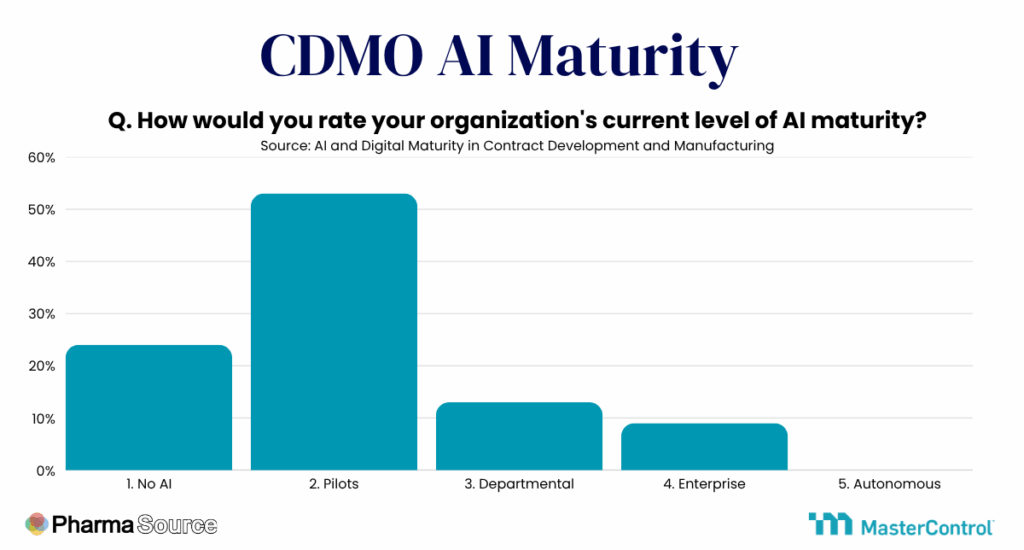
The gap reflects different approaches to AI adoption. While most CDMOs experiment with isolated use cases, Thermo Fisher spent years building the organizational infrastructure required for enterprise-scale deployment.

Ryan Snyder, Thermo Fisher’s Senior Vice President and Chief Information Officer, described the company’s deliberate approach in a March 2025 Forbes interview: “We didn’t want AI to be a hammer looking for a nail. Instead, we treat it as part of a broader toolkit that includes automation and traditional machine learning.”
That preparation included consolidating automation, AI and data teams under unified leadership, establishing governance frameworks, and structuring AI strategy around three distinct pillars: operational efficiency, product and service enhancement, and customer experience.
Pressure from sponsors is building across the sector. While 92% of CDMOs report sponsors discussing digital requirements, these conversations haven’t yet reached deal-breaking status. That window is closing as digital readiness shifts from competitive advantage to market requirement.
The Three-Year Foundation
The OpenAI announcement represents the visible outcome of strategic work that predates the generative AI boom. Thermo Fisher’s approach prioritized governance and organizational readiness over rapid technology deployment.
“The mistake some organizations make is expecting IT to clean up and manage all the data,” Snyder explained in the Forbes interview. “In reality, business leaders must be actively involved because they understand the context of what good data means.”
The company consolidated its automation, AI and data teams under unified leadership as a shared service supporting all divisions. This structure allows teams to select appropriate tools for specific problems rather than forcing single solutions across the organization.
The governance framework identifies high-impact AI applications while preventing siloed deployments. “AI governance is critical,” Snyder emphasized. “We need to democratize access to these tools while ensuring they are deployed ethically and effectively.”
This foundation enabled the company to move quickly when the right partnership opportunity emerged. The collaboration with OpenAI focuses initially on Thermo Fisher’s PPD clinical research business, where the technology will analyze trial data, optimize study design, and support patient recruitment. ChatGPT Enterprise will roll out to the company’s 130,000+ employees globally.
From Strategy to Execution
The partnership gives Thermo Fisher access to OpenAI’s models and APIs across its business units, with initial focus on two areas: shortening clinical trial cycle times through faster data analysis and optimized study design, and earlier identification of therapies unlikely to succeed, allowing pharmaceutical customers to redirect R&D investments toward higher-probability candidates.
The collaboration extends across Thermo Fisher’s Accelerator Drug Development platform, spanning early development through Phase III trials, clinical manufacturing, supply chain, and commercialization.
Operational Implications for CDMOs
The deployment carries specific implications for Thermo Fisher’s Patheon manufacturing business. Faster clinical trial timelines mean successful candidates move into production stages sooner, requiring CDMOs to ramp capacity more quickly. Earlier identification of likely failures allows manufacturing resources to be redirected away from candidates with poor prospects toward projects with higher success probability.
“Reducing the time and cost of clinical trials can have a massive impact on drug development,”
Snyder noted in the Forbes interview. “AI enables us to speed up the process while improving accuracy.”
Thermo Fisher is actively recruiting AI talent across multiple geographies and experience levels to support deployment. Current open positions include Data Engineers focused on AI applications, Director-level Data & Analytics roles, and Machine Learning Engineers developing production AI systems. The company is also establishing Data Science Leadership Development Programs for longer-term talent pipeline development.
What Separates Leaders from Laggards
The Thermo Fisher deployment demonstrates that enterprise-scale AI implementation requires years of groundwork in governance, data management, and organizational alignment before technology partnerships deliver value.
For the 80% of CDMOs still in preliminary AI phases, the implication is clear: the preparation gap matters more than the technology gap. Companies running disconnected pilot projects without unified governance, consolidated data teams, or strategic frameworks face substantial catch-up requirements.
The window for building these capabilities is narrowing. As sponsor expectations for digital capabilities intensify and early adopters demonstrate operational advantages, AI readiness is shifting from differentiator to baseline requirement.
Don’t Miss: AI and Digital Maturity in Contract Manufacturing, December 4th
PharmaSource and MasterControl will host an exclusive webinar examining the state of AI and Digitization across the CDMO industry, based on new benchmarking research into implementation strategies, sponsor expectations, and competitive implications for contract manufacturers at different stages of digital maturity. Sign up here