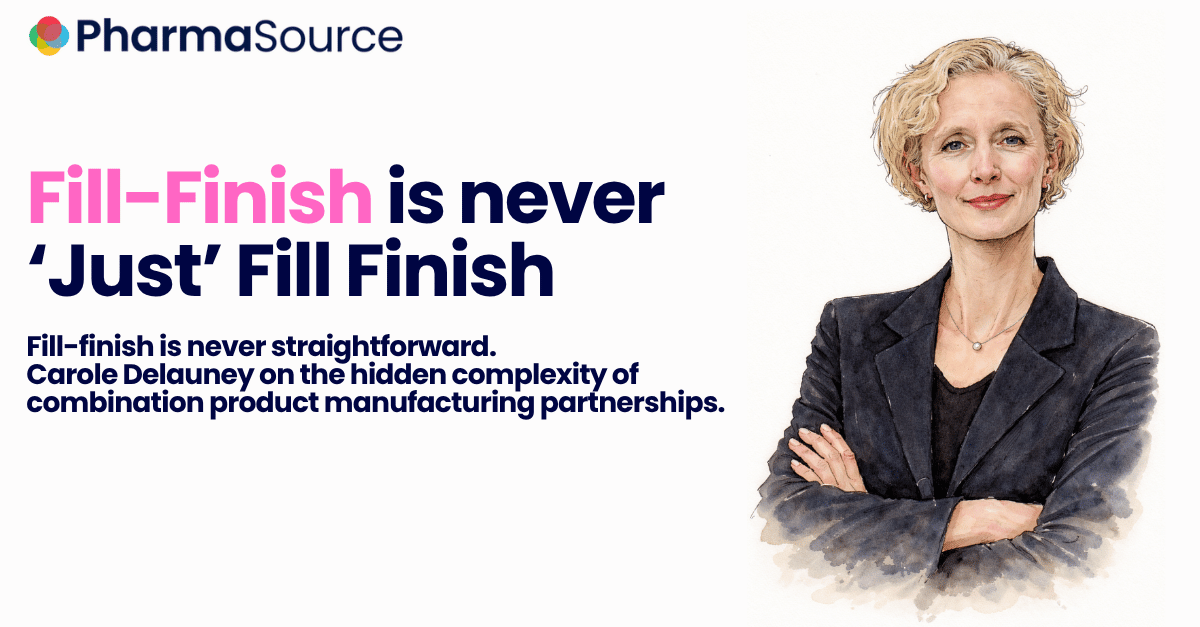
Guest Editorial by Carole Delauney, President, pharmaDEL SAS
Over the past four decades, parenteral injectable manufacturing has undergone a dramatic transformation. (1). The shift from simple ampoules and vials to sophisticated combination devices has created unprecedented development complexity. Biotechnology and pharmaceutical companies now face a critical decision when assessing the currently available options for contract manufacturing organization (CMO) solutions. As Steven Kaufman stated in a recent interview (2):
‘What differentiates the best (autoinjector suppliers) from the rest is the ability to think through the entire value chain – to understand the fill-finish side, the primary container side, the device side, the manufacturing side and the final assembly, labelling and release.’
Steven Kaufman, Executive Director, Combination Product Solutions, Inc.
In fact, this observation is relevant to any type of project development that can be visualized as a house of cards, comprising different interconnected elements. Ultimately, a CDMO partner’s ability to understand the interdependence of manufacturing solutions from drug substance to final product, and their capability to develop and control these solutions, could accelerate clients’ timelines and increase project success. However, this level of integrated knowledge is not yet widely available in the industry. This is because it requires an in-depth understanding of how to align the expertise of several suppliers who usually work independently of each other.
Technical available options and their drawbacks
To illustrate what biotechnology and pharmaceutical companies are experiencing, let’s use a specific example. For intravitreal (IVT) treatments, the drug product (DP) solution can be supplied in either a 0.5 ml glass or polymer syringe. The prefilled syringe is placed in a blister, which is then sealed with Tyvek and processed through external sterilization to reduce the risk of infection during intravitreal injections. Sterilization can be performed using ethylene oxide (EO) gas, vaporized hydrogen peroxide (VHP), or nitrogen dioxide (NO₂).
Building the IVT DP supply chain is highly complex since the capabilities of drug substance manufacturing, aseptic filling, blistering, sterilization, and cartoning are unlikely to co-exist under one roof. However, it can be difficult to define a solution that is timely, economical, and feasible: new primary packaging solutions may not be easily transferable to any fill-finish lines, depending on the expertise that has already been developed by the CDMO and line manufacturer.
Evaluating CDMO solutions would therefore require additional safety checks, since the lead time for new format parts, specifically stopper bowls, can be as high as forty-eight weeks if a solution needs to be engineered from scratch, which could put projects at risk. Primary packaging partners may also provide highly trained experts to assist CDMOs with implementation projects.
Therefore, the most successful CDMOs will be those capable of understanding the full picture, openly explaining their business reality, actively aligning partners, and proposing transparent solutions to clients. Such projects require a strategic approach to build a solid path and a clever solution. A partial understanding of the start-to-end solution may result in increased project risk, failure, or even legal action.
Suppliers’ solutions to accelerate developments
To accelerate development, individual CDMO partners have built integrated solutions by either expanding their in-house capabilities or acquiring additional external expertise through mergers and acquisitions (M&As).
These ‘one-stop shop’ solutions can ultimately decrease the complexity of DP developments, but only if they are developed with a full understanding of the expectations of the development partner and with the full support of management, which is often correlated with change management initiatives.
Indeed, to be truly efficient, such integrated service offerings require technical pre-alignment between teams providing different areas of expertise. This step is crucial to avoid offering partial solutions, and becomes even more important when skills are available in different locations or countries.
Such an integrated offering should not only be a communication tool, but should also be effectively tested over integrated technical solutions and timelines with specific examples. Underestimating this process could result in solutions being tried out during clients’ projects, which could put them at risk.
Recently, suppliers have initiated projects to offer integrated combination product solutions to the industry. For example, SHL, Gerresheimer, and Aptar Pharma have announced their collaboration to provide a fully tested combination of syringes, stoppers, and auto-injectors.
Another example is West’s integrated, verified Synchrony™ S1 prefillable syringe system, which was announced in January this year. While this approach is not new, BD solutions have been developed for years with the same idea in mind.
These additional examples demonstrate an industry-wide trend towards providing integrated, designed solutions to shorten development paths. Although these solutions may not be suitable for all DP requirements, they could ultimately be beneficial if they are aligned with an integrated ordering system and non-exclusive downstream solutions developed with fill-finish partners to avoid the additional lead time and cost of adapting filling lines.
However, the industry will always require flexibility since development pipelines comprise both simple and complex pharmaceutical entities for which suppliers have developed bespoke solutions.
Future approaches and opportunities – collaborations beyond expectations
A DP is ultimately the result of an integrated solution proposed by different suppliers and manufacturing partners who are aligned in their efforts to provide a suitable solution that is ultimately delivered to patients.
While the transition from a vial to a prefilled syringe rarely occurs at the early development stage due to its complexity, extended lead time, and development costs, suppliers and manufacturing partners should be prepared to suggest ways to optimize the development of combination drug products.
Two potential options may co-exist: an all-integrated combination solution for development companies willing to quickly progress to the next stage, and an access to fully customizable solutions for more complex entities or Target Product Profiles.
In both cases, industry partners should proactively evaluate the best ways to collaborate in developing integrated solutions. While the industry is currently looking for ways to streamline combination DP developments and optimize patient access to treatment, partners who understand the need to define concrete solutions and invest time in developing such co-strategies will stay ahead of the game and ultimately become more successful.
Carole Delauney is a sterile fill-finish specialist with over 25 years of experience in the pharmaceutical and CDMO industry. Currently engaged in a mission as Sterile Fill-Finish Technical & Commercial Interface Lead (Consultant) at Delpharm, she has built an extensive career spanning business development, CMC strategy, and manufacturing partnerships across biologics, small molecules, and ATMPs. She is also President of pharmaDEL SAS, her life sciences consultancy, and works as an independent consultant for investors, biotech and pharma companies, and CDMOs.
References
- Allmendinger, Andrea. (2021). Opportunities in an Evolving Pharmaceutical Development Landscape: Product Differentiation of Biopharmaceutical Drug Products. Pharmaceutical Research. 38. 1-19. 10.1007/S11095-021-03037-5.
- Interview: Steven Kaufman. Delivering the Future – Inside the World of Autoinjector Innovation”. ONdrugDelivery, Issue 178 (Oct 2025), pp 130–133.
- Zeiss B, Lee L, Cordier S, “More Than the Sum of its Parts: How Supplier Collaboration Drives Successful Combination Products”. ONdrugDelivery, Issue 178 (Oct 2025), pp 64–70.
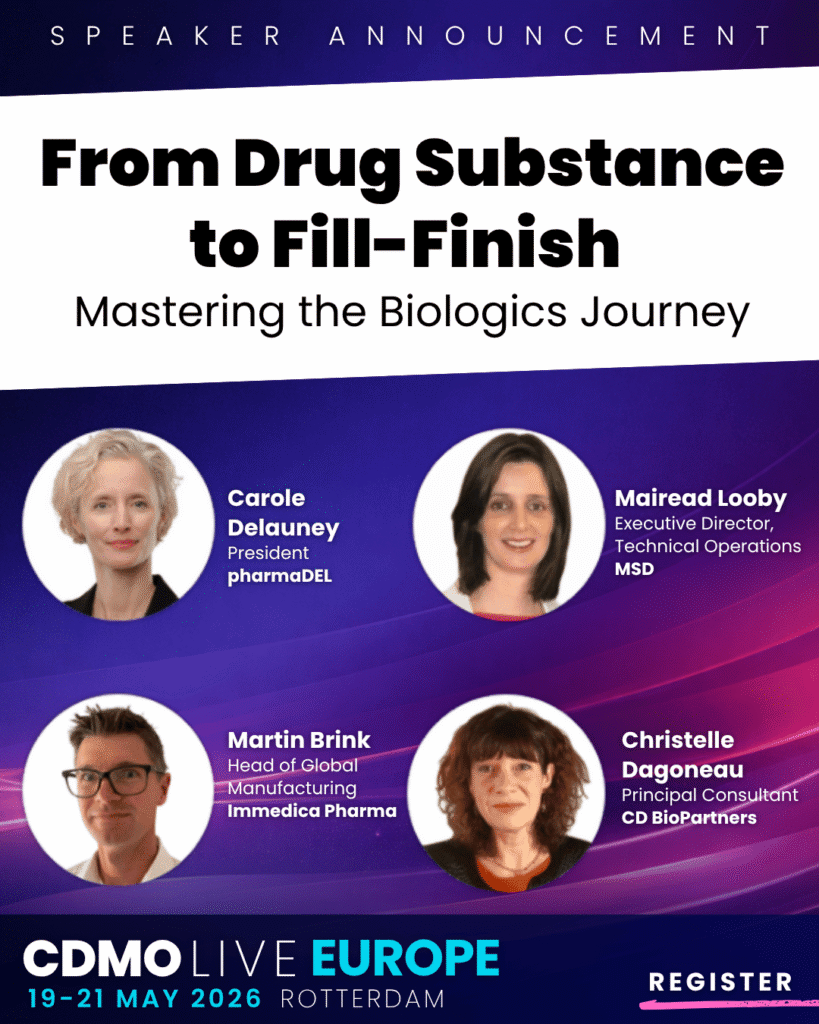
Mastering the Drug Substance to Fill Finish Journey for Biologics
Carole will be leading a panel at CDMO Live Europe, Rotterdam, May 19-21, titled: Mastering the Drug Substance to Fill Finish Journey for Biologics: From Cell Line Development to Vial.