Choosing the right drug discovery partner has never been more consequential, or more complicated. Artificial intelligence is compressing timelines, regulators are rewriting the rulebook on AI and animal testing in the same year, and a new wave of geopolitics is reshaping where discovery work actually gets done. This guide breaks down what drug discovery services really involve, where the market stands in 2026, which companies are leading the field, and exactly what to evaluate before you sign a contract.
What are drug discovery services
Drug discovery is the process of identifying a compound that can be used to treat and cure diseases. A drug discovery effort typically addresses a biological target that has been shown to play a role in disease development or begins with a molecule with interesting biological activities.
Drug discovery has recently evolved significantly as a result of emerging technologies which allows the process to become more refined, accurate, and time-consuming. Drugs were discovered by identifying the active ingredient in traditional remedies or by chance, as in the case of penicillin.
Artificial intelligence-integrated drug discovery and development has accelerated the growth of the pharmaceutical sector, leading to a revolutionary change in the pharma industry. As per analysis from McKinsey & Company – AI Agents Could Cut Clinical Trial Timelines 50%, and could dramatically accelerate clinical drug development, delivering 35 to 45 percent productivity gains across all clinical functions.
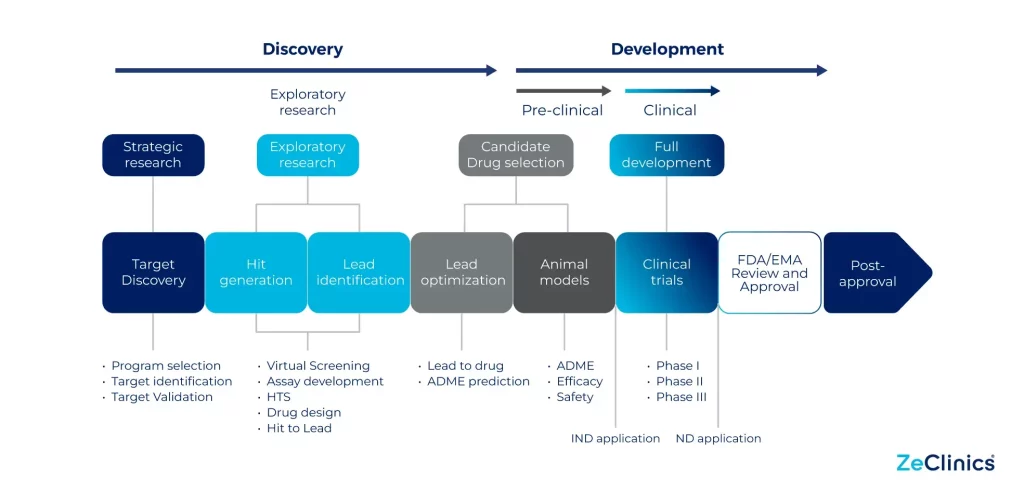
The Five Steps of the Drug Discovery Process
1. Early Drug Discovery
- Identify and validate therapeutic targets.
- Screen large compound libraries (HTS, HCS, virtual screening).
- Hit-to-lead refinement based on potency, selectivity, activity.
- Lead optimization to improve efficacy, safety, and ADME properties.
- Use in vitro and alternative models to narrow candidates.
2. Pre-Clinical Phase
- Test optimized leads in vitro and in animal models.
- Evaluate ADME, toxicity, and preliminary efficacy.
- Generate data required for first-in-human studies.
3. Clinical Phase
- Submit IND to regulatory agencies.
- Phase I: 20–100 healthy volunteers — safety, dosage, PK.
- Phase II: 100–500 patients — dose selection, efficacy, side effects.
- Phase III: 300–3,000 patients — confirm efficacy and monitor long-term safety.

4. Regulatory Approval
- Submit NDA with full clinical and manufacturing data.
- Regulatory review of safety, efficacy, and risk–benefit.
- Approval typically takes 1–2 years.
5. Post-Market Safety Monitoring
- Phase IV surveillance for long-term and rare adverse effects.
- Update labeling, add contraindications, or withdraw drug if needed.
Latest Drug Discovery News-
-
WuXi XDC Licenses WuXiTecan-2 ADC Technology to Ona Therapeutics
-
Oncodesign Services and Nexus BioQuest Partner to Give Biotech Sponsors a Clearer Route to Specialist Preclinical CRO Expertise
-
Single Cell Discoveries extends CRO services from discovery to clinical development
-
Sygnature Discovery Formalizes DEL Screening CRO Collaboration With X-Chem to Widen Hit-Finding Options for Drug Discovery Programs
-

Shilpa Medicare Launches Dedicated Complex Small-Molecule CDMO
-
Syneos Health Partners With Causaly to Embed Agentic AI Across Scientific CRO Workflows
Drug Discovery Market Size and Growth Outlook (2026 to 2035)
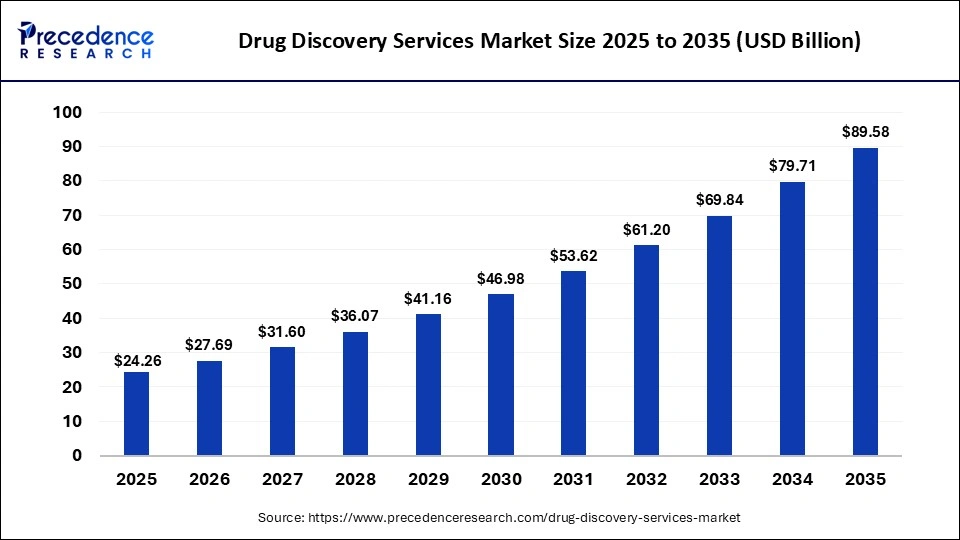
The global drug discovery services market was valued at USD 27.69 billion in 2026 and is projected to surpass USD 89.58 billion by 2035, expanding at a 13.95% CAGR from 2026 to 2035. This growth is primarily driven by increasing investment in drug discovery and development activities. (Source : Precedence Research)
Regionally, North America continues to hold the largest share of the drug discovery services market, supported by dense R&D infrastructure and a high concentration of pharmaceutical and biotechnology headquarters, according to Fortune Business Insights. Growth in the academic and research institute segment is also outpacing the market overall, projected at roughly 6.1% CAGR, reflecting increasing collaboration between universities and contract providers.
What is driving growth in 2026: precision medicine pipelines, AI driven discovery platforms, sustained biotechnology venture funding, research into complex and previously undruggable disease targets, and demand for faster lead optimization, per the ResearchAndMarkets 2026 report.
AI in Drug Discovery: The 2026 Regulatory Landscape
Artificial intelligence has moved from an experimental tool to a regulatory subject in its own right. Three developments from the past year matter most for anyone sourcing drug discovery services in 2026.
FDA’s draft AI guidance and the joint FDA EMA principles. In January 2025, the FDA issued its first draft guidance specifically addressing the use of AI in regulatory decision making for drugs and biological products, introducing a seven step, risk based framework for assessing whether an AI model is credible enough for its intended use. Final guidance is expected in 2026. Notably, this framework explicitly excludes AI used purely for early drug discovery or internal operational efficiency, so it applies mainly once AI generated evidence supports a regulatory submission. On January 14, 2026, the FDA and the European Medicines Agency jointly published the Guiding Principles of Good AI Practice in Drug Development, a set of ten high level, non binding principles covering the entire product lifecycle, including human centric design, data governance, and life cycle management of AI models. Read more from McGuireWoods’ summary of the guidance.
The EU AI Act. Obligations for general purpose AI models began phasing in from August 2025, with higher risk obligations, which could touch some drug development AI applications, phasing in from August 2026, per Drug Discovery News. Sponsors working with European regulators or European based discovery partners should track this closely.
A concrete clinical proof point. For years, AI’s contribution to drug discovery was measured mainly in efficiency claims. That changed with rentosertib (ISM001-055), an AI discovered small molecule developed by Insilico Medicine for idiopathic pulmonary fibrosis, which reported the first published Phase IIa efficacy and safety results for a fully AI discovered drug. Separately, Isomorphic Labs, the Alphabet backed drug design company built on DeepMind’s AlphaFold technology, released its unified Isomorphic Labs Drug Design Engine (IsoDDE) in February 2026 and is targeting first in human trials for an AI designed candidate by the end of 2026, according to company statements reported by Fortune and IntuitionLabs.
What this means for pharma decision makers: when evaluating a drug discovery partner that uses AI, ask how they document model validation and context of use, since this is now the explicit basis regulators are using to assess AI generated evidence, not simply whether AI was used at all.
Podcast Spotlight: Stefan Randl on AI, Speed & Manufacturing Capacity
In this episode, Stefan Randl, CSO at Siegfried, highlights the mounting pressure on pharma to reduce costs while accelerating development.
He notes that AI is set to transform drug discovery, enabling faster, higher-quality molecule design — but warns of a looming capacity crunch:
“You cannot build manufacturing capacity as fast as AI increases the number of drug candidates. The key will be maximizing existing capacity.”
Click here to listen to the podcast.
- Virtual screening: AI algorithms can screen millions of molecules virtually which dramatically increases the efficiency of finding potential drug candidates compared to traditional methods.
- Predictive modeling: AI can predict how drugs will interact with cells and tissues, allowing researchers to optimize their design and avoid potential side effects.
Key drivers
The market for drug discovery services is getting bigger because of several important reasons.
- Growing R&D Expenditure: drug discovery and development have seen significant growth over the last decade in terms of clinical studies and the introduction of novel drug molecules. As per clinical trial.gov the number of registered studies went up from 32,517 in 2019 to 36,770 in 2022 at a CAGR of 4.2 %
- Accelerated Drug Development: Utilizing specialized expertise and advanced technologies speeds up the pipeline, bringing drugs to market quicker and maximizing return on investment.
- Focus on Core Competencies: Pharmaceutical companies can strategically delegate non-core activities like drug discovery to dedicated experts, enabling them to focus on their core strengths.
- Access to Cutting-Edge Tools: Outsourcing opens doors to advanced technologies and platforms unavailable in-house, boosting innovation potential and access to specialized equipment and knowledge.
- Globalization of R&D: Collaborating with geographically diverse service providers unlocks a broader talent pool and expertise which further enriches the research landscape.
BIOSECURE Act and the Reshoring of Drug Discovery Outsourcing
Sourcing decisions in 2026 cannot be separated from geopolitics. The BIOSECURE Act became U.S. law on December 18, 2025 as part of the FY2026 National Defense Authorization Act. It restricts federal agencies from contracting with designated “biotechnology companies of concern,” with a multi year transition period, according to Vision Life Sciences’ 2026 analysis.
The scale of exposure is significant: an estimated 79% of biopharma companies have at least one contract with a China based or China owned CDMO, representing USD 10 billion to USD 20 billion in annual contract value, per the same analysis. In June 2026, WuXi AppTec was added to the U.S. 1260H list, a statutory step toward “biotechnology company of concern” status, though enforcement applies only where a federal funding nexus exists and existing contracts carry a multi year safe harbor, per ichgcp’s 2026 CRO market report.
The practical effect for buyers of drug discovery and related outsourced services:
- Many sponsors are adopting “China plus one” sourcing strategies, diversifying toward providers in South Korea, India, and Europe rather than abandoning existing relationships outright.
- The Act’s restrictions primarily target CDMO and manufacturing contracts with a federal funding nexus, not general CRO discovery or clinical trial work, so the practical impact varies considerably by service type and customer base.
- Western and Asia Pacific CDMOs outside mainland China, including providers in South Korea, are reporting increased inbound inquiries as sponsors reassess supply chain risk, per Vision Life Sciences.
Pharma decision makers evaluating a drug discovery outsourcing partner should now factor country of ownership and any federal funding exposure into supplier risk assessments alongside the traditional criteria of expertise, cost, and track record.
Benefits of Employing Drug Discovery Services
Partnering with drug discovery services brings a bunch of good things for pharmaceutical companies:
- Faster Time to Market: Get your drug to patients sooner, maximizing market exclusivity and revenue potential.
- Reduced R&D Costs: Access specialized expertise and technology without the hefty investment in internal infrastructure and equipment.
- Enhanced Innovation: Tap into a wider pool of scientific talent and benefit from cutting-edge research approaches and technologies.
- Risk Mitigation: Share development risks with your service provider, minimising potential setbacks and financial losses.
- Focus on Core Competencies: Dedicate internal resources to your core strengths while leveraging external expertise for drug discovery. This approach allows you to optimise your expertise.
- Access to Advanced Technologies: Gain access to state-of-the-art equipment and platforms, ensuring your research utilizes the latest scientific advancements.
Challenges
Even though outsourcing has lots of good things but we need to know there could be some tough parts too.
- Finding the Right Partner: Identifying the best fit for your specific needs, project requirements, and budget can be complex.
- Intellectual Property Concerns: Protecting your confidential drug information requires robust intellectual property agreements and vigilant oversight.
- Communication and Collaboration: Building effective communication and collaboration channels with your service provider is crucial for smooth project execution and timely updates.
- Loss of Control: Letting go of some project control can be challenging for companies accustomed to full internal development.
- Transparency and Cost Management: Ensuring cost transparency and clear communication throughout the project is essential to avoid budget overruns or unexpected charges.
Opportunities
Drug discovery services offer various opportunities for advancements in the pharmaceutical industry. Some key opportunities include:
- Innovation and Novel Therapies: Drug discovery services provide a platform for developing innovative and novel therapies. This opens doors to groundbreaking treatments for diseases and medical conditions.
- Efficiency in Research: Outsourcing drug discovery services can enhance research efficiency by tapping into specialized expertise and cutting-edge technologies. This allows pharmaceutical companies to accelerate the drug development process.
- Cost-Effective Solutions: Utilizing external drug discovery services can be a cost-effective strategy. It eliminates the need for extensive in-house resources and infrastructure, allowing companies to allocate funds more efficiently.
- Access to Specialized Knowledge: Drug discovery services often involve collaboration with experts in specific therapeutic areas. This provides pharmaceutical companies with access to specialized knowledge and insights that may not be available in-house.
- Risk Mitigation: Collaborating with experienced service providers can help mitigate risks associated with the drug development process. Specialized expertise and a proven track record contribute to more reliable outcomes.
Top Drug Discovery Companies and Service Providers to Know in 2026
The drug discovery services landscape spans traditional contract research organizations, integrated CRDMOs, and a fast growing tier of AI native discovery companies. This is not an exhaustive or ranked list, but it reflects the organizations most frequently cited across 2026 industry coverage.
Established CROs and integrated service providers
- Evotec — a global drug discovery specialist combining AI, high throughput screening, and multi omics data through its PanHunter platform, with an established base of pharma partnerships, per PharmaNow.
- Charles River Laboratories and WuXi AppTec — large scale integrated discovery, safety assessment, and manufacturing providers; note that WuXi AppTec’s position is affected by the BIOSECURE Act discussed in Section 5.5 below.
- Thermo Fisher Scientific, Labcorp, and Pharmaron — broad drug development service providers spanning discovery through manufacturing, though not directly comparable to pure play clinical CROs in scale or scope, per ichgcp’s 2026 CRO ranking analysis.
AI native and computational discovery companies
- Isomorphic Labs (UK) — Alphabet backed, built on AlphaFold; targeting first in human trials for an AI designed candidate by late 2026.
- Insilico Medicine — developer of rentosertib, the first AI discovered molecule to report Phase IIa efficacy data.
- Recursion Pharmaceuticals, Owkin, Genesis Therapeutics, Insitro, Atomwise, and Cradle — a competitive set of AI drug discovery companies cited across multiple 2026 industry roundups, per PharmaNow’s 2026 rankings.
How to find the right drug discovery services partner
Finding the right drug discovery services partner is crucial for the success of pharmaceutical projects. Here are steps and considerations to help you identify the ideal partner:
Define Your Needs
- Clearly outline your project goals, timelines, and specific requirements.
- Identify the areas where you need expertise and support within the drug discovery process.
Evaluate Expertise
- Look for partners with expertise in the specific therapeutic area or technology relevant to your project.
- Assess their track record and experience in successfully delivering similar projects.
Check References
- Obtain references from previous clients or collaborators.
- Validate the partner’s reputation, reliability, and the quality of their deliverables.
Regulatory Compliance
- Ensure the potential partner adheres to regulatory standards relevant to your project.
- Check for certifications and compliance with Good Laboratory Practice (GLP) or Good Manufacturing Practice (GMP), depending on your needs.
Communication and Collaboration
- Evaluate the partner’s communication style and willingness to collaborate.
- Effective and transparent communication is crucial for successful collaboration
Infrastructure and Resources
- Assess the partner’s facilities, equipment, and technological capabilities.
- Ensure they have the necessary resources to meet the requirements of your project.
Cost Transparency
- Clearly understand the cost structure and pricing model of the partner.
- Request a detailed breakdown of costs to avoid unexpected expenses.
Intellectual Property (IP) Protection
- Clarify and discuss intellectual property rights and protection measures.
- Ensure that your proprietary information and discoveries are safeguarded.
Flexibility and Scalability
- Assess the partner’s ability to adapt to changing project requirements.
- Consider whether they can scale their operations according to the evolving needs of your project.
Cultural Fit
- Evaluate the cultural fit between your organization and the potential partner.
- Shared values, work ethics, and collaboration styles contribute to a smoother partnership.
Review Contract Terms
- Carefully review and negotiate contract terms.
- Ensure that responsibilities, timelines, and deliverables are clearly outlined in the agreement.
Ask the Right Questions in an RFP
- Craft a Request for Proposal (RFP) with targeted questions to assess the partner’s capabilities and compatibility with your project.
- Include questions about their experience, team, facilities, and approach to problem-solving.
Frequently Asked Questions (FAQs)
1. What are drug discovery services?
Drug discovery services support the identification and development of compounds that can treat or cure diseases. These services involve target identification, high-throughput screening, hit-to-lead optimization, ADME evaluation, toxicity testing, and preparation for clinical studies. They help pharmaceutical companies refine promising molecules into viable drug candidates.
2. Why are drug discovery services becoming increasingly important?
The growing complexity of modern drug development, combined with the need for speed and precision, has made specialized expertise essential. Advanced technologies such as artificial intelligence, virtual screening, and companion diagnostics have transformed drug discovery. Outsourcing these activities allows pharma companies to innovate faster, reduce risks, and access tools and talent that may not be available in-house.
3. How is AI transforming drug discovery and development?
AI accelerates drug discovery by analyzing massive datasets, identifying targets, predicting molecule behavior, and optimizing lead candidates. According to McKinsey & Company, AI tools and AI agents could reduce clinical trial timelines by up to 50% and deliver a 35–45% productivity boost across clinical functions. AI-driven virtual screening and predictive modeling also help minimize side effects and improve drug design accuracy.
4. What are the key market trends shaping drug discovery services today?
Major trends include the rise of AI-powered platforms, personalized medicine, decentralized clinical trials, increased collaboration between pharma and academic partners, and a growing focus on sustainability. Companies are adopting greener processes, expanding access through digital tools, and leveraging global research networks to accelerate innovation and reduce costs.
5. What are the benefits of outsourcing drug discovery?
Outsourcing provides faster time to market, reduced R&D costs, improved innovation, access to advanced technologies, and shared risk. Service providers offer specialized expertise, state-of-the-art tools, and scalable resources that help pharmaceutical companies stay focused on their core competencies while enhancing research efficiency.
6. How can pharmaceutical companies choose the right drug discovery services partner?
Selecting the right partner involves evaluating expertise, reviewing past performance, checking regulatory compliance (GLP/GMP), and assessing communication capabilities. Companies should also consider infrastructure quality, cost transparency, IP protection, scalability, and cultural alignment. A well-structured Request for Proposal (RFP) with targeted questions can help identify a partner that aligns with project goals and timelines.