Good Distribution Practice, or GDP, is the rulebook that keeps a medicine exactly as safe and effective on delivery day as it was the moment it left the factory. This guide breaks down what GDP guidelines for pharmaceuticals actually require in 2026, from EU and WHO standards to US DSCSA rules, and what it takes for CDMOs and distributors to stay compliant.
The pharmaceutical supply chain has evolved into a complex global network where maintaining product quality from factory to patient requires rigorous oversight at every touchpoint. Good Distribution Practice (GDP) represents the quality framework that ensures medicines retain their safety, efficacy, and integrity throughout this journey a critical capability as the contract development and manufacturing organization (CDMO) sector expands its role in pharmaceutical logistics.
The global pharmaceutical logistics market the infrastructure layer GDP governs is valued at roughly $85–109 billion in 2026 and is projected to reach $156–206 billion by 2033–2034, growing at a CAGR of 7.9–9.5% depending on methodology (Fortune Business Insights; Coherent Market Insights). Within this, the pharmaceutical cold chain logistics segment where GDP requirements are strictest is expected to grow from $22.75 billion in 2025 to $44.1 billion by 2033 at a 9.12% CAGR (DataM Intelligence), while the healthcare cold chain third-party logistics market alone is forecast to grow from $45.76 billion to $83.40 billion by 2033 (Grand View Research). This expansion is directly accelerating demand for GDP-certified CDMOs and 3PLs capable of handling temperature-sensitive, high-value biologics at scale.
The biologics segment represents a particularly high-growth area within GDP-regulated distribution. Cold-chain pharmaceutical logistics essential for maintaining the stability of biologics, vaccines, and biosimilars is experiencing accelerated growth as these products dominate late-stage pharma pipelines. In Europe alone, the cold chain logistics market is valued at €22.51 billion in 2026, rising to €28.29 billion by 2031, driven largely by demand for ultra-low-temperature shipping below -120°C for cell and gene therapies (Mordor Intelligence). Meanwhile, Asia-Pacific is the fastest-growing regional market, with a projected CAGR above 21.5% through 2033, fueled by rapid cold-storage infrastructure investment in markets like India (Coherent Market Insights).
What is Good Distribution Practice?
Good Distribution Practice describes the minimum standards that wholesale distributors must meet to ensure medicines maintain their quality and integrity throughout the supply chain, from manufacturing facility to dispensing point. GDP encompasses the systematic controls, documentation, and quality management practices required to prevent product degradation, contamination, counterfeiting, or diversion during warehousing, transportation, and handling.
The framework applies to the entire logistics process—including storage facilities, transport vehicles, inventory management systems, and personnel training—ensuring that every link in the distribution chain operates under validated, controlled conditions.
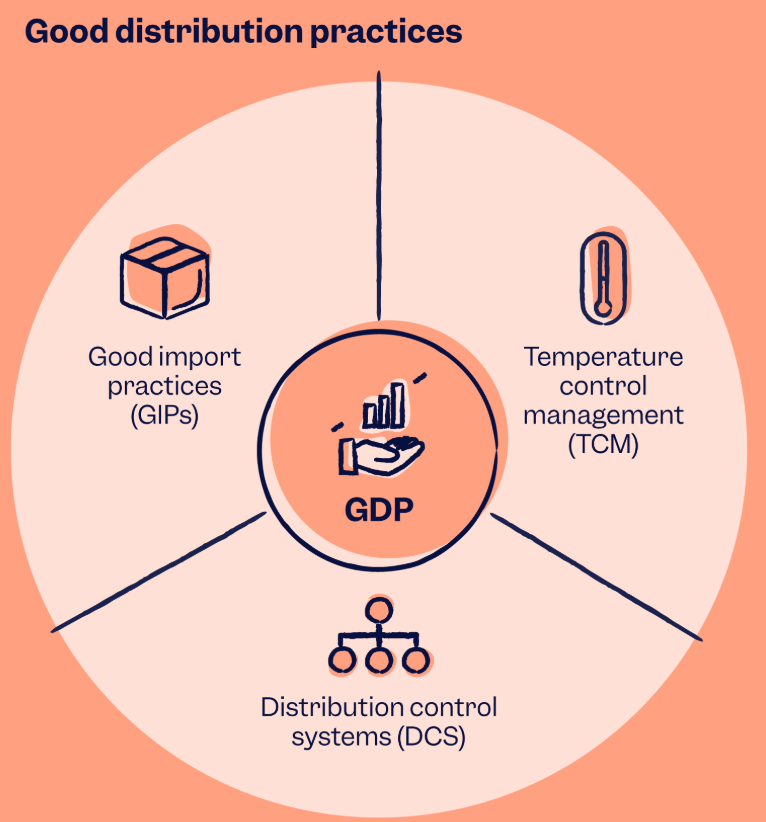
Key Principles of Good Distribution Practice
GDP is built on a small set of core principles that apply across every regulatory framework, whether EU, WHO, or US based. Understanding these principles makes the more detailed requirements easier to navigate.
Quality management – A documented quality system with a written quality policy, defined procedures, and management accountability for distribution outcomes, as required under the European Medicines Agency’s GDP framework.
Personnel and responsibility – A named Responsible Person with the authority to approve procedures, oversee training, and halt distribution when quality is at risk.
Premises and storage – Facilities qualified for the products they hold, with mapped and monitored temperature zones and controlled access.
Vehicles and transport equipment – Qualified, temperature controlled transport with documented performance under representative and seasonal conditions.
Documentation – Records that are attributable, legible, contemporaneous, original, and accurate, commonly referred to as ALCOA, and retained for a defined minimum period.
Traceability – The ability to locate any batch in the distribution network quickly, supporting rapid recalls and regulatory investigations.
Quality risk management – A risk based approach, in line with ICH Q9, that scales oversight and controls according to patient impact rather than applying uniform controls everywhere.
Self inspection. Regular internal audits against GDP requirements, with documented findings and corrective action, in line with the WHO Good Distribution Practices framework.
Why Good Distribution Practice Matters
GDP exists because manufacturing quality alone does not guarantee that a patient receives a safe, effective medicine. A product made to perfect GMP standards can still be compromised by a broken cold chain, poor warehouse hygiene, inadequate segregation of returned stock, or entry into the supply chain through an unverified intermediary.
The consequences of weak distribution practices extend well beyond a single failed shipment.
Patient safety – Temperature excursions, contamination, or counterfeit infiltration can render a medicine ineffective or actively harmful, particularly for biologics, vaccines, and other sensitive products with narrow stability windows.
Business continuity -A single major GDP failure can trigger a product recall, halt distribution while corrective actions are implemented, and in serious cases lead to suspension of a wholesale distribution authorization.
Regulatory standing – Repeated or serious GDP deficiencies found during inspection can delay certificate renewal, invite more frequent inspections, and in extreme cases result in warning letters or authorization withdrawal.
Reputation and commercial trust – For CDMOs and distributors competing for outsourcing contracts, a clean GDP inspection history is often a baseline requirement for sponsors evaluating potential partners.
Counterfeit prevention – Robust GDP controls, including verified sourcing and secure chain of custody, are one of the primary defenses against counterfeit medicines entering the legitimate supply chain, a problem estimated to be worth between 200 billion and 432 billion dollars annually worldwide.
Who Needs GDP Certification?
GDP certification applies to any organization that stores, handles, transports, or takes legal title to medicinal products before they reach the patient. This includes:
- Wholesale distributors holding a Wholesale Distribution Authorisation (WDA) in the EU/UK
- Manufacturers distributing their own finished products
- CDMOs offering integrated fill-finish-to-delivery services
- Third-party logistics providers (3PLs) and freight forwarders handling pharmaceutical cargo
- Brokers who arrange the sale or purchase of medicines without physically handling stock
- Importers bringing medicinal products into a regulated market
Retail pharmacies dispensing directly to patients generally fall outside GDP’s scope but remain subject to related good pharmacy practice standards.
How Does Good Distribution Practice Work?
GDP functions as an extension of Good Manufacturing Practice (GMP) into the post-production supply chain. While GMP focuses on manufacturing processes to ensure products are consistently made to quality standards, GDP covers distribution activities to ensure those same products reach patients without quality compromise.
The operational framework rests on several interconnected elements:
Quality Management System: A documented quality system establishes organizational structure, procedures, and resources needed to demonstrate that distributors meet quality requirements, including authorized procurement protocols and release procedures.
Temperature Mapping Under GDP: Temperature mapping is one of the most heavily scrutinized elements of a GDP inspection, and one of the most commonly cited sources of deficiency findings. It is the qualification study that proves a warehouse, cold room, or transport vehicle consistently maintains its labeled storage conditions, and it identifies hot and cold spots before permanent monitoring sensors are placed.
Traceability Architecture: Every movement of product through the distribution network must leave a digital fingerprint, enabling rapid location and retrieval of specific batches within hours when quality issues or recalls occur. Modern serialization requirements have elevated this capability from basic lot tracking to unit-level identification.
Personnel Competency: All individuals handling pharmaceutical products—from warehouse technicians to transport drivers—receive role-specific training covering product security, identification of falsified medicines, and proper handling protocols, with documented effectiveness assessments.
Risk-Based Oversight: Quality risk management principles require distributors to assess potential threats to product quality and implement controls proportionate to patient impact, scaling resources and audit frequency according to product criticality and historical performance.
Regulatory Framework and Standards
GDP requirements originate from multiple authoritative sources that create a harmonized global standard despite regional variations:
The European Union GDP Guidelines (2013/C 343/01) serve as the de facto global template for wholesale operations, while the World Health Organization GDP Annex 5 provides a risk-based blueprint aimed at blocking substandard and counterfeit products in all market tiers. In the United States, the Drug Supply Chain Security Act (DSCSA) establishes serialization and interoperability mandates driving end-to-end digital traceability.
Additional standards that support pharmaceutical distribution include:
- The Pharmaceutical Inspection Co-operation Scheme (PIC/S) PE 011-1 Guide, which harmonizes inspection standards across participating regulatory authorities
- IATA Temperature Control Regulations and CEIV Pharma Certification for air transport of pharmaceutical products
- USP Chapter 1079, which provides industry guidance on good storage and distribution practices
- GDP for Active Pharmaceutical Ingredients and Excipients- GDP requirements do not stop at finished dosage forms. The European Medicines Agency’s own definition of GDP explicitly covers the sourcing, storage, and transportation of active pharmaceutical ingredients (APIs) and other ingredients used in medicine production, not just the finished product.
In the European Union and United Kingdom, wholesale distribution authorization requires GDP certification issued by national competent authorities following successful inspection. The European Medicines Agency coordinates harmonization, while individual member states conduct inspections and issue certificates.
The European Medicines Agency (EMA) coordinates GDP oversight across EU member states and maintains the authoritative register of GDP certificates, while national inspectorates (such as MHRA in the UK) continue to issue jurisdiction-specific guidance — including 2026 updates on the use of AI tools in preparing GDP inspection responses.
High-Value Specialty Pharmaceuticals: Products with five-figure or six-figure treatment costs attract cargo theft and counterfeiting attempts, necessitating GPS tracking, geofencing, and secure chain-of-custody protocols
2026 Regulatory Watch
In early 2026, the European Medicines Agency and the Pharmaceutical Inspection Co-operation Scheme opened a joint public consultation on a proposed revision to Annex 15, covering qualification and validation. The proposal would extend Annex 15’s scope to active substance manufacturers and align it more closely with ICH Q9(R1) risk management principles, reinforcing a risk based approach to qualification activities, including temperature mapping. This is currently a consultation, not a finalized rule, and is worth monitoring for CDMOs planning validation investments through 2026 and 2027.
Common GDP Inspection Findings in 2026
Regulatory scrutiny of GDP compliance has intensified through 2026, with national authorities publishing more detailed non-compliance reports than in prior years. Recent inspection trends show recurring deficiency categories:
- Temperature excursion documentation gaps — incomplete or unreconciled cold-chain data logs
- Inadequate self-inspection programs — infrequent or superficial internal GDP audits
- Weak falsified-medicine detection procedures — insufficient staff training to identify suspect product
- Poor segregation practices — returned, recalled, or quarantined stock not physically or electronically separated from saleable inventory
- Incomplete Responsible Person authority — RPs lacking documented senior-management access or the authority to halt shipments
For example, a 2026 inspection of a Spanish wholesale distributor identified 29 separate deficiencies in a single audit — illustrating how granular GDP inspections have become (GMP Compliance Association). CDMOs and distributors that proactively address these categories through self-inspection programs are best positioned to avoid warning letters and certificate suspensions.
Growth Factors: What Is Driving GDP Expansion?
Several trends are increasing demand for GDP-compliant pharmaceutical distribution:
- Biologics & Biosimilars: Growing use of temperature-sensitive therapies is driving demand for validated cold-chain infrastructure and controlled distribution.
- Globalized Supply Chains: Multi-country sourcing, manufacturing, and distribution create more handoffs, increasing the need for robust pharma supply chain controls.
- Regulatory Enforcement: Stronger inspections, penalties, and efforts to combat counterfeit medicines are raising GDP compliance standards worldwide, increasing the importance of regulatory authorities.
- Direct-to-Patient Models: Specialty pharmacies and home delivery are expanding last-mile distribution, requiring GDP-compliant logistics beyond traditional wholesale channels.
- Personalized & Advanced Therapies: Cell and gene therapies often involve single-patient, irreplaceable batches, making precise handling and distribution critical.
- Digital Traceability: Serialization and traceability requirements such as U.S. DSCSA and the EU Falsified Medicines Directive are integrating digital systems into GDP operations.
- DSCSA Enforcement: Enhanced Drug Distribution Security requirements for U.S. wholesale distributors took effect on August 27, 2025, with small dispensers facing a final deadline of November 27, 2026. This is accelerating adoption of interoperable electronic, EPCIS-based product-tracing systems (Frier Levitt).
- Counterfeit Drug Risks: The continued scale of counterfeit pharmaceutical trade is sustaining pressure for stronger GDP controls, serialization, and cross-border supply-chain oversight (QMS Templates
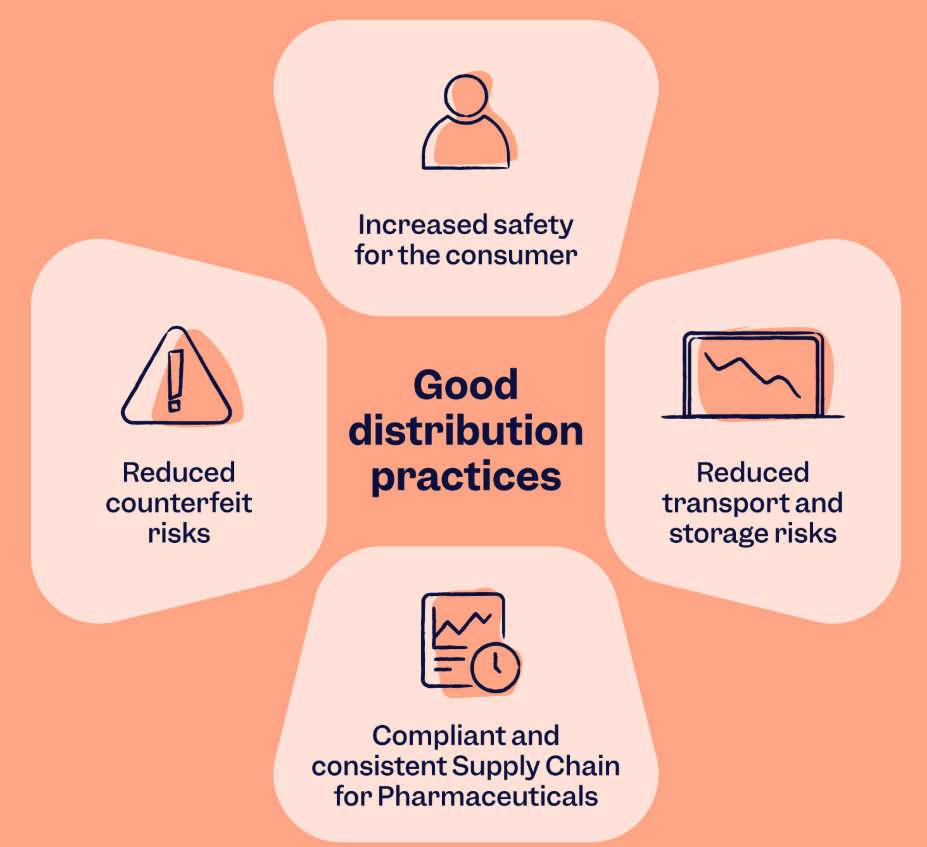
The CDMO Role in GDP-Compliant Distribution
Contract development and manufacturing organizations increasingly provide not just drug substance and drug product manufacturing but also integrated distribution services. This evolution reflects customer demand for turnkey solutions that maintain chain of custody and GDP compliance from fill-finish through commercial delivery.
CDMOs that offer distribution services must satisfy dual regulatory expectations: GMP for manufacturing operations and GDP for post-manufacturing logistics. The intersection between these standards requires careful management, as thermal mapping systems, environmental monitoring, and documentation practices must satisfy both frameworks simultaneously.
Contract Manufacturing Challenges Specific to GDP
Dual Regulatory Burden: CDMOs must maintain both GMP and GDP compliance, with manufacturing sites requiring Qualified Persons to certify batch release under GMP, while distribution operations require Responsible Persons to oversee GDP compliance, roles with distinct responsibilities and authorities.
Multi-Client Facility Management: CDMOs handling products for multiple sponsors must prevent mix-ups, cross-contamination, and inadvertent product disclosure. GDP requirements for segregated storage areas, covering returned products, recalled materials, and suspected counterfeits, become more complex when managing inventory for dozens of clients simultaneously.
Serialization Complexity: CDMOs providing packaging services must integrate their serialization systems with each sponsor’s enterprise platform, ensuring that unique product identifiers are correctly generated, applied, and reported through the global traceability network. Technical failures in these integrations can halt distribution.
Cold-Chain Qualification for Novel Modalities: As CDMOs take on advanced therapy projects requiring ultra-low temperature storage or cryogenic shipping, they must invest in specialized equipment and qualify transport lanes that may have minimal historical performance data.
Finding the Right CDMO Partner for GDP-Critical Distribution
Selecting a CDMO capable of maintaining GDP compliance throughout manufacturing and distribution requires systematic evaluation across multiple dimensions:
Regulatory Track Record and Certifications
- Verify current wholesale distribution authorizations and GDP certificates from relevant national competent authorities for all markets you intend to serve
- Request evidence of recent regulatory inspections, including frequency, scope, and outcomes with any observations or corrective actions documented
- Assess inspection history quality: CDMOs with clean inspection records and rapid CAPA closure demonstrate mature quality systems
- Review market-specific compliance: Confirm the CDMO holds appropriate certifications for your target regions (MHRA for UK, member state authorities for EU, DSCSA compliance for US)
Facility and Equipment Qualification
- Conduct site visits to personally assess storage facilities, environmental monitoring systems, and transport fleet
- Verify temperature and humidity mapping for all storage zones, with calibrated sensors providing continuous monitoring and automated excursion alerts
- Examine segregation practices for returned goods, recalled materials, and suspected falsified medicines, ensuring physical or electronic barriers prevent commingling
- Assess cold-chain infrastructure: For temperature-sensitive products, confirm vehicles undergo qualification including performance testing under maximum load and extreme ambient conditions
Quality Management System Maturity
- Evaluate QMS integration: Assess whether the CDMO treats distribution as an extension of GMP rather than a separate function
- Request self-inspection evidence: Documentation of GDP audit frequency, auditor qualifications, and examples of findings with subsequent CAPA
- Assess risk management approach: Look for application of ICH Q9 principles to distribution, with resources scaled according to patient impact rather than uniform oversight
Technology and Data Integrity Capabilities
- Validate ALCOA+ compliance: Environmental monitoring systems must generate data that is Attributable, Legible, Contemporaneous, Original, and Accurate with complete audit trails
- Verify serialization integration: Confirm the CDMO can exchange EPCIS messages in real time with your enterprise systems for DSCSA or Falsified Medicines Directive compliance
Personnel Competency and Training
- Confirm Responsible Person designation: Individual with clearly defined authority, adequate resources, and documented competency to oversee GDP activities
- Assess management access: Responsible Person should have direct senior management access and authority to halt distribution when quality concerns arise
Traceability and Recall Performance
- Request mock recall results: Evidence of locating and quarantining specific lots within two hours demonstrates system maturity
- Evaluate tracking systems: Complete traceability across distribution channels with all supply chain parties readily identifiable
- Verify documentation retention: Records maintained for minimum seven years unless local regulations specify longer periods
Third-Party Logistics Management
- Examine supplier qualification programs: Pre-selection audits, performance scorecards, and ongoing monitoring mechanisms for outsourced providers
- Review written contracts: Verify GDP requirements are explicitly stated including temperature monitoring, staff training, deviation reporting, and recall management
- Evaluate audit frequency: Regular on-site assessments of logistics partners rather than relying solely on certificates or self-declarations
Geographic Reach and Infrastructure
- Map network coverage: Evaluate the CDMO’s distribution capabilities relative to your commercial or clinical trial requirements
- Evaluate last-mile capabilities: Confirm distribution network extends to final delivery points, not just major hubs
Security and Anti-Counterfeiting Measures
- Review high-value product handling: Segregation, inventory reconciliation, and enhanced security for products attractive to diversion
- Evaluate transport security: GPS tracking with geofencing, driver verification, and route deviation alerts for vehicles
- Examine falsified medicine procedures: Protocols for identifying, quarantining, and reporting suspected counterfeits to authorities
Cost Structure and Transparency
- Request detailed pricing models: Separate manufacturing from distribution services for clear understanding of GDP-related costs
- Understand investment implications: Premium pricing often reflects investments in monitoring systems, cold-chain infrastructure, and training that reduce risk
- Assess total cost of ownership: Balance service fees against potential product losses from distribution failures
GDP vs. GMP vs. GSP: Clearing Up the Confusion
These three acronyms are frequently confused. A quick reference:
| Standard | Focus | Applies To |
|---|---|---|
| GMP (Good Manufacturing Practice) | Production quality and consistency | Manufacturing sites |
| GDP (Good Distribution Practice) | Storage, transport, and supply chain integrity | Wholesalers, CDMOs, 3PLs |
| GSP (Good Storage Practice) | Warehousing conditions specifically | Warehouses, depots |
GDP is best understood as the bridge connecting GMP (what happens at the factory) to the point of dispensing — with GSP as a subset of GDP focused specifically on storage environments.
Key Takeaways
Good Distribution Practice represents the quality bridge between pharmaceutical manufacturing and patient care, ensuring that medicines arrive in the same condition they left the production line. For CDMOs, GDP compliance is no longer optional—it’s a baseline expectation for any organization providing integrated manufacturing and distribution services.
The most successful CDMO partnerships in GDP-critical distribution share common characteristics: robust quality systems that integrate GMP and GDP seamlessly, investment in digital technologies that provide real-time visibility and data integrity, personnel trained to recognize and respond to distribution risks, and management commitment to continuous improvement rather than minimum compliance.
As the pharmaceutical industry continues shifting toward biologics, personalized medicines, and global supply networks, GDP capabilities will increasingly differentiate leading CDMOs from commodity providers. Organizations that master temperature-controlled logistics, serialization requirements, and rapid recall execution will capture the high-value business that defines the industry’s future.
Frequently Asked Questions
What is the difference between GMP and GDP in pharmaceutical manufacturing?
GMP focuses on manufacturing processes to ensure products are consistently produced to quality standards, while GDP covers distribution activities to ensure those same products maintain quality throughout storage, transportation, and delivery. GMP requires a Qualified Person who can certify batch release, whereas GDP requires a Responsible Person who oversees distribution compliance but cannot release product batches.
Who needs GDP certification?
Any organization involved in the storage, movement, or delivery of pharmaceutical products requires GDP certification in the EU and UK, including manufacturers who distribute their own products, wholesale distributors, transport and logistics companies, and CDMOs providing integrated manufacturing and distribution services.
How long does GDP certification remain valid?
Following the end of COVID-19 emergency regulatory flexibilities, GDP certificates issued by national competent authorities typically require renewal based on regular re-inspection cycles, with most jurisdictions conducting inspections every two to three years. Extensions beyond standard validity periods are now decided case-by-case as inspection backlogs have largely resolved.
What are the most common GDP violations found during inspections?
Temperature control failures, inadequate documentation practices that violate ALCOA principles, insufficient personnel training, weak procedures for identifying falsified medicines, and failure to maintain effective traceability systems represent the most frequent GDP deficiencies identified during regulatory inspections.
How does serialization relate to GDP compliance?
Serialization requirements under DSCSA and the EU Falsified Medicines Directive elevate GDP from primarily physical controls to integrated digital-physical systems, requiring wholesale distributors to verify product authenticity, exchange interoperable traceability data, and investigate suspect products within defined timelines.
What temperature monitoring is required under GDP?
GDP requires continuous monitoring systems with calibrated sensors that detect temperature variations in storage areas and transport vehicles, enabling prompt corrective action when excursions occur. For cold-chain products, real-time data loggers must maintain audit trails proving that specified temperature ranges were maintained throughout distribution.
How quickly must a CDMO execute a product recall under GDP?
While specific timelines vary by jurisdiction, leading practice and regulatory expectations suggest that distributors should be capable of locating and quarantining suspect lots within two hours of recall initiation. Mock recall exercises testing this capability serve as key performance indicators for GDP compliance maturity.
Does GDP apply to clinical trial materials?
Yes, GDP principles apply to investigational medicinal products used in clinical trials. The same requirements for environmental control, traceability, trained personnel, and quality systems extend to clinical supplies, though some jurisdictions provide modified guidance recognizing the distinct nature of investigational products versus commercial medicines.