GUIDE

Pharmaceutical Logistics: Trends, Technologies, Challenges, and Future Outlook

Pharmaceutical Logistics

An overview of the pharmaceutical logistics category  for pharmaceutical procurement teams. This guide provides you with the overall market size and trends, key drivers, opportunities and challenges, key suppliers in the category and how to improve strategic supplier partnerships.

Pharmaceutical logistics is the end-to-end process of managing the storage, handling, and distribution of pharmaceutical products from the manufacturer to the end user. As a critical part of the pharma supply chain, it ensures that medications are transported safely, securely, and on time while maintaining product integrity and compliance with regulatory standards.

This process includes temperature-controlled shipping, inventory management, cold chain logistics, warehousing, and quality assurance protocols that prevent product degradation or safety risks. With growing demand for biologics, vaccines, and other temperature-sensitive drugs, the need for advanced pharma logistics solutions has become increasingly important.

Pharmaceutical logistics providers must also comply with stringent FDA, GMP, and GDP regulations. To stay competitive and meet regulatory expectations, companies are investing in digital platforms, advanced tracking systems, and IT infrastructure that support real-time visibility, risk mitigation, and supply chain resilience.

Source- Pazago

Overall, pharma logistics plays a vital role in ensuring an efficient, compliant, and customer-focused distribution network that supports patient access and drives growth in the global pharmaceutical market.

Pharmaceutical Logistics Market Size and Trends

The global pharmaceutical logistics market size was valued at USD 99.3 billion in 2024 and is projected to grow from USD 117.6 billion in 2026 to USD 208.3 billion by 2033, at a CAGR of 8.5% from 2025 to 2033.

Growth in this market is fueled by increasing demand for temperature-sensitive drugs and biologics, rising international pharmaceutical trade, and the continued expansion of e-commerce within the healthcare sector. (Source- GrandView Research)
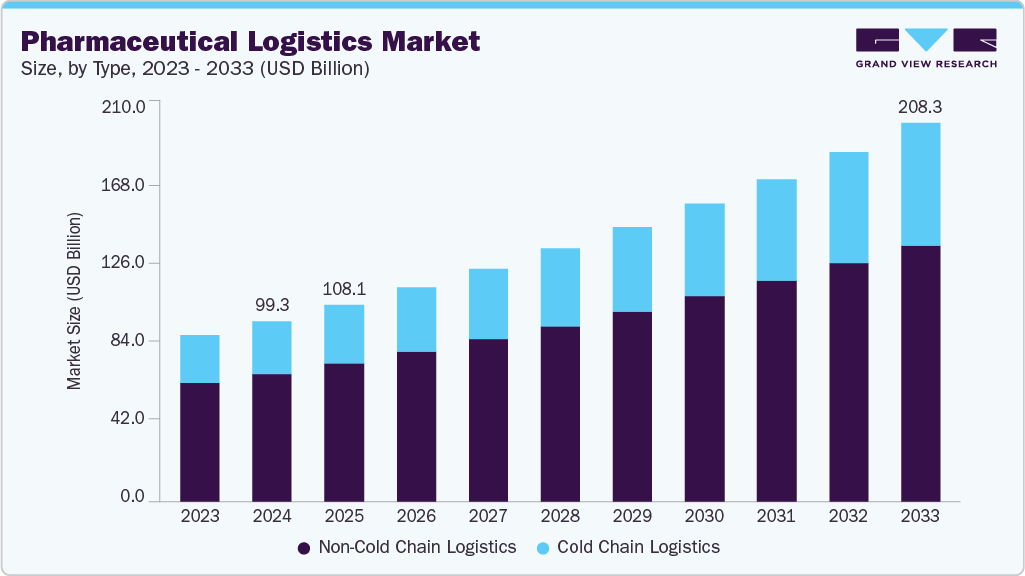
Source- Grand View Research


Why Pharmaceutical Logistics Is More Critical Than Ever

Pharmaceutical logistics has become more complex than ever as the global healthcare industry shifts toward biologics, specialty medications, personalized therapies, and increasingly interconnected supply chains. Unlike traditional logistics, pharmaceutical logistics requires precise temperature control, regulatory compliance, secure handling, and complete product traceability to ensure medications remain safe and effective from manufacturing to patient delivery.

According to the World Health Organization’s Good Distribution Practices (GDP) guidelines, maintaining medicine quality throughout storage and distribution is essential for protecting patient safety and preventing product degradation. These internationally recognized guidelines establish best practices for handling, transporting, and storing pharmaceutical products while preserving their quality throughout the supply chain.

The rapid growth of biologics, vaccines, cell and gene therapies, and GLP-1 medications has significantly increased demand for specialized logistics solutions that support temperature-controlled transportation, validated packaging, and continuous shipment monitoring. Fortune Business Insights identifies specialty pharmaceuticals and biologics as key drivers of the pharmaceutical logistics market, highlighting the growing need for advanced logistics capabilities worldwide.

Market drivers for Pharmaceutical Logistics

1. Increased Demand for Pharmaceutical Products

The demand for pharmaceutical products continues to rise due to factors such as population growth, an aging population, and the increasing prevalence of chronic diseases. This has led to a growing need for efficient and reliable logistics services to ensure that medicines and healthcare products are delivered to patients in a timely and safe manner.

2. Advancements in Technology and Transportation

The pharmaceutical logistics market has benefited from advancements in transportation technology, including more efficient air freight and sea freight systems. Additionally, the use of advanced technologies such as RFID and IoT has improved supply chain visibility and tracking capabilities, helping to reduce the risk of product damage and loss.

3. Growing Importance of Cold Chain Logistics

Cold chain logistics, which refers to the transportation and storage of temperature-sensitive products, has become increasingly important in the pharmaceutical industry due to the rise of biologic medicines and vaccines that require strict temperature control. This has led to a growing demand for specialized cold chain logistics services and infrastructure.

4. Stringent Regulatory Requirements 

The pharmaceutical industry is heavily regulated, and logistics providers must comply with a range of regulations and standards to ensure the safety and efficacy of pharmaceutical products. This has led to a growing need for logistics providers with specialised expertise in regulatory compliance.

Overall, these key drivers are expected to continue to support the growth of the pharmaceutical logistics market in the coming years, although challenges such as security risks and cost pressures may also pose significant obstacles.

SWOT Analysis

Overall, the pharmaceutical logistics market presents both significant opportunities and challenges, and logistics providers must be able to adapt to changing market conditions and customer demands in order to succeed.

Strengths

Weaknesses

Strengths

  • Strong demand for pharmaceutical products and a growing trend towards outsourcing logistics services.
  • Increasing focus on regulatory compliance and quality control, which plays to the strengths of larger logistics providers with established processes and expertise.
  • Technological innovation and investment in areas such as IoT, blockchain, and AI, which can provide greater efficiency, transparency, and security in logistics operations.
  • High entry barriers due to the capital-intensive nature of logistics infrastructure and the need for specialised expertise in cold chain logistics.

Weaknesses

  • Intense competition and price pressure, which can result in lower profit margins for logistics providers.
  • Dependence on a few key customers, which can create risks in the event of a loss of business or changes in customer demand.
  • Complexity and variability of regulations in different markets, which can create challenges in maintaining compliance across multiple regions.
  • Risk of supply chain disruptions due to external factors such as natural disasters, political instability, and pandemics.

Opportunities

Threats

Opportunities

  • Growing demand for healthcare products and the expansion of the pharmaceutical market in emerging economies such as China and India.
  • Increasing adoption of e-commerce and digital platforms for pharmaceutical distribution, which can create new opportunities for logistics providers.
  • Development of new drugs and therapies, which may require specialized logistics solutions and create new market niches for logistics providers.
  • Adoption of sustainability and eco-friendliness initiatives, which can differentiate logistics providers and create opportunities for value-added services.

Threats

  • Increasing competition from new entrants and smaller logistics providers, particularly in emerging markets.
  • Trade tensions and political instability, which can create uncertainties and disruptions in global supply chains.
  • Technological disruption and the emergence of new logistics models, such as peer-to-peer networks and decentralised platforms.
  • Potential changes in regulations and trade policies, which can create challenges in maintaining compliance and lead to higher costs for logistics providers.

Key Challenges in Pharmaceutical Logistics

Pharmaceutical logistics plays a vital role in moving medicines, biologics, and vaccines safely and efficiently, but the sector faces several operational and regulatory challenges that can affect product quality and delivery timelines.

Cold chain management:
Many pharmaceuticals require strict temperature control. Maintaining cold chain integrity demands specialized packaging, refrigerated transport, and continuous monitoring to prevent product degradation.

Inventory management:
Fluctuating demand, long lead times, and regulatory requirements make inventory control complex. Companies must rely on forecasting tools, automated systems, and real-time visibility to reduce stockouts and minimize excess inventory.

Distribution network complexity:
The pharma supply chain involves multiple stakeholders. Coordinating across manufacturers, distributors, logistics providers, and healthcare facilities requires streamlined processes and strong communication to avoid delays.

Regulatory compliance:
Strict GDP, GMP, FDA, and international transport regulations require accurate documentation, temperature controls, audits, and quality management systems to ensure full compliance during storage and distribution.

Risk management:
Supply chains face risks from natural disasters, geopolitical events, transportation delays, and supplier disruptions. Effective contingency planning and real-time monitoring are essential for maintaining continuity.

Technology integration:
While IoT, blockchain, AI, and automation improve visibility and efficiency, implementing these technologies can be costly and require significant infrastructure upgrades and staff training.

Transportation challenges:
Pharmaceutical transport must meet strict temperature, documentation, and routing requirements. Delays at borders or from carrier issues can jeopardize product quality, making real-time tracking and reliable carriers essential.

AI and Digital Transformation in Pharmaceutical Logistics

Digital transformation is redefining pharmaceutical logistics by improving operational efficiency, increasing supply chain visibility, and strengthening regulatory compliance. Technologies such as artificial intelligence, machine learning, the Internet of Things (IoT), blockchain, and predictive analytics enable organizations to build more resilient and data-driven supply chains.

AI-powered demand forecasting helps companies anticipate fluctuations in demand, while predictive analytics identifies transportation risks before they disrupt operations. IoT-enabled sensors continuously monitor temperature, humidity, and shipment conditions, helping protect temperature-sensitive pharmaceuticals throughout distribution.

Warehouse operations are also becoming increasingly automated. Robotics, automated storage and retrieval systems, and digital inventory management platforms improve order accuracy, reduce manual labor, and accelerate order fulfillment. McKinsey’s research on digital operations explains how modern supply chains improve efficiency and resilience through advanced technologies

Source- Maersk


Emerging Trends Shaping Pharmaceutical Logistics in 2026

The pharmaceutical logistics industry is evolving rapidly as manufacturers invest in digital technologies, expand cold chain capabilities, and strengthen supply chain resilience. Several emerging trends are expected to shape the market throughout 2026 and beyond.

Artificial Intelligence Is Improving Supply Chain Performance

Artificial intelligence (AI) is transforming pharmaceutical logistics by helping companies forecast demand, optimize transportation routes, automate warehouse operations, and identify potential disruptions before they affect deliveries. AI-powered analytics also improve inventory management, reduce waste, and support faster decision-making. McKinsey explains how advanced analytics and digital planning strengthen healthcare supply chains, enabling organizations to improve operational performance and resilience.

Cold Chain Logistics Continues to Expand

Demand for temperature-controlled logistics continues to increase as biologics, vaccines, biosimilars, and cell and gene therapies become a larger share of the global pharmaceutical market. DHL’s Life Sciences & Healthcare division highlights growing investment in cold chain infrastructure and real-time shipment monitoring to protect temperature-sensitive medicines throughout transportation.

End-to-End Supply Chain Visibility

Real-time visibility has become a competitive advantage for pharmaceutical companies. IoT sensors, RFID technology, GPS tracking, and cloud-based logistics platforms enable organizations to monitor shipments continuously, identify temperature deviations, and respond quickly to transportation disruptions. DHL emphasizes that end-to-end visibility improves product traceability and regulatory compliance while supporting more efficient pharmaceutical distribution.

Sustainability Is Becoming a Strategic Priority

Pharmaceutical companies are increasingly investing in reusable insulated packaging, electric vehicle fleets, energy-efficient warehouses, and optimized transportation routes to reduce carbon emissions while maintaining product quality. DHL’s sustainability strategy outlines how healthcare supply chains are reducing environmental impact through greener logistics practices

Solutions and Best Practices in Pharmaceutical Logistics

  • Use temperature-controlled warehousing and real-time inventory tracking.
  • Select transport modes based on speed and cold chain requirements.
  • Apply IoT and GPS monitoring for shipment visibility.
  • Automate documentation to meet regulatory compliance.
  • Improve supply chain visibility with digital platforms and analytics.
  • Prioritize GDP compliance through audits and training.
  • Leverage AI and blockchain for forecasting and traceability.
  • Partner with reliable logistics and supply chain providers.

Conclusion-

Pharmaceutical logistics plays a vital role in ensuring safe, efficient delivery of critical medications. Despite challenges such as temperature-controlled distribution, regulatory compliance, and complex global supply networks, adopting advanced technologies and improving collaboration across stakeholders can strengthen supply chain performance. As the industry evolves, leveraging automation, AI, and sustainable logistics practices will be essential for maintaining product quality, meeting rising healthcare demands, and supporting a resilient pharmaceutical supply chain.

Frequently Asked Questions-

1. What is pharmaceutical logistics and why is it important for procurement teams?

Pharmaceutical logistics refers to the storage, handling, and distribution of medicines, biologics, and vaccines across the pharma supply chain. For procurement teams, it is essential because reliable logistics partners ensure product integrity, regulatory compliance, and on-time delivery, directly impacting patient safety and supply chain performance.

2. What are the biggest challenges in pharmaceutical logistics today?

Key challenges include cold chain management, regulatory compliance, complex distribution networks, inventory fluctuations, transportation delays, and technology integration. These issues can affect product quality and increase operational risk across the pharmaceutical supply chain.

3. What factors are driving growth in the pharmaceutical logistics market?

Market growth is driven by rising demand for biologics and temperature-sensitive drugs, expanding global pharmaceutical trade, increased e-commerce in healthcare, and advancements in cold chain logistics, IoT tracking, and automation technologies.

4. What should procurement teams look for in a pharmaceutical logistics supplier?

Procurement teams should evaluate suppliers based on GDP/GMP compliance, cold chain capabilities, real-time tracking systems, global distribution coverage, risk-management processes, and experience handling regulated pharmaceutical products.

5. How is technology transforming pharmaceutical logistics operations?

Technologies such as IoT sensors, GPS tracking, blockchain, automation, and AI improve supply chain visibility, forecasting accuracy, temperature monitoring, and traceability. These tools reduce product spoilage, prevent counterfeiting, and strengthen regulatory compliance.

6. How can procurement improve strategic partnerships with logistics providers?

Procurement teams can enhance supplier partnerships by sharing demand forecasts, aligning on quality standards, implementing performance KPIs, conducting regular audits, and collaborating on risk-management and digital-visibility initiatives.

EXCLUSIVE DOWNLOAD

Download the full CDMO Live Report for 112 pages of insights and best practices in external manufacturing.

EARLY BIRD TICKETS PRICES RISE SEP 18
Days
Hours
Minutes
Seconds