Quality by Design (QbD) has moved from a regulatory ideal to the default expectation for how safe, effective drug products get made. Instead of testing quality into a finished batch, QbD builds it in from the first line of the Quality Target Product Profile through the final control strategy on the plant floor.
This guide covers what QbD means in practice, the ICH framework behind it (from Q8 through the newly implemented Q13 and Q14), the tools teams use to apply it, and what has changed in 2026, including AI governance under the EU’s draft GMP Annex 22 and the FDA’s push to accelerate domestic manufacturing through its PreCheck program.
What is Quality by Design in Pharmaceutical Manufacturing?
Quality by Design is a systematic, science-based approach that integrates quality considerations throughout the entire pharmaceutical product lifecycle, from initial concept through commercial manufacturing. Rather than relying on end-product testing to ensure quality, QbD builds quality directly into products and processes through enhanced scientific understanding.
The fundamental QbD philosophy centers on three core principles:
- Proactive quality management rather than reactive quality control
- Scientific understanding of product and process relationships
- Risk-based decision making throughout development and manufacturing
This approach enables manufacturers to understand how formulation components and process parameters affect final product quality, creating a robust foundation for consistent drug manufacturing.
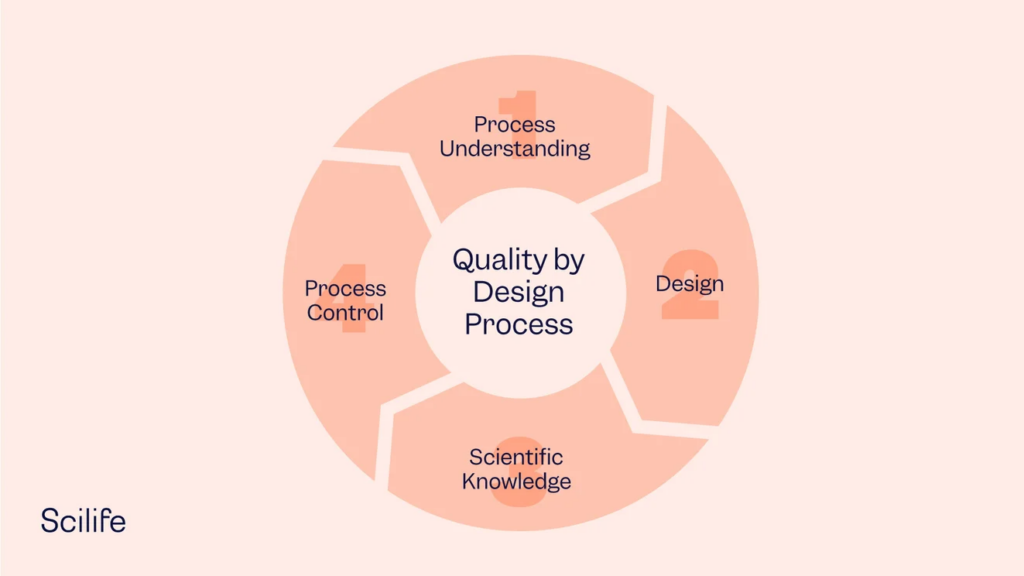
Source- Scilife
Historical Context: From Quality by Testing to Quality by Design
Historically, pharmaceutical manufacturing relied heavily on Quality by Testing approaches, which created several significant challenges. Traditional methods offered limited process understanding, with minimal science-based knowledge of key process variables and restricted understanding of parameter relationships. This reactive quality management approach required heavy reliance on end-product testing, extensive rework of out-of-specification batches, and data-intensive regulatory submissions with fragmented information. Additionally, regulatory inflexibility meant validated processes discouraged post-approval changes, with specifications based solely on batch history and limited continuous improvement opportunities.
The transition to Quality by Design addresses these limitations through knowledge-rich submissions demonstrating comprehensive product and process understanding, flexible manufacturing within scientifically justified design spaces, risk-based specifications aligned with product performance requirements, and continuous improvement capabilities within approved parameters.
Quality by Design vs. Quality by Testing: Side-by-Side Comparison
| Aspect | Quality by Testing (QbT) | Quality by Design (QbD) |
| Quality assured by | End-product testing | Science-based process understanding |
| Process flexibility | Locked; changes trigger resubmission | Flexible within approved design space |
| Specifications based on | Batch history | Product performance requirements |
| Response to variation | Reworked/rejected after the fact | Controlled during manufacturing |
| Submission style | Data-intensive, limited rationale | Knowledge-rich, demonstrates understanding |
| Continuous improvement | Discouraged post-approval | Built in via ICH Q12 |
The ICH Quality Guideline Framework: Q8 Through Q14
QbD is not defined by ICH Q8 alone. Since 2009, the International Council for Harmonisation (ICH) has built out a full suite of interlocking quality guidelines, and by 2026 that suite has matured considerably:
- Q8 (Pharmaceutical Development) established the core QbD vocabulary, including the QTPP, CQAs, and design space, and remains the foundation for everything else in this framework.
- Q9 / Q9(R1) (Quality Risk Management) provides the tools for identifying and prioritizing risk throughout development and manufacturing. Expanded training materials for Q9(R1) were published in March 2026, reflecting its continued evolution as a working standard. (IntuitionLabs)
- Q10 (Pharmaceutical Quality System) describes the quality system that sustains QbD principles across a product’s commercial lifecycle.
- Q11 (Development and Manufacture of Drug Substances) extends QbD concepts specifically to active pharmaceutical ingredients and biotechnological or biological drug substances.
- Q12 (Lifecycle Management) supports post-approval change management, letting manufacturers use “established conditions” to make certain process changes with less regulatory burden.
- Q13 (Continuous Manufacturing of Drug Substances and Drug Products) reached Step 4 in 2022 and came into effect in the EU in July 2023. It gives continuous manufacturing, an increasingly common QbD-enabled production model, its own harmonized regulatory treatment, including batch definition, real-time monitoring, and control strategy expectations unique to continuous processes. (ISPE)
- Q14 (Analytical Procedure Development), adopted alongside the revised Q2(R2), came into effect in the EU in June 2024 and is now shaping 2026 submissions. It formalizes Quality by Design thinking for analytical methods themselves, introducing the Analytical Target Profile (ATP) and Method Operable Design Region (MODR) concepts described later in this guide. (EMA)
Together, these guidelines let manufacturers implement process changes within an approved design space, and increasingly within an approved analytical MODR, without requiring full regulatory resubmission.
Five Essential Elements of QbD Implementation
1. Quality Target Product Profile (QTPP)
The QTPP defines the desired product quality characteristics, considering safety, efficacy, and patient needs. It serves as the foundation for all subsequent QbD activities.
QTPP Components Include:
- Dosage form and administration route
- Dosage strength and bioavailability requirements
- Stability and shelf-life specifications
- Container closure system compatibility
2. Critical Quality Attributes (CQAs)
CQAs represent measurable product characteristics that must be controlled within appropriate limits to ensure desired product performance.
Common CQAs in Pharmaceutical Products:
- Assay and content uniformity for active pharmaceutical ingredients
- Dissolution profile affecting bioavailability
- Physical attributes including tablet hardness, friability, and disintegration
- Impurity levels ensuring safety and stability
3. Critical Material Attributes (CMAs)
CMAs identify the physical, chemical, biological, or microbiological properties of input materials that significantly influence product quality.
Typical CMA Categories:
- Active pharmaceutical ingredient purity and polymorphic form
- Excipient functionality and variability
- Packaging material compatibility and barrier properties
4. Critical Process Parameters (CPPs)
CPPs represent process variables that significantly impact product CQAs. Understanding CPP-CQA relationships enables robust process design and control.
Examples of CPPs:
- Mixing parameters: Time, speed, and sequence
- Granulation conditions: Liquid addition rate, endpoint determination
- Compression settings: Force, speed, and dwell time
- Coating parameters: Spray rate, inlet temperature, and pan speed
5. Design Space and Control Strategy
The design space defines the multidimensional combination and interaction of input variables and process parameters demonstrated to provide assurance of quality. Operating within this space typically requires no regulatory notification for changes.
QbD Tools and Methodologies
QbD is implemented through a defined toolkit of risk assessment and experimental design methods, most of which originate in ICH Q9’s Quality Risk Management framework:
- Design of Experiments (DoE): a structured, multivariate approach to testing how multiple process or formulation variables affect CQAs simultaneously, used to define the boundaries of the design space rather than testing one variable at a time.
- Failure Mode and Effects Analysis (FMEA): a systematic method for identifying potential failure points in a process, scoring their severity, likelihood, and detectability, and prioritizing which CPPs and CMAs need the tightest control.
- Ishikawa (fishbone) diagrams: a visual tool for mapping potential causes of variability in a CQA back to categories such as materials, methods, machines, and environment, commonly used early in risk identification.
- Risk ranking and filtering: a technique for comparing and prioritizing multiple risks against one another using weighted criteria, helping teams focus limited resources on the CPPs and CMAs with the greatest impact on product quality.
- Multivariate data analysis (MVDA): statistical modeling of process and material data across many variables at once, used both to define the design space and, increasingly, to power the AI-driven soft sensors discussed later in this guide.
These tools are not applied in isolation. A typical QbD workflow uses Ishikawa diagrams and risk ranking during initial hazard identification, FMEA to prioritize which CPPs warrant formal study, and DoE to generate the data that ultimately defines the design space.
QbD Development Process: Step-by-Step Implementation
Phase 1: Product Quality Profile Definition
Begin by establishing comprehensive product requirements:
- Define therapeutic targets and patient population needs
- Establish safety profiles and efficacy benchmarks
- Create quantitative in-vitro/in-vivo correlation models
- Document regulatory and market requirements
Phase 2: Knowledge Gap Assessment
Systematically evaluate existing knowledge:
- Compile API, excipient, and process information
- Identify critical knowledge gaps through risk assessment
- Prioritise studies based on risk evaluation
- Develop experimental strategies to address gaps
Phase 3: Formulation and Process Design
Design products and processes with quality built-in:
- Optimise composition based on CMA understanding
- Define quality characteristics requiring control
- Develop flexible manufacturing processes
- Establish acceptable performance envelopes
Phase 4: Design Space Establishment
Create scientifically justified operating ranges:
- Employ Design of Experiments (DoE) methodologies
- Map relationships between CPPs and CQAs
- Define acceptable process performance boundaries
- Validate design space through confirmatory studies
Phase 5: Control Strategy Implementation
Establish comprehensive manufacturing controls:
- Develop risk-based monitoring systems
- Implement Process Analytical Technology (PAT) where appropriate
- Create real-time release testing protocols
- Establish continuous improvement procedures
Analytical Quality by Design (AQbD)
QbD principles apply not only to manufacturing processes but to the analytical methods used to test and release product, a discipline known as Analytical Quality by Design (AQbD). This has become significantly more prominent with the 2024 EU implementation of ICH Q14.
Core AQbD concepts:
- Analytical Target Profile (ATP): a prospective summary of the required performance characteristics for an analytical procedure, playing the same defining role for a test method that the QTPP plays for the product itself.
- Method Operable Design Region (MODR): a multidimensional combination of method parameters, analogous to a manufacturing design space, within which the analytical procedure is demonstrated to perform reliably.
- Enhanced vs. minimal approaches: ICH Q14 allows either a traditional, minimal approach to method development and validation under Q2, or an enhanced, QbD-based approach using ATP and MODR, which offers more flexibility to adjust a validated method later without full revalidation. (Assyro AI)
AQbD matters in practice because analytical methods, particularly multivariate techniques like NIR and Raman spectroscopy used in PAT, have historically had no ICH-level validation guidance of their own. Q14 closes that gap, giving manufacturers a defensible, science-based route to justify method changes within an approved MODR rather than resubmitting for every adjustment.
Process Analytical Technology (PAT) Integration
PAT represents a critical enabler of QbD implementation, providing real-time understanding of manufacturing processes through timely measurement of critical quality attributes.
Process Analytical Technology (PAT) Integration
PAT represents a critical enabler of QbD implementation, providing real-time understanding of manufacturing processes through timely measurement of critical quality attributes.
PAT Technologies in Pharmaceutical Manufacturing
Spectroscopic Methods:
- Near-infrared (NIR) spectroscopy for moisture content and blend uniformity
- Raman spectroscopy for polymorphic form identification
- UV-Vis spectroscopy for concentration monitoring
Physical Property Monitoring:
- Particle size analyzers for granulation endpoint determination
- Texture analyzers for tablet hardness and friability
- Dissolution testers for immediate release profile verification
Process Control Systems:
- Statistical process control for trend monitoring
- Multivariate data analysis for pattern recognition
- Real-time release testing for batch disposition
Implementing PAT within QbD frameworks provides enhanced process understanding through continuous monitoring, reduced testing burden via real-time quality assessment, faster batch release eliminating traditional testing delays, and improved process control enabling proactive adjustments.
Quality by Digital Design (QbDD): AI, Digital Twins and Real-Time Release
Recent peer-reviewed literature describes the convergence of QbD with artificial intelligence, digital twins, and advanced data analytics as an evolution of the discipline, sometimes termed Quality by Digital Design (QbDD). (ScienceDirect, February 2026)
Where AI is already being applied within QbD frameworks:
- Soft sensors: machine learning models that infer hard-to-measure attributes, such as blend uniformity, from correlated process signals, effectively extending PAT without additional physical instrumentation.
- Advanced process control and anomaly detection: AI systems that monitor multivariate process data in real time and flag or correct deviations before they affect a batch. (ScienceDirect / PubMed, March 2026)
- Computer vision inspection: automated visual inspection of vials, tablets, and packaging as part of the control strategy.
- Predictive maintenance: using equipment and process data to anticipate failures before they cause deviations or downtime.
Regulatory guardrails are catching up in 2026. The EU’s draft GMP Annex 22, out for consultation from July to October 2025 with finalization expected by the end of 2026, would restrict AI use in GMP-critical functions to static, deterministic models, while permitting generative AI and large language models only in non-critical contexts with documented human oversight. (European Pharmaceutical Review) The FDA has moved in parallel: in April 2026, it issued a warning letter that specifically cited inappropriate use of AI in pharmaceutical manufacturing, after a company used AI agents to generate specifications and master production records without adequate Quality Unit review. (Pharmaceutical Technology)
The practical takeaway for manufacturing teams: AI can meaningfully extend a QbD control strategy, particularly for monitoring and inferential measurement, but human, Quality Unit-reviewed oversight of any AI-generated GMP document or decision remains a firm regulatory expectation on both sides of the Atlantic.
Advantages of QbD Implementation
Operational Benefits
“Right First Time” Manufacturing
- Significantly reduced batch failures and rework requirements
- Lower manufacturing costs through improved efficiency
- Decreased process downtime and increased capacity utilisation
Enhanced Process Understanding
- Science-based knowledge of critical process relationships
- Improved troubleshooting capabilities
- Predictable process performance across manufacturing scales
Quality and Regulatory Advantages
Consistent Product Quality
- Reduced batch-to-batch variability
- Enhanced therapeutic efficacy, particularly for generic products
- Improved patient safety through robust quality systems
Regulatory Flexibility
- Process changes within design space without resubmission
- Reduced regulatory oversight requirements
- Faster time-to-market for new drug applications
Long-term Strategic Benefits
Continuous Improvement Culture
- Framework for ongoing process optimisation
- Innovation opportunities within established parameters
- Technology transfer facilitation between sites
Supply Chain Resilience
- Better supplier qualification and management
- Reduced supply disruption risks
- Enhanced change control procedures
Common Implementation Challenges and Solutions
Organizational Challenges
Stakeholder Alignment
Challenge: Ensuring all departments understand and support QbD principles
Solution: Comprehensive training programs and cross-functional QbD teams
Corporate Inertia
Challenge: Resistance to changing established practices
Solution: Pilot programs demonstrating clear business benefits
Technical Challenges
Initial Investment Requirements
Challenge: Significant upfront costs for new equipment and training
Solution: Phased implementation with clear ROI metrics
Information System Integration
Challenge: Capturing and managing increased data complexity
Solution: Investment in modern quality management systems with QbD capabilities
Regulatory Challenges
Global Harmonization
Challenge: Varying regulatory expectations across markets
Solution: Early engagement with regulatory agencies and adherence to ICH guidelines
Analytical Method Validation
Challenge: Establishing appropriate analytical standards for CQAs
Solution: Risk-based approach to method development and validation
Industry Applications and Case Studies
QbD implementation in tablet manufacturing typically focuses on blend uniformity as a CQA with mixing parameters as CPPs, tablet hardness and friability controlled through compression parameters, and dissolution profile managed via formulation and process variables. Sterile manufacturing applications emphasize sterility assurance through filtration and terminal sterilization parameters, container closure integrity via sealing process control, and particulate matter control through environmental and process monitoring.
QbD for Biologics, Cell and Gene Therapies
QbD principles apply across modalities, but advanced therapies present distinct challenges given greater inherent product and process variability.
Vaccines and sterile injectables: control strategies emphasize sterility assurance, container closure integrity, and particulate control, with continuous manufacturing (ICH Q13) increasingly applied to improve consistency in high-volume sterile production.
Biologics (monoclonal antibodies, recombinant proteins): CPPs center on cell culture conditions (temperature, pH, dissolved oxygen, feed strategy), while CQAs typically include glycosylation profile, aggregation, and charge variants; ICH Q11 provides the drug-substance-specific QbD framework for this category.
Cell and gene therapies: these products often involve live cells or viral vectors as the drug substance itself, making process consistency and real-time monitoring especially critical. The FDA’s Advanced Manufacturing Technology (AMT) designation, first awarded to Cellares in April 2025 for its automated cell therapy platform, and its selection into the FDA’s PreCheck Pilot Program in June 2026, illustrate how regulators are actively encouraging QbD-aligned automation for this modality. (Pharmaceutical Technology)
Choosing a CDMO with Strong QbD Maturity
For sponsors outsourcing development or manufacturing, a CDMO’s QbD maturity directly affects technology transfer timelines, regulatory risk, and long-term process flexibility. When evaluating a potential CDMO partner, consider asking:
- Design space ownership: Can the CDMO clearly articulate the design space and control strategy for processes similar to yours, or do they rely primarily on fixed, validated parameters with limited flexibility?
- PAT and analytical capability: Does the CDMO operate in-line or on-line PAT (NIR, Raman, particle size analysis) that supports real-time monitoring, or is quality confirmed primarily through end-of-batch testing?
- AQbD readiness: Has the CDMO’s analytical team implemented ICH Q14 concepts such as ATP and MODR, particularly relevant if your program will rely on multivariate release methods?
- Change control track record: How has the CDMO historically handled process changes within an approved design space, and how quickly have those changes been implemented without full regulatory resubmission?
- Digital quality systems: Does the CDMO use electronic batch records and data historians that support the knowledge management and continuous improvement expectations under ICH Q10 and Q12, or does documentation remain largely paper-based?
- AI governance: If the CDMO uses AI-assisted monitoring or documentation tools, can they demonstrate Quality Unit oversight consistent with emerging expectations under the EU’s draft GMP Annex 22 and current FDA enforcement posture?
A CDMO’s answers to these questions are often a better predictor of technology transfer success than headline capacity or facility size alone, since a mismatch in QbD maturity between sponsor and CDMO is a common source of tech transfer delay.
Key Takeaways
Quality by Design represents a fundamental shift in pharmaceutical manufacturing philosophy, moving from reactive quality control to proactive quality building. Successful QbD implementation requires comprehensive understanding of product and process relationships, supported by appropriate analytical technologies and robust control strategies.
The benefits of QbD extend beyond immediate quality improvements, enabling pharmaceutical companies to achieve greater operational efficiency, regulatory flexibility, and long-term competitive advantage. As the industry continues evolving toward more sophisticated manufacturing approaches, including AI-enabled Quality by Digital Design and an expanding ICH framework through Q13 and Q14, QbD principles will remain central to ensuring consistent, high-quality drug products for patients worldwide.
Frequently Asked Questions
What is the difference between QbD and traditional quality approaches?
QbD proactively builds quality into products and processes through scientific understanding, while traditional approaches rely primarily on end-product testing to ensure quality. QbD enables continuous improvement and regulatory flexibility within established design spaces.
What are CPP and CQA in pharmaceutical manufacturing?
Critical Process Parameters (CPPs) are process variables that significantly influence product quality, while Critical Quality Attributes (CQAs) are measurable product characteristics that must be controlled to ensure desired performance. Understanding CPP-CQA relationships is fundamental to QbD implementation.
How does ICH Q8 relate to Quality by Design?
ICH Q8 provides the regulatory framework for enhanced pharmaceutical development, emphasizing QbD principles. It enables manufacturers to establish design spaces within which process changes can be made without regulatory resubmission, facilitating innovation and continuous improvement.
What is PAT in pharmaceutical manufacturing?
Process Analytical Technology (PAT) involves real-time monitoring and control of manufacturing processes through timely measurement of critical quality attributes. PAT integration supports QbD by providing enhanced process understanding and enabling proactive quality management.
What are the main challenges in implementing QbD?
Primary challenges include initial investment requirements, organizational change management, regulatory complexity, and the need for enhanced analytical capabilities. Success requires comprehensive planning, stakeholder alignment, and phased implementation approaches.
How does QbD benefit generic drug development?
QbD helps generic manufacturers demonstrate pharmaceutical equivalence through enhanced product understanding, reduces development timelines through efficient study design, and ensures consistent therapeutic performance through robust manufacturing processes.
What role does risk assessment play in QbD?
Risk assessment (following ICH Q9 principles) is integral to QbD, helping identify and prioritize critical attributes and parameters, guide experimental design, and establish appropriate control strategies based on potential impact on product quality and patient safety.
Is Quality by Design mandatory for drug approval?
QbD itself is not a legal mandate in most jurisdictions, but regulators including the FDA and EMA strongly encourage it, and elements of QbD, particularly demonstrated process understanding and risk-based control strategy, are now standard expectations in most marketing authorization submissions, especially for generics reviewed under the FDA’s Question-based Review (QbR) framework.