Last week, we reported on the FDA’s accelerating enforcement activity — including 30 warning letters issued to telehealth companies in a single day and a broader surge in manufacturing-related citations. The response from the PharmaSource community was significant. A recurring theme in the comments: enforcement pressure is already shaping how sponsors choose and retain their CDMO partners.
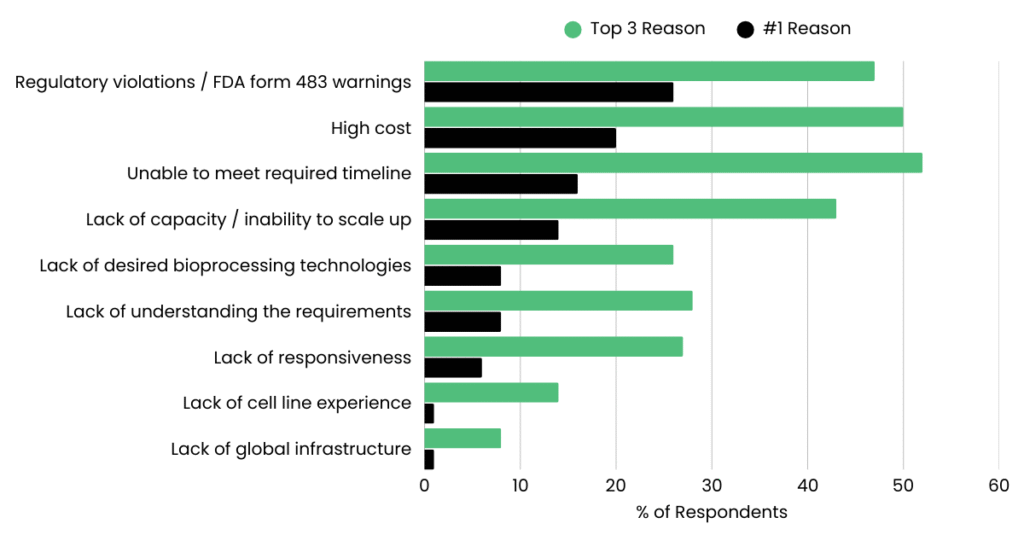
New data from ISR’s Bioprocessing Market Outlook 2025–2030 puts numbers to that. When asked the single main reason a CDMO would lose a bid, more respondents cited regulatory violations or FDA Form 483 warnings (26%) than any other factor — above high cost (20%), inability to meet timelines (16%), or lack of capacity (14%).
Top Reasons CDMOs Lose Bids
(% of respondents citing as main reason, n=100)
| Reason | Main Reason | Top 3 |
|---|---|---|
| Regulatory violations / FDA Form 483 warnings | 26% | 47% |
| High cost | 20% | 50% |
| Unable to meet required timeline | 16% | 52% |
| Lack of capacity / inability to scale up | 14% | 43% |
| Lack of desired bioprocessing technologies | 8% | 26% |
| Lack of understanding the requirements | 8% | 28% |
| Lack of responsiveness | 6% | 27% |
| Lack of cell line experience | 1% | 14% |
| Lack of global infrastructure | 1% | 8% |
The enforcement backdrop makes this finding particularly timely. CDER warning letters with manufacturing or GMP-related subjects rose from 39 in 2023 to 78 in 2024 to 111 in 2025 — a near tripling in two years, based on FDA data. The 30 letters issued on March 3 to telehealth firms over compounded GLP-1 marketing are part of a broader pattern, not an isolated campaign.
For sponsors managing external manufacturing networks, the regulatory record of a CDMO is not simply a compliance checkbox. As Liesbeth Foester, Head of External Manufacturing Quality at UCB, explained in a recent PharmaSource interview, quality has formal veto power in their CDMO selection process: “If I were to say this is not acceptable from a quality perspective, it would not pass.”
The accountability question also featured prominently in responses to last week’s article. Joseph Payne, a pharma and biopharma executive, summarized the position that regulators and many sponsors now hold: “Quality oversight cannot be delegated. Vendor management must be active, not periodic. Technical and quality governance between sponsor and CDMO must be tightly integrated.”
This view is consistent with how the FDA frames the issue. In a warning letter to ABR Pharma cited in a 2026 industry analysis by IntuitionLabs, the agency described contract facilities as “extensions of the manufacturer’s own facility” — meaning quality failures at a CDMO are treated as the sponsor’s failures as well.
The ISR data reflects this accountability logic playing out at the selection stage. A CDMO’s regulatory track record is, for a quarter of sponsors, the factor most likely to end the conversation before it begins.
Source: ISR, Bioprocessing Market Outlook: 2025–2030 (5th Edition). n=100 respondents, Q3 2025. FDA CDER Warning Letter data, 2021–2026.