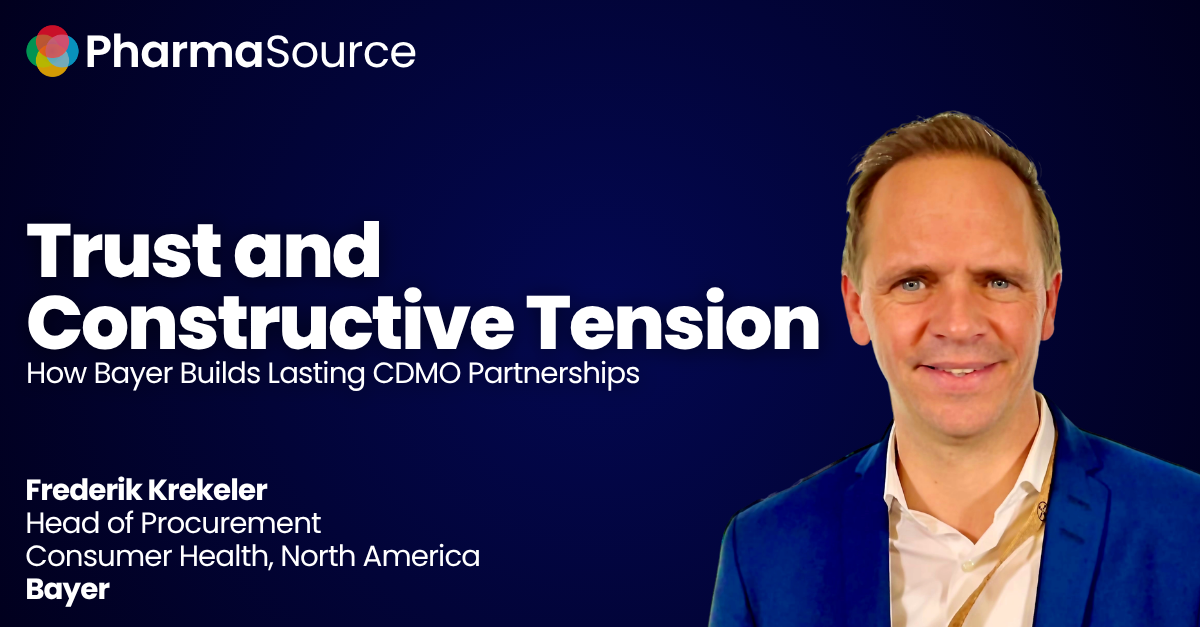
“The quality of any relationship becomes most visible during times of challenge and pressure,” says Frederik Krekeler.
Frederik Krekeler is Head of Procurement for Bayer’s Consumer Health business in North America, leading sourcing strategy and supplier partnerships across a critical global network. With over 20 years of supply chain leadership spanning Europe, Latin America, and North America, he is known for building strategic CDMO relationships that deliver both resilience and commercial performance.
Ahead of CDMO Live Americas (20-21 October, Boston), Frederik shares the principles behind Bayer’s approach to CDMO partnership management, covering the multi-year network reset of Project Martini, the innovation days and Negotiation Factory programs that keep suppliers engaged year-round. For anyone managing external manufacturing relationships in a rapidly evolving market, it’s a practical and candid playbook.
What North America Taught Frederik About CDMO Relationships
Frederik’s career has moved from Germany to Latin America and across North America, giving him a sharp sense of how supplier relationships differ by region.
In Europe, he found structure and compliance at the center of most partnerships, with long-term stability valued above speed. In Latin America, personal relationships carry greater weight, with flexibility seen as essential for navigating uncertainty. North America operates differently again: commercially driven, data-heavy, and fast-moving.
The speed of decision-making was the biggest adjustment. Counter-proposals that might take weeks in Europe can arrive within days in the US, and the pressure from retail customers flows directly into how CDMOs engage.
“I had to overcome making faster decisions with less perfect information. This market moves very quickly.”
Frederik also notes a shift in CDMO ownership structures. Private equity has replaced many of the family-owned businesses that once characterized the sector, changing the dynamics of how partnerships are built and sustained. That said, he sees real upside in the North American market: executive access at CDMOs is strong, responsiveness is high, and the appetite for co-creating innovation is genuine.
Defend Internally, Hold Accountable Externally
At the core of Frederik’s approach is a clear belief that procurement’s role extends well beyond negotiation. Bayer’s team acts as a mediator, aligning internal stakeholders on realistic expectations while holding CDMOs accountable for delivery.
It starts at supplier selection. Setting clear, mutual expectations from the outset, he argues, prevents partnerships from deteriorating under pressure later. From there, trust is built through consistency: regular reviews, transparent communication, and a shared understanding of who is responsible for what.
“When issues arise, both parties have to perform. If the supplier is behind, we hold them accountable. But if it’s also us — and most of the time it’s a mixed bag — part of our role is telling internal stakeholders what they may not want to hear.”
This balance between internal advocacy and external accountability is, Frederik says, where procurement adds its most visible value. Credibility with suppliers comes not from aggression but from consistency, and suppliers notice it.
That philosophy extends all the way to the C-suite. Frederik sees executive-level relationships as essential, not just for strategic alignment on capacity and roadmaps, but for navigating difficult situations when they arise.
“Recently, I was approached directly by the CEO of one of our largest suppliers because there was a disconnect between our two organizations. Having that trusted relationship really helped both sides resolve it.”
Regular executive connects, kept separate from operational reviews, sustain those relationships through the ups and downs of partnership.
Engineering Constructive Tension Across a Global Network
The most ambitious initiative Frederik discusses is Project Martini, a cross-functional, multi-year program to redesign Bayer Consumer Health’s external manufacturing network from the ground up.
The ambition went well beyond price negotiation. The goal was to build a more resilient, transparent, and commercially competitive CDMO network, with standardized terms applied consistently across the board.
The defining concept was constructive tension: deliberately shifting the supply landscape from static and comfortable into something more competitive.
“We brought over 100 CMOs to the table, interviewed them, and shared that we would reset our landscape — with different terms, but also more opportunities for them. That changed supplier behavior immediately.”
The program resulted in hundreds of millions of euros in spend being awarded across more than 200 products. Crucially, it combined existing partners with new entrants, giving Bayer far greater visibility into market capability, capacity, and the true economics of their supply base.
Frederik is clear-eyed about what drove it: transparency in this industry rarely happens voluntarily.
“Transparency is not a given. Sometimes you have to force it through competition — and that’s something we did very successfully.”
For procurement leaders considering a network reset, Project Martini offers a clear lesson: structured competition, paired with genuine opportunity for suppliers, can unlock savings and strategic insight without burning trust.
Keeping Suppliers Engaged: Innovation Days and the Negotiation Factory
Resetting a network is one challenge. Keeping partners engaged and aligned year-round is another. Bayer runs several ongoing programs designed to maintain momentum between major strategic initiatives.
Innovation Days bring CDMOs onsite alongside key raw material suppliers, particularly in nutrition where ingredient suppliers and CDMOs are closely interdependent. Sessions focus on specific, product-level ideas rather than general capability showcases, with clear accountability for follow-through.
“We hold suppliers accountable for their commitments in the next phase. It’s not just presentations — we want to turn innovation into a tangible pipeline.”
The Negotiation Factory is a more targeted initiative: a time-boxed, commercially focused event bringing together selected suppliers or product categories for a defined outcome.
“It’s heavily prepared, cross-functional, and purely commercially driven on both sides — volume commitments, pricing commitments. Suppliers engage well because they see we act on those commitments, and they see something more than just their base business.”
Together with regular quality business reviews and executive connects, these programs create a structured rhythm of engagement that keeps CDMO relationships active and productive throughout the year.
Where AI Is Actually Moving the Needle
AI is generating significant interest across pharmaceutical outsourcing, but Frederik is focused on where it delivers measurable results today, and honest about the fact that most organizations, including Bayer, are still working through the use cases.
He points to three areas where AI is creating real impact. In sourcing and network design, advanced analytics help match products to CDMOs based on capacity, capability, and risk profiles. In supply chain planning, scenario modeling helps avoid dangerous volume concentration with a single partner. In quality and compliance, AI is accelerating documentation turnaround and surfacing relevant regulatory changes before they become issues.
“The biggest application I see right now is in the supply chain arena — running scenarios around demand and capacity so we’re not over-concentrating volume with one partner.”
His consistent caveat: human judgment stays in the loop. AI tools are a powerful baseline, not a replacement for decision-making.
DTC, Agility, and What Will Drive CDMO Sourcing Decisions Next
The rise of direct-to-consumer platforms is already reshaping what Bayer asks of its external manufacturing partners. Smaller product launches, faster speed-to-shelf, and a growing appetite for format experimentation all point toward one thing: CDMOs that can flex quickly will win more business.
“Manufacturing flexibility is becoming a competitive advantage, not just a nice-to-have. We need partners that can switch formats and tolerate variable demand without weeks of replanning.”
A recent example: Bayer successfully launched a new nutritional product significantly faster than usual, driven by a collaborative approach with a CMO partner that understood the commercial urgency from the outset.
Looking ahead, Frederik sees three forces that will shape CDMO sourcing decisions: sustained cost pressure as input costs rise and OTC competition intensifies; supply chain resilience as product life cycles shorten and customer expectations increase; and ESG and sustainability, which he expects to shift from a reporting requirement to a genuine selection criterion.
His overarching view is unambiguous: external manufacturing partnerships are not a transitional arrangement. They are central to how consumer health innovation gets built and scaled.
“CDMOs are here to stay. They play a key role in future innovation and growth. But we need strong partners — speed, flexibility, and resilience are what will define successful relationships going forward.”
Frederik Krekeler will be speaking at CDMO Live Americas about Strategic Procurement: Building Win-Win CDMO Alliances Beyond Price. Download the agenda here